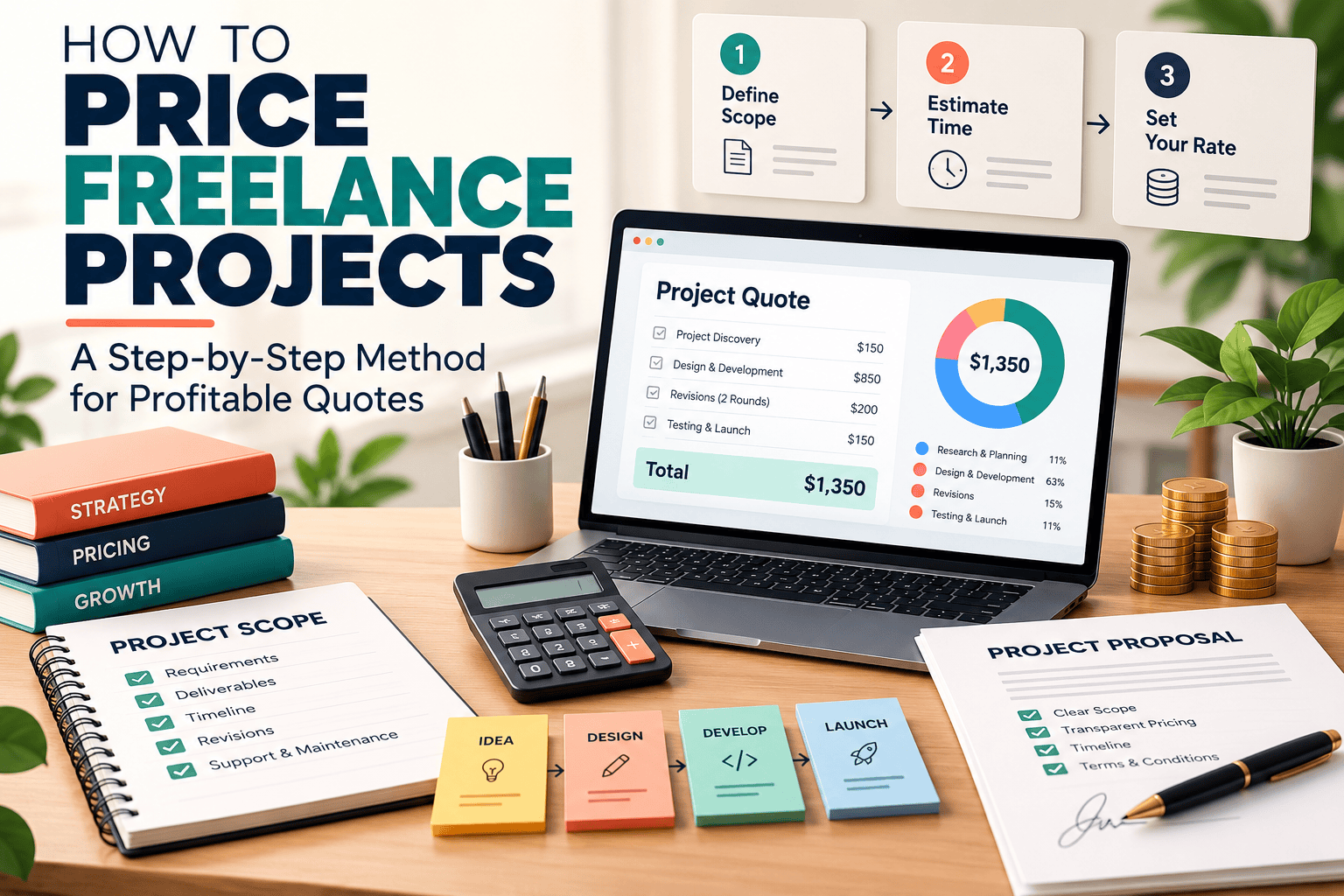
How to Price Freelance Projects: A Step-by-Step Method for Profitable Quotes
Setting a freelance project price is not simply a matter of multiplying your hourly rate by the number of hours you expect to work. A reliable quote must account for the work itself, the time spent communicating and managing the project, direct expenses, uncertainty, payment or marketplace fees, and the value of delivering a useful result. This guide walks through a repeatable process for building a quote that is understandable to a client and financially workable for you.
Use the Zynprint Freelance Project Pricing Calculator alongside the steps below to estimate your project amount after platform fees and direct costs. The calculator supports your decision; it cannot determine the correct price without an accurate scope and realistic assumptions.
1. Define the outcome before estimating the price
Start by describing what the client will receive. “Design a website” is too broad to estimate consistently. A more useful scope might identify the number of page templates, required content, responsive states, integrations, design rounds, handoff files, and who supplies copy and images. For a graphic design project, list the number of concepts, final variations, file formats, print specifications, and included revisions.
Ask the client what success looks like, which deliverables are essential, what is out of scope, who approves the work, and when feedback will arrive. Record assumptions in the proposal. If the client has not supplied final content, for example, state whether copywriting or content entry is included. Clear assumptions reduce the risk of silently absorbing extra work.
2. Break the project into work packages
Divide the deliverable into activities that can be estimated separately. A website might include discovery, sitemap, wireframes, visual design, development, content entry, testing, revisions, launch support, and handoff. A logo project might include briefing, research, concept development, refinement, export preparation, and brand-file organization.
For each activity, estimate focused production time and supporting time. Supporting work includes client calls, email, project management, file preparation, quality checks, and documenting decisions. These tasks are real labor even when they do not appear in the final deliverable.
Use three estimates when uncertainty is meaningful: optimistic, likely, and cautious. A simple planning estimate can be the likely duration plus a modest allowance for uncertain tasks. Avoid treating the optimistic estimate as a promise.
3. Calculate your minimum sustainable hourly floor
Your hourly floor is a planning tool, not necessarily the price you show a client. Begin with the income you need to earn, then account for business expenses, taxes or statutory obligations applicable to your situation, unpaid time, and the number of hours you can realistically bill.
For example, if you need $2,000 per month for owner compensation and business costs, and you expect 80 genuinely billable hours, the starting floor is $25 per billable hour. If only 60 hours are billable after administration, learning, marketing, and leave, the floor becomes about $33.33. This is why dividing a desired monthly income by every working hour can understate the rate you need.
Keep local tax and legal obligations separate from this illustrative calculation. Requirements differ by country, business structure, and client arrangement. Consult a qualified local adviser for obligations that apply to you.
4. Include direct costs and platform fees
List project-specific costs such as stock assets, fonts, printing proofs, paid plugins, subcontractors, shipping, or special software. Decide whether the client reimburses these at cost, whether you include them in a fixed fee, or whether you purchase them only after approval. Do not bury uncertain expenses in an unexplained line item.
If you use a freelance marketplace or payment provider, check its current fee schedule. Fees can vary by platform, contract type, payment method, country, and policy changes. Enter the applicable percentage or fixed charge into the project pricing calculator rather than assuming every platform deducts the same amount.
When a platform deducts a percentage from the client payment, the gross quote must be high enough to leave your required net amount after that deduction and other direct costs. Confirm whether the calculator’s fee field represents a percentage of the project amount and whether fixed costs are entered separately.
5. Account for revisions, feedback, and uncertainty
Revision time is often underestimated because a “small change” can require reopening files, checking related layouts, exporting variants, and getting approval. Define the number of included revision rounds and explain what counts as a new direction or scope change.
For uncertain work, use a contingency allowance based on the actual risks rather than adding an arbitrary percentage to every quote. Examples include incomplete content, legacy code, unclear print specifications, multiple stakeholders, or dependencies on third-party services. If uncertainty is too high, propose a paid discovery phase or a range with a clear process for converting it into a fixed quote.
6. Choose an appropriate pricing model
Hourly pricing
Hourly pricing can work when the scope is evolving, the client needs ongoing support, or the work is difficult to predict. Agree on a rate, reporting cadence, approval threshold, and an estimate of likely hours. Explain that an estimate is not a fixed cap unless the agreement says so.
Fixed project pricing
A fixed fee is useful when deliverables, assumptions, and acceptance criteria are clear. Build it from estimated effort, costs, fees, and risk. Define payment milestones and the procedure for additional requests. A fixed price transfers more estimation risk to the freelancer, so the scope must be especially clear.
Value-based pricing
Value-based pricing considers the business outcome, not only production time. It requires a grounded understanding of the client’s goals, the impact of the work, alternatives, and the client’s willingness to pay. Avoid claiming guaranteed revenue or results. You can explain the value of a deliverable without promising a specific commercial outcome.
7. Worked example: a small design project
Imagine a project with 12 hours of design and production, 3 hours of meetings and project administration, and 2 hours for final quality checks and exports. At a planning rate of $35 per hour, labor totals $595. Suppose project-specific assets cost $25 and a marketplace fee of 10% applies to the client payment. If you want to recover the $620 labor-plus-cost amount after that fee, the gross quote is approximately $688.89, because $688.89 less 10% is about $620.
This example is only arithmetic, not a recommended market rate. Your rate, fees, taxes, expenses, project risk, and client context may differ. Use the calculator to test scenarios, then review whether the resulting quote fits the scope and your business needs.
8. Present the quote so clients can evaluate it
A professional quote should state the project objective, deliverables, exclusions, schedule, client responsibilities, revision allowance, price, payment milestones, quote validity period, and how changes are approved. If you offer options, make the difference meaningful—for example, core deliverables versus an expanded package—not a confusing list of nearly identical prices.
Use plain language. Explain what the client receives and what happens if the scope changes. A short rationale can help: “The fee includes discovery, two design directions, two refinement rounds, responsive exports, and final source files.” This is more useful than defending a price with vague claims about being premium.
9. Revisit estimates using actual project data
After delivery, compare estimated hours and costs with actuals. Record which tasks took longer, how many revision rounds occurred, and whether feedback or dependencies caused delays. Over several projects, this creates a more accurate estimating history than relying on memory.
Do not use one unusually fast project as the new standard. Track similar project types separately, and update your assumptions when tools, process, experience, or client requirements change.
10. Common pricing mistakes to avoid
- Quoting before the deliverables and exclusions are clear.
- Counting only production time and ignoring communication, testing, and handoff.
- Forgetting platform fees, payment charges, assets, or subcontractors.
- Offering unlimited revisions without defining what qualifies as a revision.
- Using a fixed fee for an open-ended brief without a change-control process.
- Promising business outcomes that depend on factors outside your control.
- Copying another freelancer’s rate without considering your costs, workload, specialization, and market.
Frequently asked questions
Should I charge by the hour or by the project?
Choose based on how predictable the scope is and how the client wants to manage changes. Hourly billing can fit evolving work; fixed pricing can fit defined deliverables. Either model needs clear expectations and a process for extra work.
How much should I add for revisions?
Estimate revision effort from the project’s complexity and your agreed number of rounds. State the included rounds and charge separately for new directions or additional deliverables. Avoid a universal percentage that ignores the actual brief.
Can a pricing calculator tell me what to charge?
A calculator can help with arithmetic, fee deductions, and scenario comparisons. It cannot assess the full quality of your scope, your positioning, client value, local obligations, or whether your estimates are realistic. Treat its result as an input to a professional quote.
What if a client says the quote is too high?
Clarify whether the concern is budget, scope, timing, or perceived value. If appropriate, reduce or phase deliverables rather than silently discounting the same workload. Keep the essential outcome and acceptance criteria clear.
Final checklist before sending a freelance quote
- Deliverables and exclusions are written down.
- Estimated production and supporting hours are included.
- Direct expenses and current platform/payment fees are accounted for.
- Revisions, dependencies, and uncertainty have a defined treatment.
- Payment terms, schedule, and change requests are clear.
- The quote has been checked against your minimum sustainable rate.
For a quick net-earnings estimate, open the Zynprint Freelance Project Pricing Calculator. Pair the result with a detailed scope and a written proposal so the number is supported by a realistic plan.