How to Turn a Client Job Post into a Winning Fiverr or Upwork Proposal
Winning more freelance work is rarely about sending the longest proposal. It is about showing the client, quickly and clearly, that you understood what they are trying to accomplish and that your experience fits the job.
On Fiverr and Upwork, many freelancers make the same mistake: they begin with themselves. They talk about years of experience, software they know, certificates, or a long list of services before addressing the client’s actual problem. A stronger approach is to read the job post as a set of signals, extract the important details, and turn those details into a short, client-first proposal.
This guide shows exactly how to do that. It also explains how a Fiverr and Upwork proposal generator can help you move from a raw job description to a more relevant first draft without replacing your judgment or experience.
Why generic proposals get ignored
A generic proposal can be grammatically perfect and still feel irrelevant. Consider an opening such as, “Hello, I am an experienced freelancer with 10 years of experience and I would love to work on your project.” It tells the client almost nothing about their specific situation.
The problem becomes even clearer when the client has posted a detailed requirement. If they explain that their WordPress contact page needs better spacing, a cleaner form, mobile improvements, and removal of outdated elements, a proposal that only says “I can build your website professionally” misses the point.
Clients are usually trying to reduce uncertainty. They want to know whether you understood the assignment, whether you have solved similar problems, whether your approach is sensible, and whether communication will be easy. A client-first proposal addresses those concerns before filling the message with self-promotion.
This does not mean you should repeat the entire job post. The goal is selective personalization. Pick the details that reveal the client’s main need, connect them to relevant experience, and explain what you would do.
The client-first proposal framework
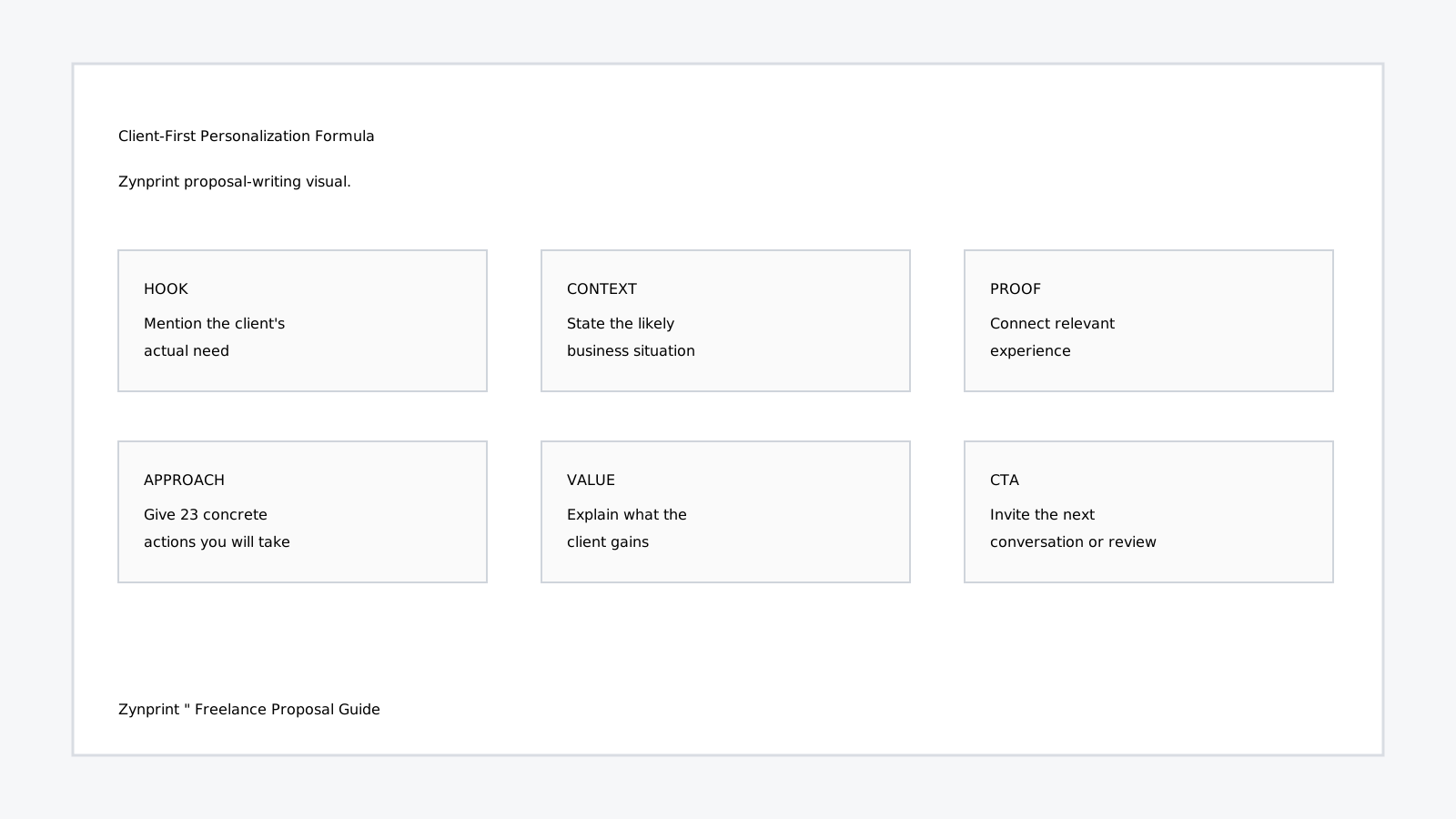
A practical structure for Fiverr and Upwork proposals is:
- Open with the client’s core need.
- Explain the likely situation or objective in one sentence.
- Connect that need to one relevant project or experience.
- Describe two or three concrete actions you can take.
- Show the value of those actions without making exaggerated promises.
- Close with a natural call to action and, when appropriate, a useful free suggestion or review.
This structure keeps the proposal focused while still giving the client evidence that the message was written for them.
Step 1: Find the real need inside the job post
The job title is not always the real need. “WordPress Developer Needed” is broad. The description may reveal that the client actually needs a landing page rebuilt, a contact form corrected, a WooCommerce checkout simplified, or an existing design translated into Elementor.
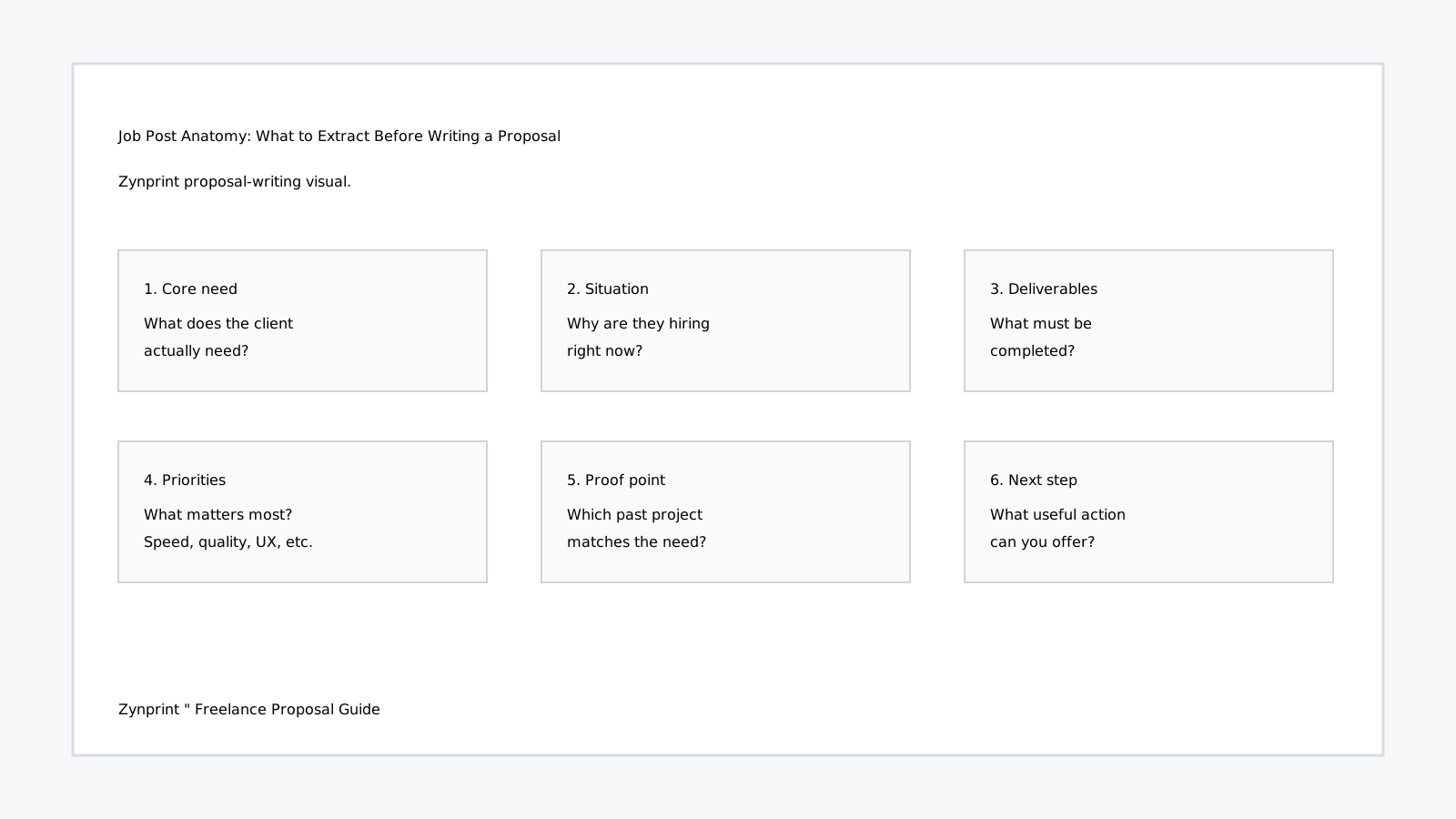
Before writing, ask five questions:
- What does the client want completed?
- What problem is causing them to look for help?
- What outcome would make them satisfied?
- Which skills or deliverables are explicitly required?
- What detail can I mention that proves I actually read the post?
The fifth question is especially important. A specific detail creates relevance. You do not need to mention every requirement. One or two accurate observations are often stronger than a paragraph that repeats everything.
Step 2: Separate requirements from assumptions
Good personalization does not mean inventing information. If a client says their website looks outdated, you can reasonably discuss visual consistency and modernization. You should not claim that their conversion rate is falling unless they said so or you have evidence.
Use three levels of information:
- Direct requirement: something the client explicitly requested.
- Reasonable situation: a practical interpretation that follows from the requirement.
- Unsupported assumption: a fact you cannot know from the post.
Build your proposal primarily from the first two. Avoid the third.
For example, if a client asks for a product catalog and sales sheets, you can say that the materials need to make product information easy to scan and consistent across pages. You should not claim that their current sales team is losing deals because of poor documents unless they told you that.
Step 3: Turn requirements into proposal language
One of the most useful proposal-writing skills is translation. The client writes a requirement; you turn it into a sentence that explains how you will respond to it.
Suppose a client says: “I need someone to clean up my WordPress contact page and make it look professional on mobile.” Do not simply write, “I can do WordPress and mobile responsive design.” Instead, translate the requirement into an action-oriented statement such as: “For your contact page, I would focus on cleaner form presentation, spacing and hierarchy, mobile usability, and removing outdated elements so the page feels consistent with the rest of the site.”

The second version is stronger because it demonstrates understanding. It also gives the client a mental picture of what you will actually work on.
Step 4: Match the right portfolio proof
Your portfolio should support the proposal, not interrupt it. If the client needs a Shopify store, send relevant ecommerce work. If they need a WordPress redesign, show WordPress examples. If they need a product catalog, show catalog or sales-sheet work.
More links are not automatically better. A client who receives ten unrelated portfolio links now has ten things to ignore. A short selection of relevant work makes the decision easier.
Before adding a link, ask:
- Does this project resemble the client’s requested work?
- Does it demonstrate the specific skill I mention?
- Is the link working and professional?
- Can I explain in one sentence why it is relevant?
If you use the free Fiverr and Upwork proposal generator, keep your portfolio input focused on valid, relevant website URLs. The quality of the proposal still depends on choosing the right proof.
Step 5: Use facts without turning the proposal into a résumé
Facts can increase credibility when they are relevant. Useful facts include years of experience, number of similar projects, a measurable result you can substantiate, or a concrete scope you have handled.
The key is context. “I have 10 years of experience” is weaker by itself than “I have 10 years of WordPress experience, including redesigns, Elementor builds, forms, and responsive layouts.” The second statement connects the fact to the client’s requirement.
Do not manufacture statistics. Avoid phrases such as “I guarantee 100% results,” “I am the best freelancer,” or “I will definitely increase your sales” unless you have a defensible basis for the claim. Professional proposals should create confidence, not pressure.
Step 6: Write for Fiverr differently from a long-form sales letter
Fiverr buyers may arrive from a gig, search result, or direct message and may already have seen your service description. Your proposal or response therefore needs to add context rather than repeating your entire profile.
A useful Fiverr response can quickly establish three things: you understand the request, you have relevant experience, and you know what you would do next.
For example:
I noticed you are looking for someone who can redesign your product catalog while keeping the existing brand style consistent. This usually comes up when a catalog has the right information but needs stronger hierarchy and a more professional presentation, which is similar to product-document work I have handled for clients. For your catalog, I can focus on page structure, product information hierarchy, typography, spacing, and consistent visual treatment across the sales sheets. If you share the current file, I can review the existing structure and point out a few practical improvements before we start.
Notice that the example does not spend the first paragraph explaining every skill the freelancer owns. It stays close to the buyer’s request.
Step 7: Adapt the same thinking to Upwork
Upwork proposals often need to respond directly to a detailed job description. The platform also gives freelancers an opportunity to compete on relevance rather than simply submitting a generic cover letter.
A strong Upwork proposal can follow this sequence:
- Identify the central requirement.
- Show that you understand the business or technical context.
- Reference a closely related project.
- List two or three actions you would take.
- Answer an important concern from the job post.
- Suggest a simple next step.
If the job description contains a website URL, existing design, screenshots, or a detailed workflow, those details can provide useful context. Read them before writing. The more relevant information you can accurately reference, the less your proposal will sound like a template.
Example: converting a weak proposal into a targeted proposal
Here is a simplified example for a web project.
Generic version
“Hello, I am a professional web developer with many years of experience. I can create your website professionally and make it responsive. I am hardworking, reliable, and available to start immediately. Please contact me to discuss.”
There is nothing obviously wrong with the grammar, but it could be sent to hundreds of clients. It does not demonstrate that the freelancer understands this specific job.
Targeted version
“I noticed you are looking for someone who can rebuild your existing service website while keeping the current brand direction. This usually comes up when the business has the right content but the website needs a cleaner structure, stronger mobile presentation, and easier navigation, which is similar to website redesign work I have handled for service businesses. For your site, I would focus on the page hierarchy, responsive layout, calls to action, service presentation, and consistency across the main pages. If you share the current website and the pages you want prioritized, I can review the existing structure and suggest a practical improvement path before development begins.”
The second version is longer by only a modest amount, but it is much more specific. The client can see what the freelancer noticed and what the freelancer intends to do.
How to use numbers and facts naturally
Proposal writing becomes more credible when facts are attached to the client’s context. Consider these patterns:
- “I have X years of experience in the exact platform you mentioned.”
- “I have worked on similar projects involving X, Y, and Z.”
- “The project scope you described matches the type of work I regularly handle.”
- “I can structure the first phase around X, Y, and Z so you can review progress before the remaining pages are completed.”
These statements are useful because they connect evidence to action. A proposal is not a résumé; it is a small business conversation.
Where a proposal generator helps—and where it should not replace you
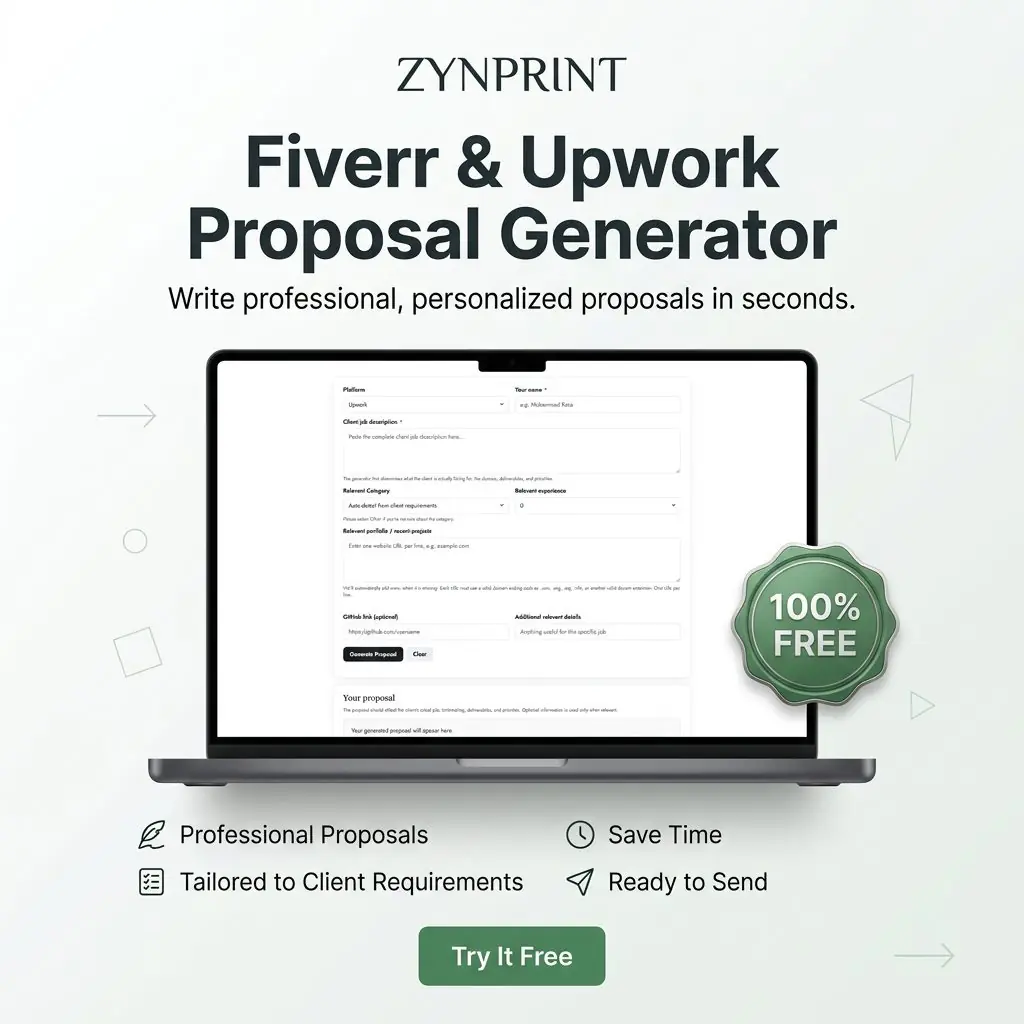
A good generator can reduce repetitive work. Instead of staring at a blank text box, you can paste the client’s job description, choose the relevant category, provide your name, add relevant experience, and include selected portfolio links.
That is useful when you submit multiple proposals, because the difficult part is often starting the structure. The Zynprint Fiverr & Upwork Proposal Generator is designed around a client-first approach: identify the core need, connect it to relevant experience, explain a practical approach, and finish with a useful next step.
But automation should not become copy-paste behavior. Read the generated proposal before sending it. Remove anything that does not fit the job. Add a specific project detail if you have one. Verify portfolio links. Make sure your experience claim is accurate. The tool can accelerate drafting; your judgment creates the final proposal.
A practical 60-second proposal review
Before sending, read only the first paragraph. If you replaced the client’s company name and job title, would the same paragraph work for another job? If yes, make it more specific.
Then review the middle section. Does it show a relevant experience connection? Does it explain what you will actually do? Are there unnecessary services that the client never requested?
Finally, review the close. Is the call to action natural? Does it make it easy for the client to reply? A simple request such as “If you share the current file, I can review the structure and suggest the first improvements” is often more useful than “Please contact me ASAP.”

Proposal checklist for Fiverr and Upwork
- Did I mention the client’s actual core need?
- Did I show that I understand the situation?
- Did I connect the job to relevant experience?
- Did I explain two or three useful actions?
- Did I avoid unsupported assumptions?
- Did I select only relevant portfolio examples?
- Did I use facts that I can honestly support?
- Is the proposal easy to scan on a phone?
- Did I remove generic filler?
- Does the closing give the client a simple next step?
Common proposal mistakes to avoid
1. Starting with your biography
The client is not hiring a biography. They are hiring a solution to a problem. Put the client’s requirement first and introduce yourself through relevant proof.
2. Repeating every line of the job post
Repeating the description does not prove understanding. Select the important requirements and explain how you will address them.
3. Sending unrelated portfolio links
Relevance beats volume. A small set of strong examples is easier to evaluate than a large collection of unrelated work.
4. Making promises you cannot prove
Avoid guaranteed results, invented metrics, or claims about the client’s business that were never stated. Honest specificity is more persuasive.
5. Making the proposal too long
A proposal should contain enough detail to demonstrate understanding, but not so much that the client has to search for the point. Short paragraphs and bullets help.
6. Sending without a final read
Always check names, links, platform terminology, project details, and the call to action. A one-minute review can prevent a surprisingly unprofessional mistake.
Useful video resources for proposal writing
If you want to see proposal-writing strategies demonstrated visually, these three resources are useful starting points:
- Upwork Proposal System That Made Me $500k (Live) — a walkthrough focused on reading job context and building proposals around it.
- How To Write Freelance Proposal in 2026 | Upwork | Fiverr | Linkedin — covers proposal writing for multiple freelance platforms.
- YouTube: Fiverr proposal writing tips — a broader collection of Fiverr-focused proposal resources.
Build a repeatable proposal system
The best freelancers do not reinvent their entire proposal every time. They build a repeatable system with flexible components.
Your system can contain a small library of relevant experiences, portfolio examples, service-specific approaches, and closing ideas. When a new job arrives, you select the pieces that match instead of copying one complete template.
For example, a WordPress proposal library might contain separate proof points for Elementor, WooCommerce, contact forms, speed optimization, responsive design, and website redesign. A graphic designer might maintain proof points for catalogs, packaging, brand identity, presentations, and print-ready artwork.
This is where a free Fiverr and Upwork proposal generator can become part of a practical workflow. Use it to create the first structured version, then personalize the final message with the details only you know from reviewing the client’s project.
Final takeaway
A better Fiverr or Upwork proposal is not necessarily longer, more impressive, or filled with more keywords. It is more relevant.
Read the job post carefully. Identify the real need. Separate facts from assumptions. Match your strongest relevant experience. Explain a practical approach. Use honest facts. Keep the message easy to scan. Then finish with a natural next step.
If you want to speed up that process, try the 100% FREE Fiverr & Upwork Proposal Generator. Paste the client’s job description, select the relevant category and experience, add your relevant portfolio URLs, and generate a client-first starting point. Then take the final step yourself: read it, personalize it, and make sure every sentence genuinely fits the client.
SEO Keywords: Fiverr and Upwork proposal generator, Fiverr proposal writing, Upwork proposal writing, freelance proposal generator, Upwork cover letter, Fiverr client response, freelance job proposal, winning freelance proposals, personalized Upwork proposal, client-first proposal.
SEM / Commercial Keywords: free Fiverr proposal generator, free Upwork proposal generator, best freelance proposal generator, proposal writing tool for freelancers, professional Upwork proposal generator, Fiverr proposal template generator, Upwork cover letter generator, freelance proposal writing tool, free proposal writing tool.
Hashtags: #Fiverr #Upwork #Freelancing #ProposalWriting #FreelanceTips #UpworkTips #FiverrTips #Freelancer #ClientAcquisition #ProposalGenerator