How to Write Fiverr & Upwork Proposals That Communicate Value, Scope and Price
A freelance proposal does more than introduce you to a client. It can also establish the value of the work, clarify the expected scope, reduce uncertainty, and make a budget conversation much easier.
This matters on both Fiverr and Upwork. A client may compare several freelancers who appear to offer the same service. If one proposal simply says, “I can do this for $200,” while another explains the problem, the approach, the deliverables, and what the client will receive, the second proposal gives the buyer much more information for making a decision.
This guide explains how to write Fiverr and Upwork proposals that communicate value without sounding pushy, how to discuss budget and scope professionally, how to avoid underpricing yourself, and how to use a Fiverr and Upwork proposal generator as part of a repeatable client-first workflow.
Why price should not be the first thing in your proposal
Price matters, but starting with price can reduce the conversation to a number before the client understands what the number represents.
Imagine two freelancers responding to a website redesign request. Freelancer A says, “I can do this for $300.” Freelancer B says, “I noticed you want to improve the existing website without losing the current brand direction. I would first review the main page structure, then focus on responsive layout, hierarchy, calls to action, and consistency across the priority pages. The initial scope would cover the agreed pages, responsive implementation, and one structured review round.”
Even before Freelancer B mentions a price, the client has a clearer picture of the service.
This does not mean you should hide your price when the platform or client requires it. It means the proposal should give the price context.
The value-first proposal framework
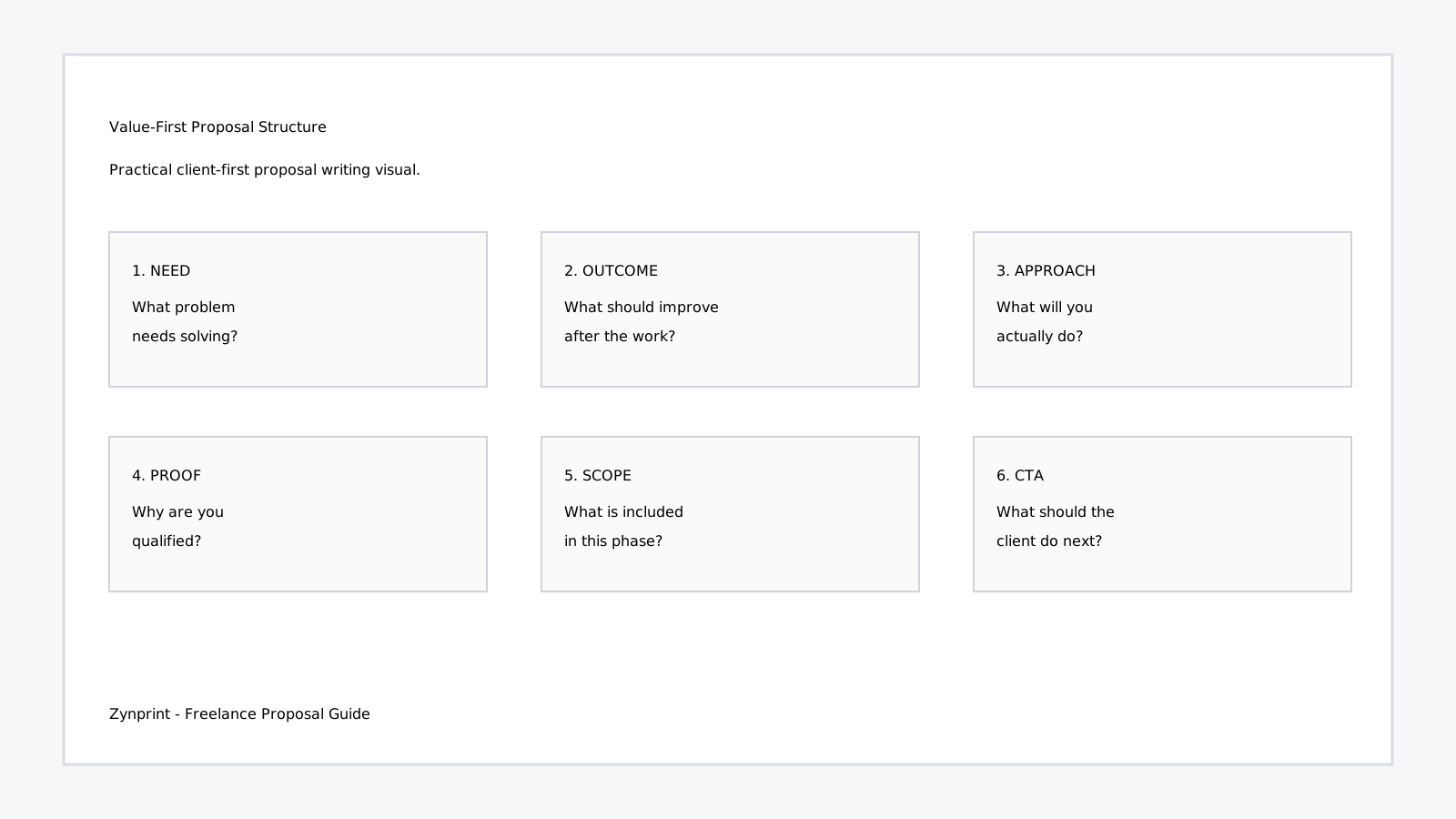
A useful proposal structure for commercial freelance projects is:
- Need: identify what the client is trying to solve.
- Outcome: explain what the completed work should accomplish.
- Approach: describe two or three important actions.
- Proof: connect the work to relevant experience.
- Scope: clarify what the proposed phase includes.
- Call to action: give the client a simple next step.
This structure is useful because it moves the discussion from “What do you charge?” toward “What exactly am I getting, and why is this approach appropriate?”
Step 1: Understand what the client is actually buying
Clients rarely buy a technical skill by itself. They buy an outcome.
A client requesting WordPress development may actually be buying a more professional website, easier content management, a better mobile experience, or a working lead-generation process.
A client requesting graphic design may actually be buying clearer communication, a stronger presentation, better sales material, or a consistent brand appearance.
A client requesting Shopify work may be buying a smoother shopping experience, better product presentation, or a more manageable storefront.
When you identify the outcome, your proposal becomes more persuasive without becoming salesy.
Step 2: Turn the client’s requirement into business value
Do not exaggerate the business impact. Simply explain the practical benefit of the requested work.
For example:
- “Redesign the product catalog” becomes “make product information easier for customers or sales teams to scan and compare.”
- “Improve the mobile website” becomes “make the key pages easier to navigate and use on smaller screens.”
- “Create a WordPress contact form” becomes “make it easier for visitors to submit inquiries and for the business to receive them reliably.”
- “Build a landing page” becomes “create a focused page that presents the offer, supporting information, and next action clearly.”
These are reasonable outcomes. They do not promise a specific conversion increase or revenue figure that you cannot prove.
Step 3: Show what is included in the scope
Scope is one of the most important parts of a professional proposal. A vague proposal can create confusion later because the client and freelancer may have different ideas about what “website design,” “logo design,” or “complete ecommerce setup” actually includes.
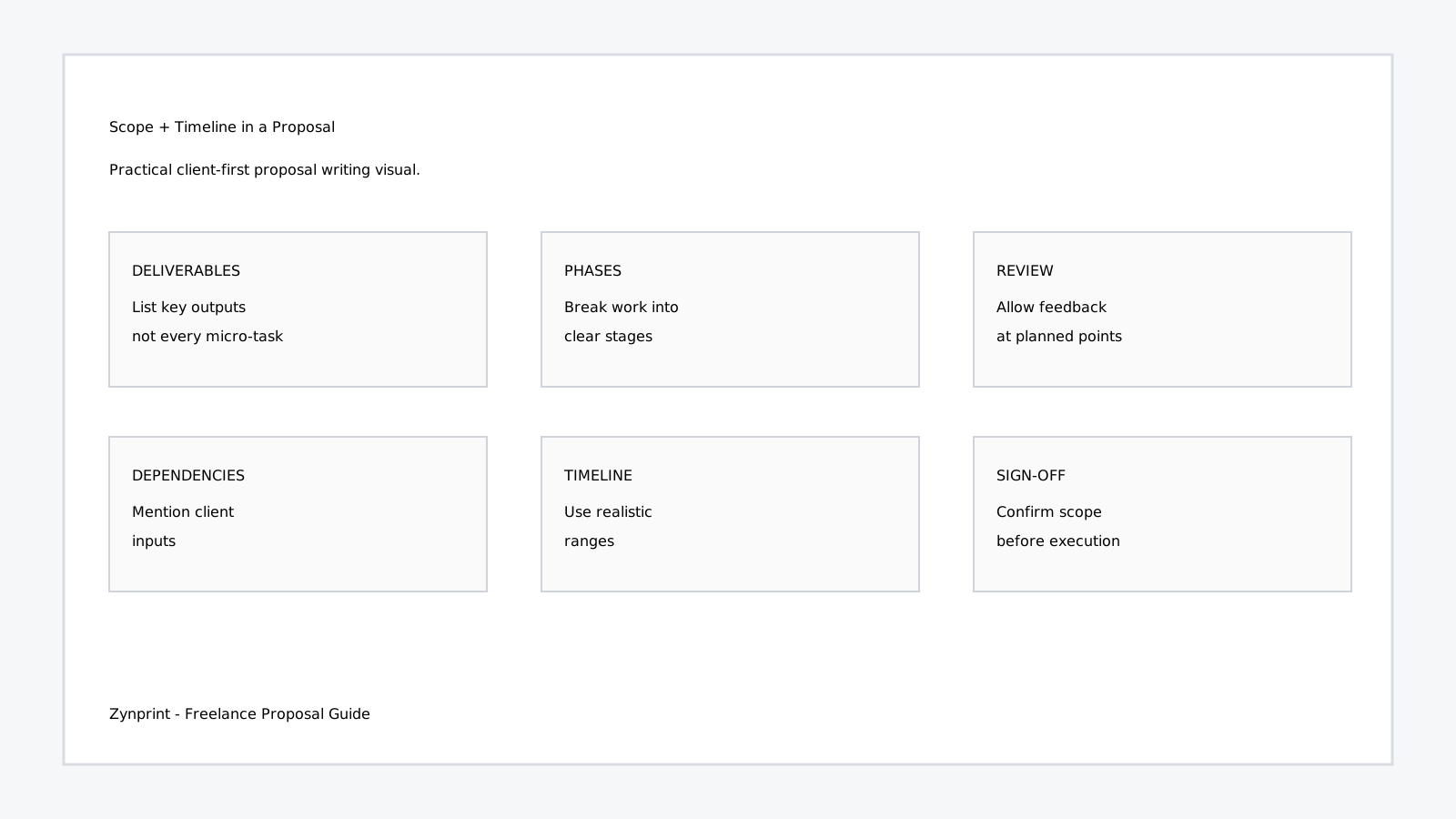
Your proposal does not need to contain a full legal contract. But it should identify the main deliverables.
For example, a website proposal might include:
- Homepage and agreed internal pages.
- Responsive desktop, tablet, and mobile layouts.
- Existing brand direction retained where requested.
- Contact form or specified integrations.
- One or two structured review rounds, depending on the agreement.
A catalog project might specify the number of pages, document format, product sections, design system, and revision rounds.
Clear scope protects both sides. It also makes your price easier to understand.
Step 4: Explain your price through scope, not excuses
When a client asks why your price is higher than another freelancer’s quote, avoid becoming defensive.
Instead, explain what the price covers.
For example:
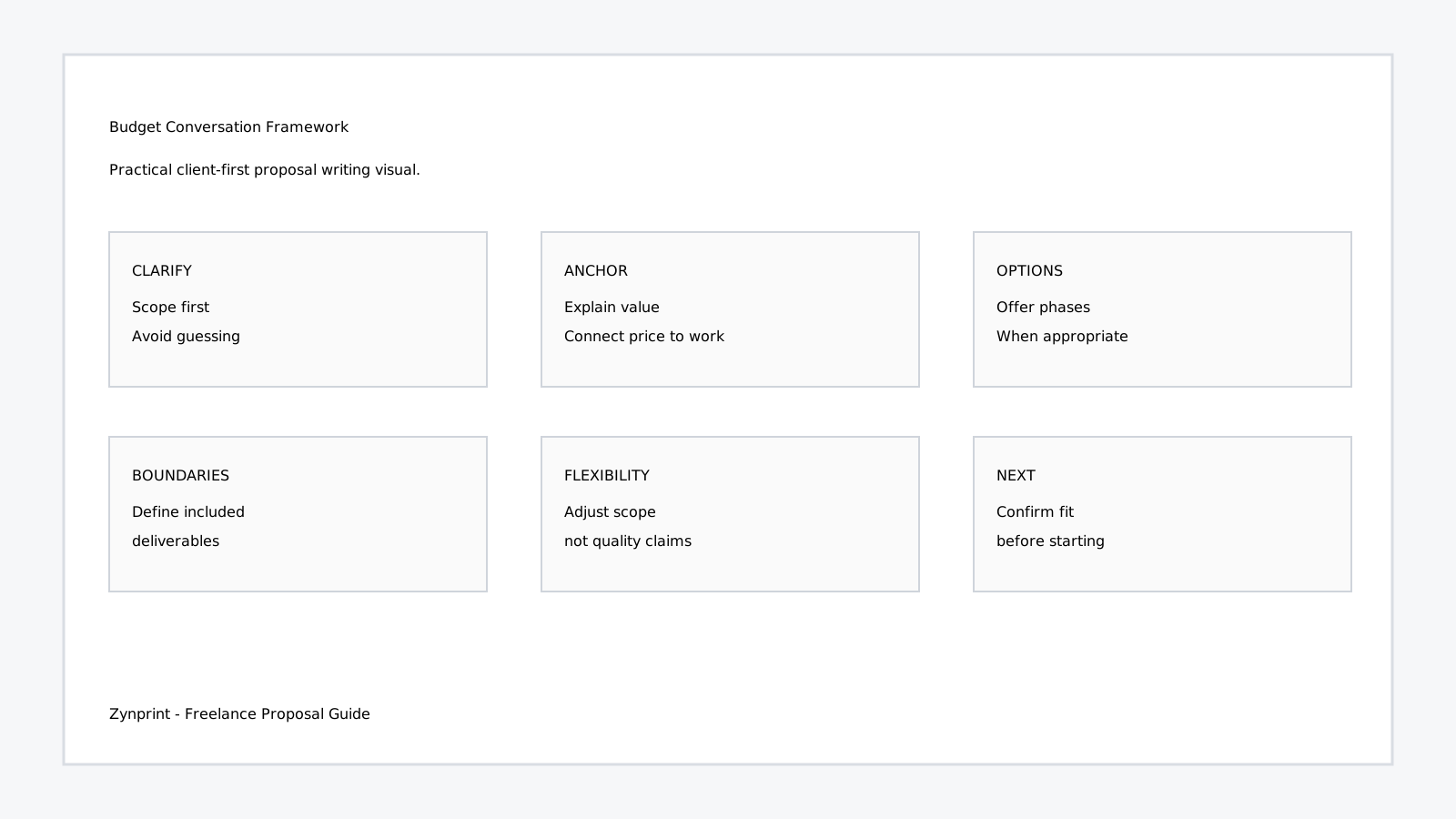
“The proposed price covers the agreed page count, responsive implementation, design adjustments, testing, and the included review round. If you need to stay within a lower budget, we can reduce the initial scope and complete the remaining pages in a later phase.”
This is a professional budget conversation because you are changing scope rather than pretending that the same amount of work can always be delivered for less.
How to handle a low client budget
Not every low-budget project is automatically a bad project. The important question is whether the requested scope fits the budget.
If a client has a limited budget, consider three approaches:
- Reduce scope: deliver the highest-priority pages or features first.
- Divide into phases: complete the essential foundation now and add secondary work later.
- Clarify requirements: sometimes the client’s initial description includes items they do not actually need.
Avoid promising the full original scope for a price that cannot reasonably support it. That creates pressure for both sides and can lead to scope creep.
Example: a budget-focused Fiverr proposal
Suppose a Fiverr buyer wants a ten-page WordPress website but gives a very limited budget.
A weak response would be:
“Your budget is too low. My price is $500. Let me know.”
A better response is:
I noticed you need a ten-page WordPress website with a responsive layout and a professional presentation. The full scope would require enough time for page structure, implementation, responsive testing, and revisions, so I would not want to promise the entire project at a budget that does not support that work properly. If you want to keep the current budget, I can suggest a first phase covering the highest-priority pages and core structure, then we can expand the remaining pages afterward. That way, you get a usable foundation without cutting corners on the initial work.
The second proposal protects your positioning while still giving the buyer a path forward.
Example: an Upwork proposal for a higher-value project
Consider an Upwork client looking for a Shopify redesign.
A proposal could begin:
I noticed you are looking for someone who can improve your existing Shopify store rather than rebuild everything from scratch. That usually means the priority is identifying the pages and customer steps that need the most attention while preserving the parts of the store that already work. I would focus first on product-page hierarchy, mobile presentation, navigation, and the path from product information to checkout, then confirm the priority changes with you before expanding the scope. I have relevant ecommerce interface experience, so I can keep the first phase focused on practical improvements rather than unnecessary changes.
Notice that the proposal creates a value conversation before discussing the final commercial details.
Step 5: Use experience as evidence, not decoration
Years of experience can support your proposal, but they should not be the entire argument.
“I have ten years of experience” is a fact. “I have ten years of WordPress experience and have handled responsive layouts, Elementor builds, forms, redesigns, and ecommerce interfaces” is more relevant when the client needs WordPress work.
Use the experience that reduces the client’s uncertainty.
If you have a relevant project, connect it directly:
“Your request is similar to a recent project where I improved the structure and responsive presentation of an existing WordPress website.”
Then, if appropriate, include the relevant portfolio link.
Step 6: Use a proposal generator without turning proposals into templates
A proposal generator is useful when you need to create a structured first draft quickly. It can help you organize the job description, category, experience, portfolio, approach, and closing.
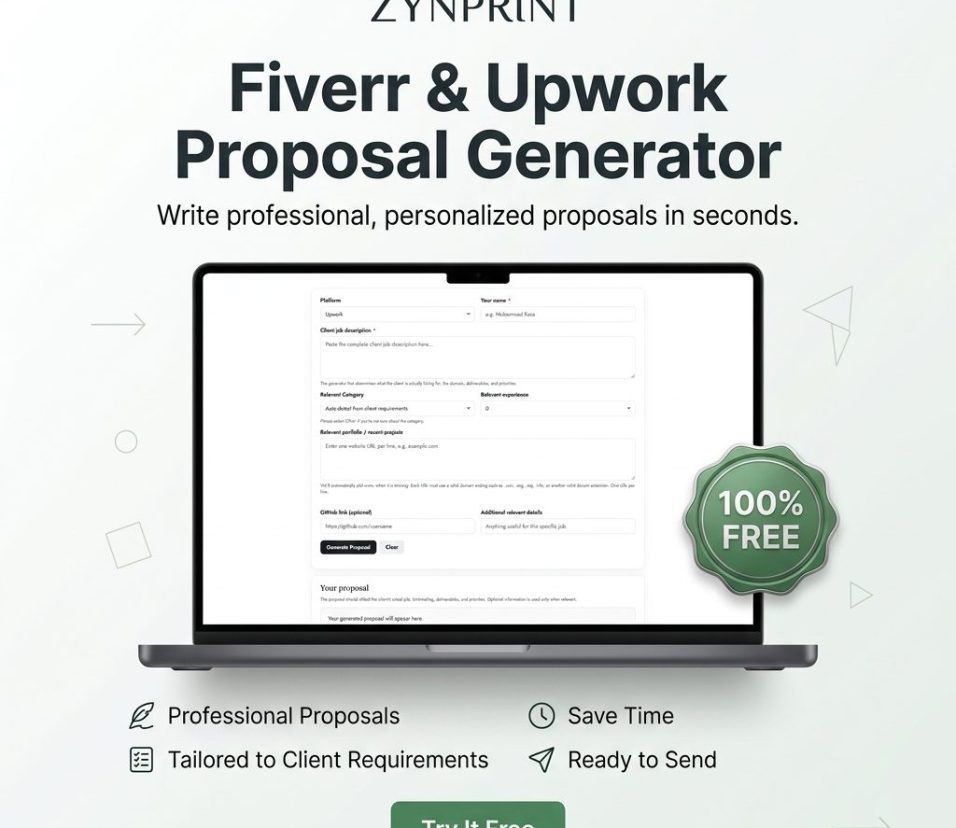
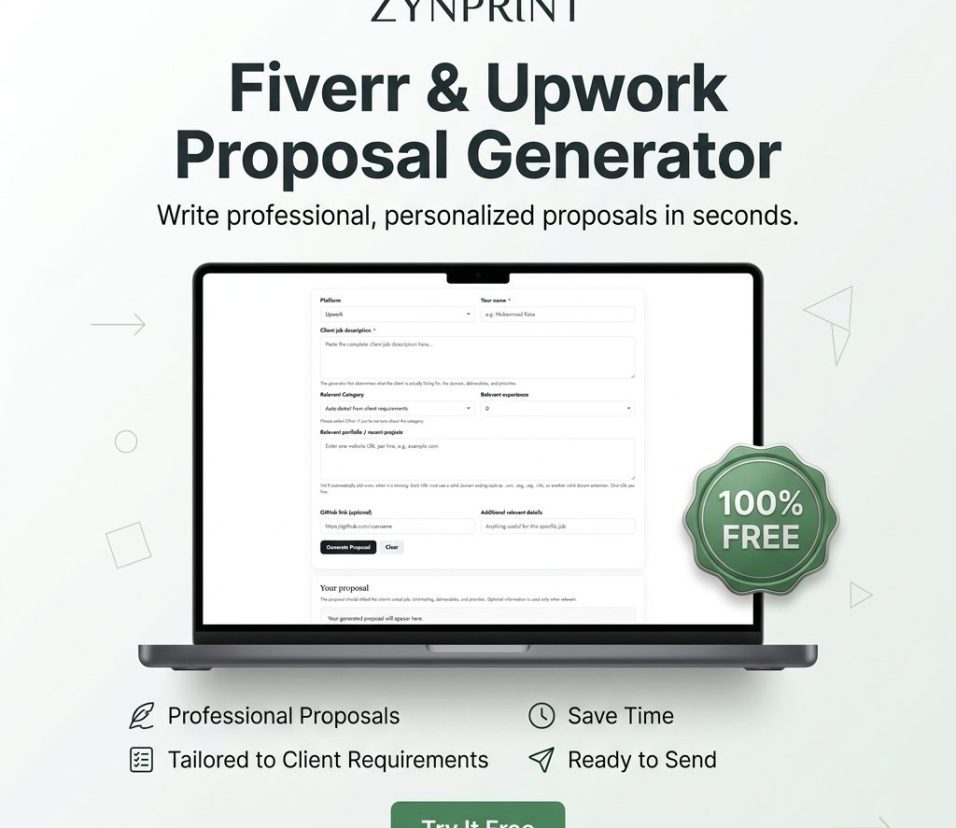
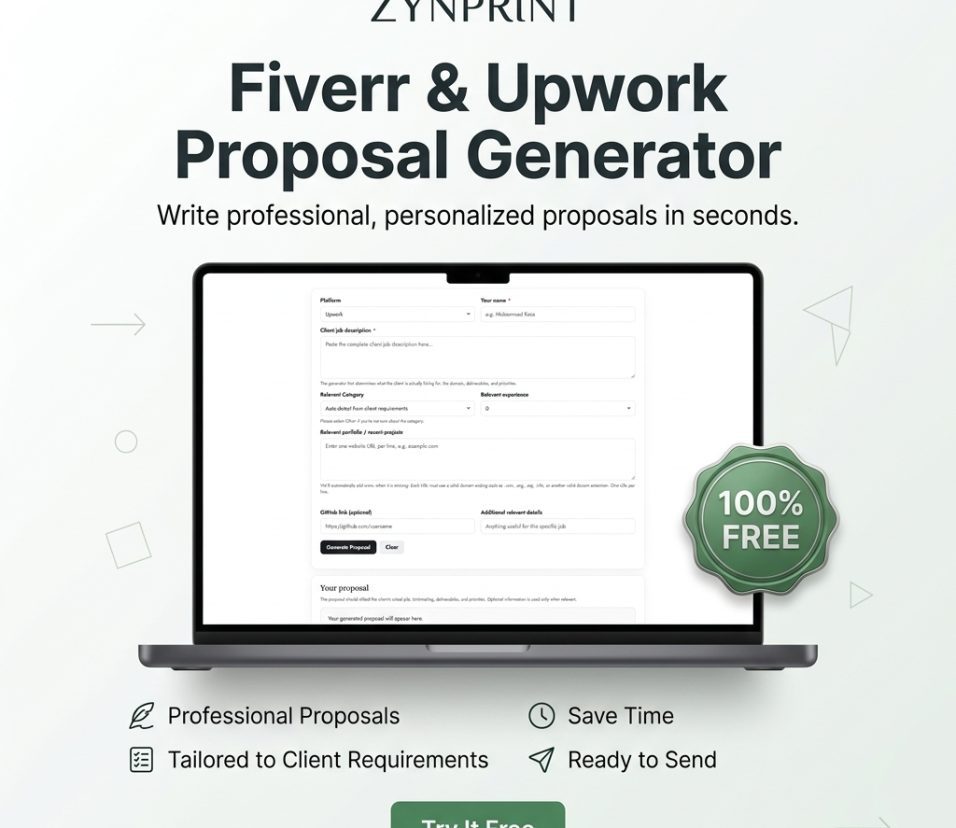
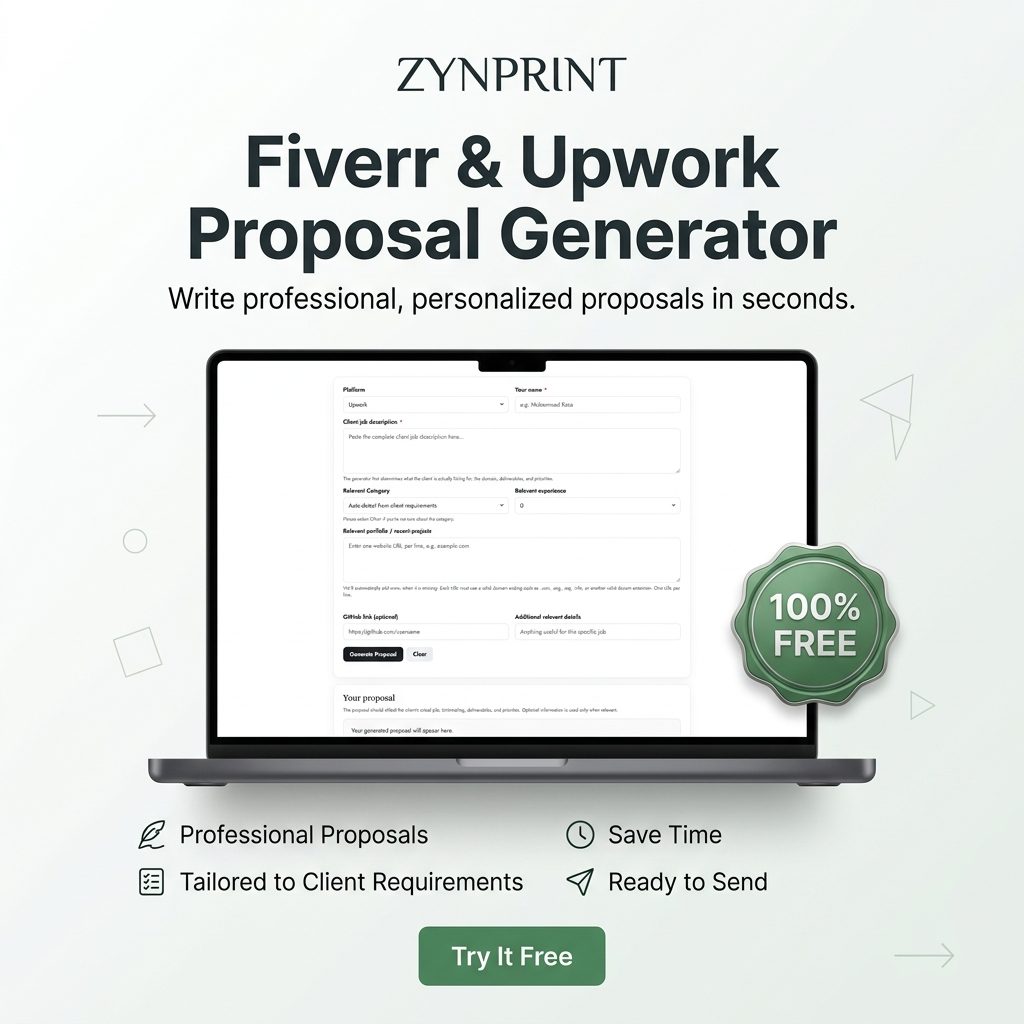
The Zynprint Fiverr & Upwork Proposal Generator is built around this client-first workflow. You provide the client’s job description and relevant information, and the tool helps create a proposal that begins with the client’s need instead of a generic freelancer biography.
For commercial projects, however, you should review the generated draft carefully. Check whether the suggested scope actually matches the job. Remove services the client did not request. Verify your portfolio links. Adjust any experience statements that do not fit the project.
The goal is faster drafting, not automatic sending.
Fiverr vs Upwork: how the commercial conversation differs
The underlying principle is the same on both platforms: make the client understand what they are getting. The communication context is different.
On Fiverr:
- Keep the response focused on the buyer’s request.
- Clarify what your service or proposed custom scope includes.
- Avoid repeating the complete gig description.
- Make the next step easy.
On Upwork:
- Respond directly to the job description.
- Address the main requirements and concerns.
- Explain your approach and relevant experience.
- Clarify scope when the project is broad.
In both cases, the client should not have to guess what you mean by “complete,” “professional,” or “high quality.” Define the important parts.
Step 7: Discuss timeline without making risky promises
Timeline can also affect perceived value. A proposal that says “I can finish tomorrow” may sound attractive, but it can become a problem if the scope is not fully understood.
Instead, use realistic ranges or phases when the requirements are still being clarified.
For example:
- Initial review and structure: first phase.
- Main implementation: second phase.
- Review and revisions: planned review stage.
- Final testing and delivery: final stage.
If the client’s feedback, content, images, access credentials, or approvals affect the timeline, mention that dependency.
Step 8: Make your call to action commercial but natural
A call to action should move the conversation forward without pressure.
Instead of “Hire me now,” try:
- “If you share the current website, I can review the priority pages and suggest the best first phase.”
- “If you send the current catalog, I can review the structure and identify the areas that need the most attention.”
- “If you confirm the page count and required integrations, I can help define the exact scope.”
These CTAs work because they invite a useful next action.
Common pricing mistakes in freelance proposals
1. Competing only on price
If every proposal becomes a race to offer the lowest number, you make it harder to build a sustainable freelance business. Compete on relevance, communication, scope clarity, and useful experience.
2. Offering unlimited revisions
“Unlimited revisions” may sound customer-friendly, but it can create unclear boundaries. Define a reasonable review process instead.
3. Promising the full scope for a very low budget
If the scope does not fit the budget, reduce the scope or divide the project into phases.
4. Giving a price without defining deliverables
A number without scope makes comparison difficult. The client may compare your price with someone offering a completely different amount of work.
5. Using unsupported ROI claims
Do not promise that a redesign will increase sales by a specific percentage unless you have a defensible basis. Explain the practical improvement instead.
6. Hiding important dependencies
If you need content, brand assets, access, product data, or approvals from the client, mention those requirements when they affect the timeline.
Proposal checklist before you discuss price
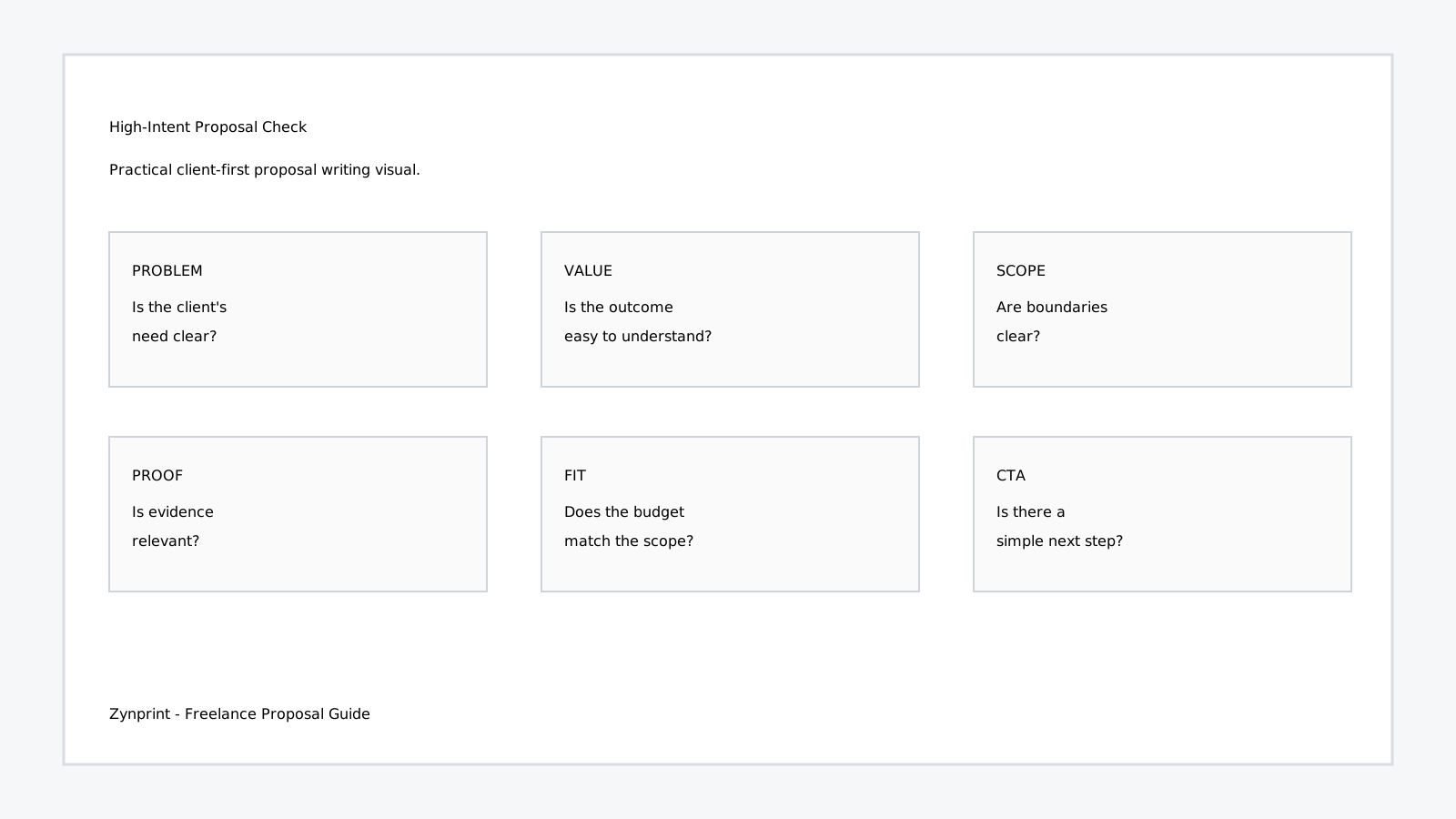
- Did I clearly identify the client’s problem?
- Did I explain the desired outcome?
- Did I connect my experience to this exact type of work?
- Did I describe two or three important actions?
- Did I define the major deliverables?
- Did I avoid promising unsupported results?
- Does the proposed scope realistically fit the budget?
- Have I separated essential work from optional work?
- Is the timeline realistic?
- Did I include relevant portfolio proof?
- Is there a natural next step?
Three YouTube resources for better proposals
These videos provide additional proposal-writing guidance that complements the framework in this article:
- Upwork Proposal Writing | Tips & Tricks — covers analyzing the client, identifying pain points, and avoiding proposal mistakes. citeturn0youtube17
- TOP 5 Upwork Proposal Tips from an $847,243 Freelancer — discusses introductions, relevant examples, value, calls to action, and proposal quality. citeturn0youtube18
- YouTube: Fiverr proposal pricing tips — a broader collection of Fiverr-focused proposal and client communication resources.
Build a repeatable commercial proposal workflow
Once you understand the framework, you can turn it into a repeatable process.
- Read the complete Fiverr or Upwork job description.
- Identify the client’s main problem and desired outcome.
- Separate essential requirements from optional requests.
- Select the most relevant portfolio proof.
- Draft the client-first opening.
- Explain two or three practical actions.
- Define the major scope and deliverables.
- Review whether the scope fits the budget.
- State a realistic timeline or project phase.
- Finish with a useful CTA.
You can use the 100% FREE Fiverr & Upwork Proposal Generator in the drafting stage. Paste the client’s job description, select the appropriate category and experience, add relevant portfolio URLs, and generate the starting proposal. Then perform your own commercial review before sending it.
Final takeaway
The strongest freelance proposals do not simply say that you are talented or affordable. They make the project easier to understand.
Show the client that you understand the problem. Explain the outcome. Connect the work to relevant experience. Define the important deliverables. Discuss budget through scope instead of defensiveness. Set realistic expectations. Then make it easy for the client to take the next step.
That approach works for both Fiverr and Upwork because it is based on a universal principle: clients want confidence that the person they hire understands the work and can communicate clearly about what will be delivered.
When you want to create that structure faster, try the 100% FREE Fiverr and Upwork Proposal Generator. Use it to build the first draft, then add the project-specific judgment that makes the proposal genuinely yours.
SEO Keywords: Fiverr and Upwork proposal generator, freelance proposal pricing, Upwork proposal writing, Fiverr proposal writing, freelance proposal template, client-first proposal, freelance pricing proposal, proposal scope and budget, winning Upwork proposal, Fiverr client proposal.
SEM / Commercial Keywords: free Fiverr proposal generator, free Upwork proposal generator, best freelance proposal generator, professional proposal writing tool, Upwork proposal generator free, Fiverr proposal generator free, freelance pricing proposal template, proposal generator for freelancers, client proposal writing tool.
Hashtags: #Fiverr #Upwork #Freelancing #ProposalWriting #FreelancePricing #UpworkTips #FiverrTips #FreelanceBusiness #ProposalGenerator #ClientAcquisition