
AI in WordPress: A Practical Guide to Using AI on Your Website
- by Muhammad Raza
- 0 Comments
- 14 minutes read
- 50 Views
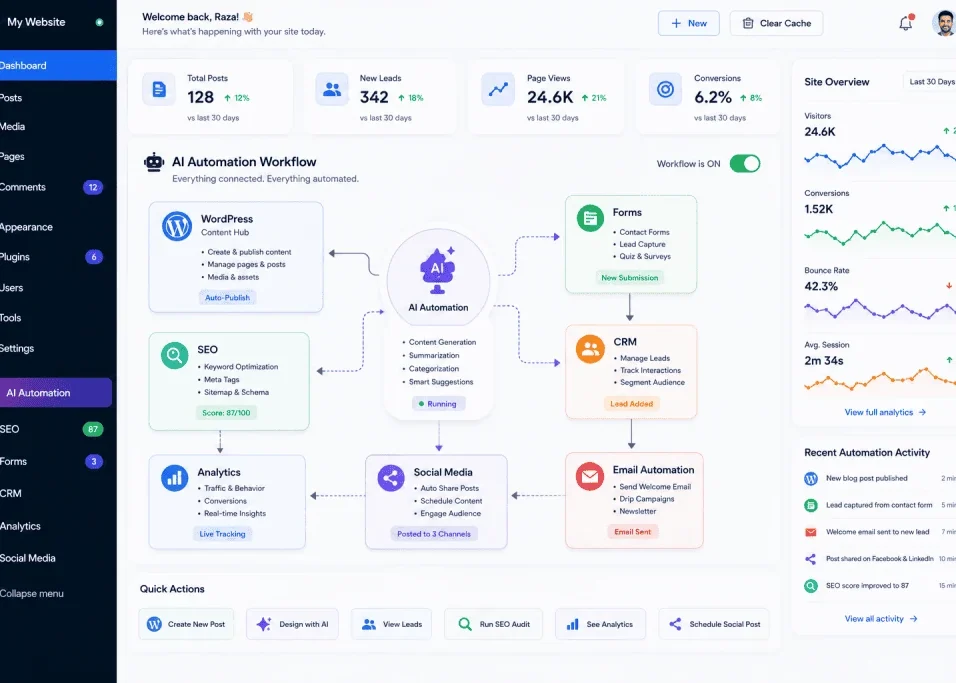
Using AI in WordPress can help you create, manage, optimize, and grow a website more efficiently without handing every decision over to automation. WordPress remains the platform that powers your site, while AI can assist with content, SEO, design, images, coding, customer support, analytics, automation, ecommerce, and everyday website management.
The most effective approach is to use AI as a productivity partner: let it handle repetitive work and first drafts while people remain responsible for strategy, accuracy, brand decisions, security, and final publishing decisions.
This guide explains 15 practical ways to use AI in WordPress, how to choose useful AI features and plugins, where human review matters, and how to build a sustainable AI-powered WordPress workflow.
3. Write and Improve WordPress Content
AI can help create first drafts for blog posts, landing pages, product descriptions, FAQs, email campaigns, and other website content.
WordPress.com currently provides an AI Assistant block that can help generate, summarize, simplify, translate, and transform content inside the WordPress editor.
This can be useful when you are staring at a blank editor.
However, the best workflow is not:
AI → Publish
A better workflow is:
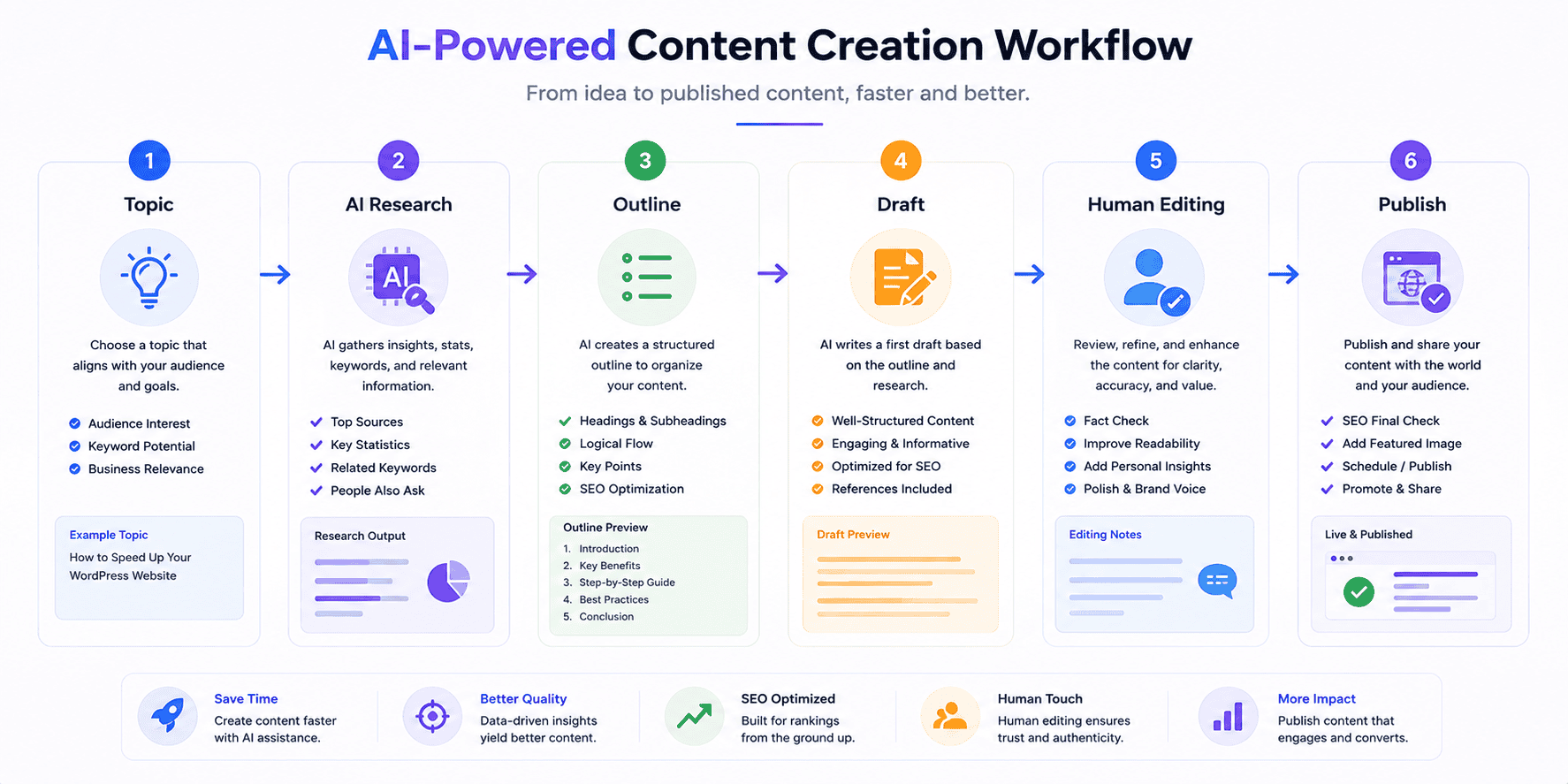
Research → AI Draft → Human Editing → Fact-Check → SEO Review → Publish
Human editing remains important because AI-generated text can be generic, repetitive, or factually incorrect.
Add your own:
- Examples
- Experience
- Opinions
- Explanations
- Original research
- Screenshots
- Case studies
- Relevant sources
This makes the article more useful and more distinctive.
4. Use AI to Improve Existing Articles
You do not always need to create new content.
Your existing WordPress articles may contain opportunities for improvement.
AI can help identify:
- Repetitive paragraphs
- Weak introductions
- Missing sections
- Unclear explanations
- Outdated wording
- Missing FAQs
- Possible internal links
- Difficult-to-read sentences
You can give AI an existing article and ask it to identify areas where the explanation could be clearer.
You can also ask it to create a summary of the article and compare that summary with the intended search intent.
However, do not automatically rewrite every old article.
If an article contains original information, personal experience, useful examples, or valuable explanations, preserve those elements.
AI should help improve your content, not erase what makes it unique.
5. Create SEO Titles and Meta Descriptions
AI can generate multiple versions of SEO titles and meta descriptions quickly.
For example, instead of a generic title like:
AI WordPress Guide
you could create:
AI in WordPress: 15 Smart Ways to Grow Your Website
The second version tells the reader more about what they will find.
AI can also help create meta descriptions.
A good description should:
- Explain the page
- Include the main topic naturally
- Encourage a click
- Avoid keyword stuffing
- Remain concise
For this article, the optimized meta description is:
Learn how to use AI in WordPress for content, SEO, design, automation, chatbots, and website growth.
The important thing is to write for users first rather than trying to insert as many keywords as possible.
6. Use AI for Keyword and Topic Research
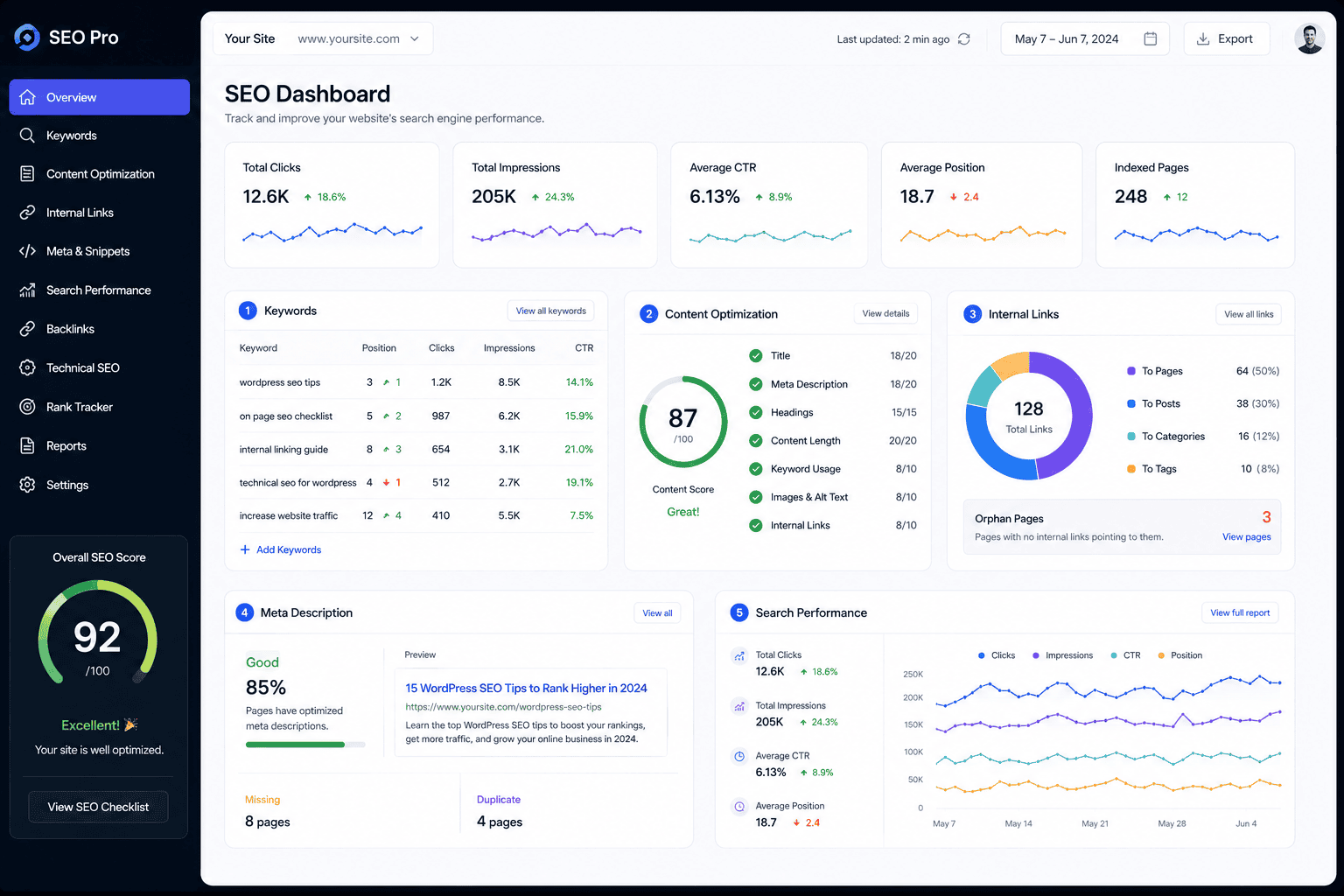
AI can be useful for creating an initial keyword map.
Suppose your main topic is WordPress AI.
AI can help organize related terms such as:
- AI WordPress plugins
- AI website builder
- AI SEO WordPress
- AI content WordPress
- WordPress AI automation
- AI chatbot WordPress
- AI website design
- WordPress AI assistant
It can also generate long-tail queries such as:
- How to use AI in WordPress
- How to automate WordPress with AI
- Best AI tools for WordPress
- How to use AI for WordPress SEO
- How to create WordPress content with AI
But there is an important limitation.
AI-generated keyword suggestions are not the same as verified search-volume data.
Use dedicated SEO research tools and actual search results when you need reliable keyword metrics.
Use AI primarily for organizing ideas, identifying related concepts, clustering topics, and developing content plans.
7. Generate Images for WordPress
Images can make long articles easier to understand.
AI image-generation tools can help create:
- Featured images
- Blog illustrations
- Workflow diagrams
- Concept graphics
- Social media visuals
- Background images
- Infographics
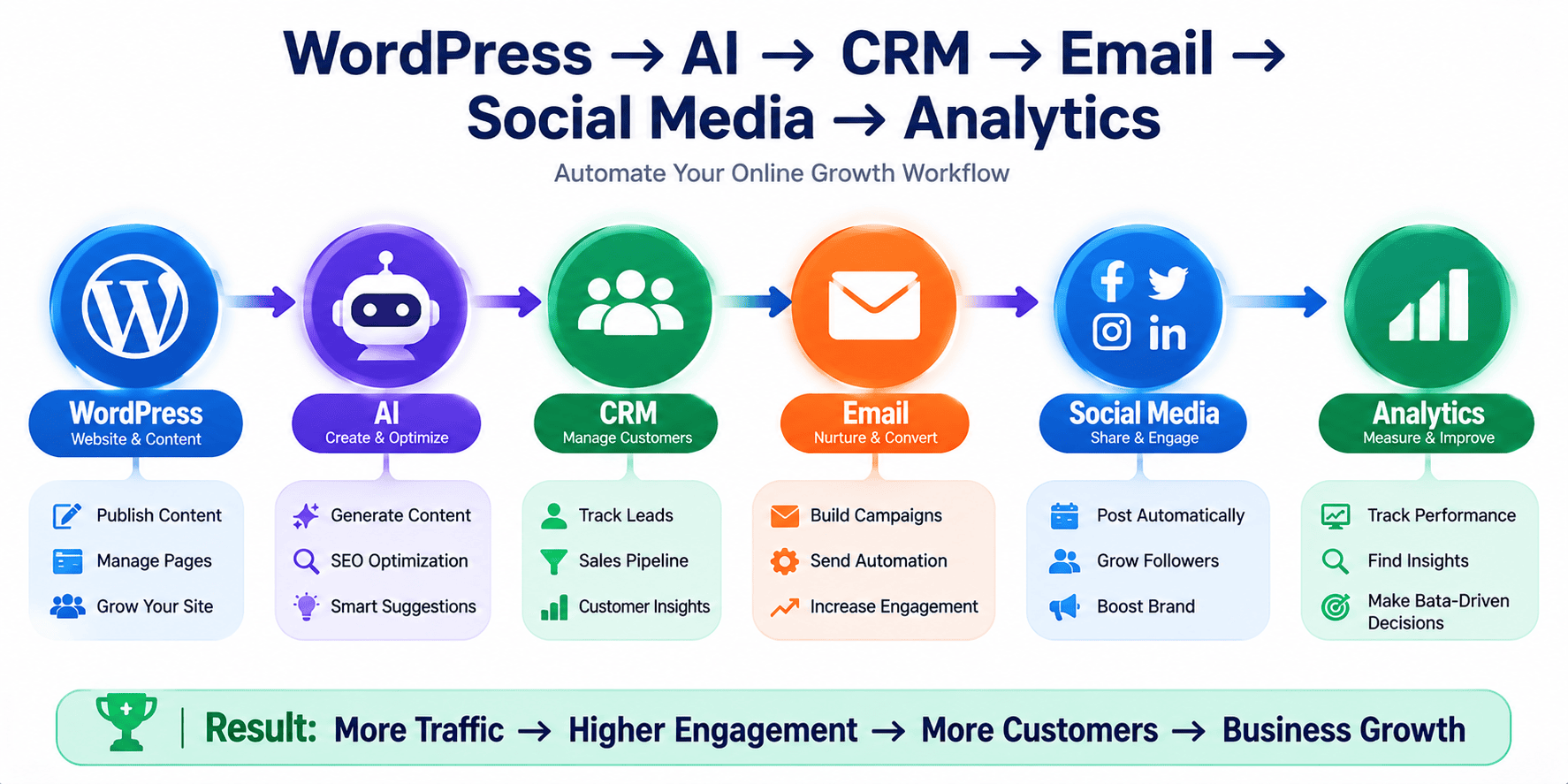
For example, an article about AI automation could include a visual showing:
WordPress → AI → CRM → Email → Analytics
This immediately communicates the idea of connected automation.
WordPress.com also provides AI-assisted image workflows for AI-created websites, including generating new images and replacing existing images in the Media Library.
However, do not add images simply to increase the number of images on a page.
Every visual should have a purpose.
8. Improve Image ALT Text With AI
AI can also help describe images for accessibility and SEO.
Instead of an unhelpful filename such as:
image123.jpg
you could use a descriptive filename such as:
ai-wordpress-automation-workflow.webp
The ALT text might be:
AI automation workflow connecting WordPress with business tools
ALT text should describe the actual image.
Do not turn ALT text into a list of keywords.
For example, this is poor:
AI WordPress AI tools WordPress SEO AI automation best AI WordPress
It does not help the visitor.
A descriptive ALT attribute is much more useful.
9. Design WordPress Websites With AI
AI can also assist with web design.
You can use it to brainstorm:
- Homepage layouts
- Landing-page sections
- Calls to action
- Typography ideas
- Navigation structures
- Content hierarchy
- Section ordering
- Visual concepts
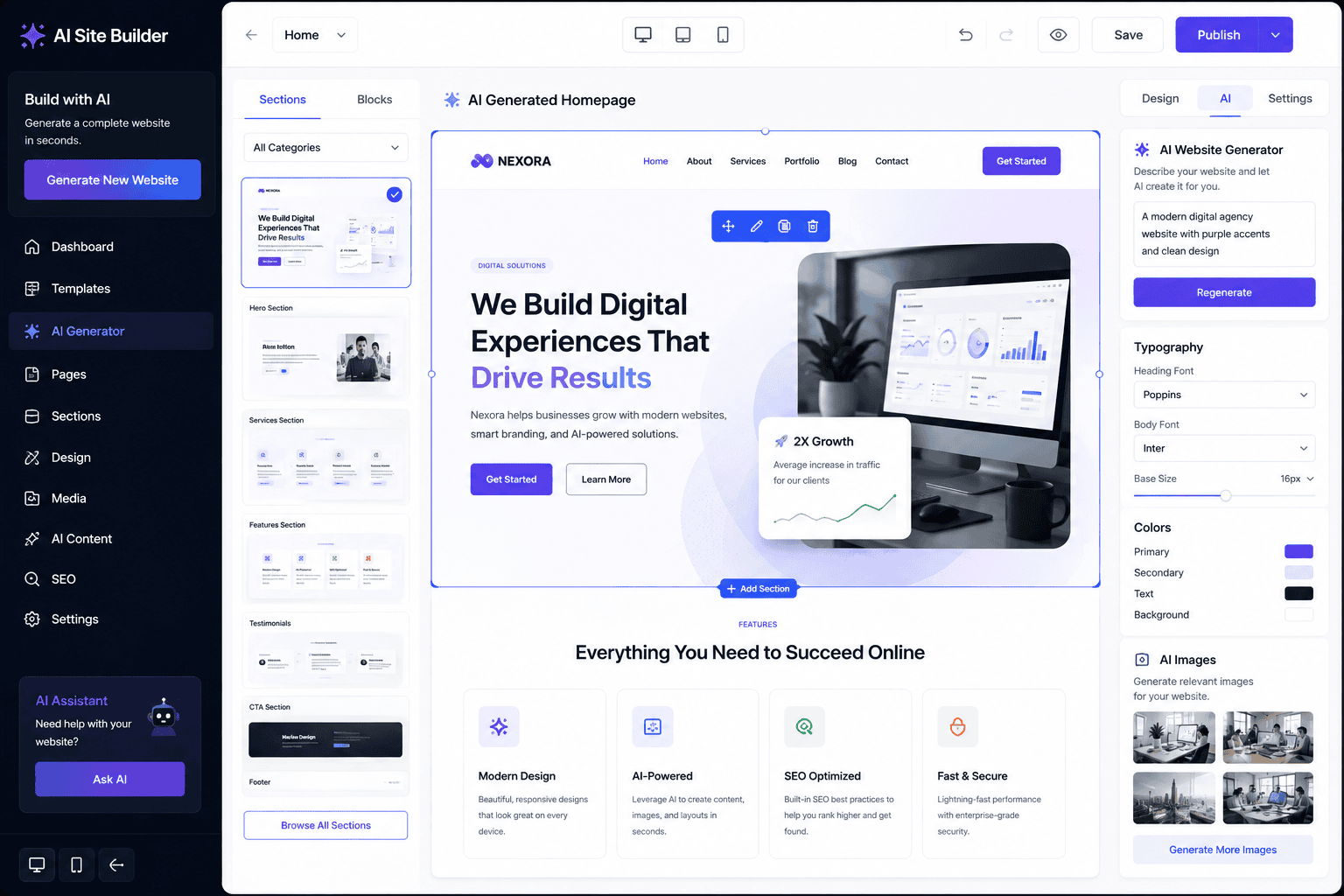
WordPress.com’s AI website builder currently allows users to describe the type of website they want and then generate an initial site with layouts, suggested images, content, and pre-filled sections. Users can continue modifying colors, text, sections, and layouts through prompts.
This changes the starting point.
Instead of beginning with a blank page, you can begin with a rough AI-generated foundation.
But customization is still important.
Your website should reflect your:
- Brand
- Audience
- Voice
- Services
- Content
- Navigation
- Visual identity
AI can create the foundation.
You create the final experience.
10. Use AI to Generate WordPress Code
Developers and advanced WordPress users can use AI for coding assistance.
AI can help with:
- HTML
- CSS
- PHP
- JavaScript
- WordPress hooks
- Shortcodes
- Custom functions
- Debugging
- Code explanations
For example, you could describe a simple WordPress feature and ask AI to suggest an implementation.
This can save time when researching syntax or trying to understand unfamiliar code.
But never assume AI-generated code is automatically safe.
Before adding code to a live website:
- Understand what it does.
- Review the code.
- Test it in a safe environment.
- Check compatibility.
- Back up the website.
- Monitor the result.
This is especially important for PHP and database-related code.
A small mistake can cause unexpected behavior or break a website.
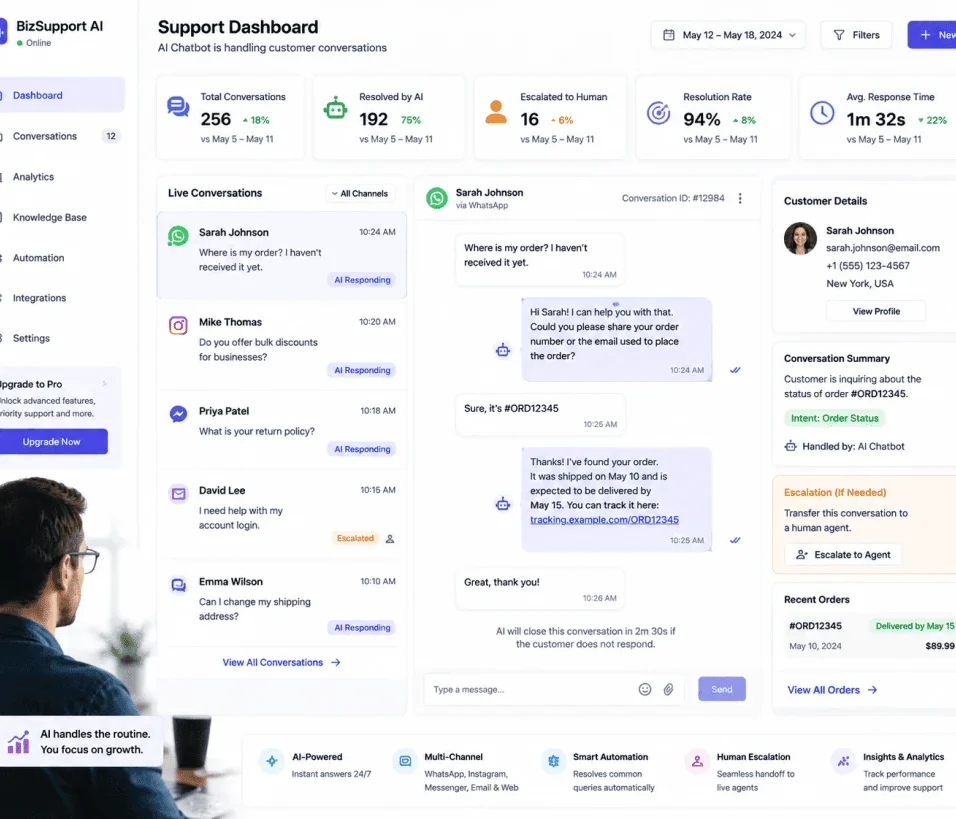
11. Add AI Chatbots to WordPress
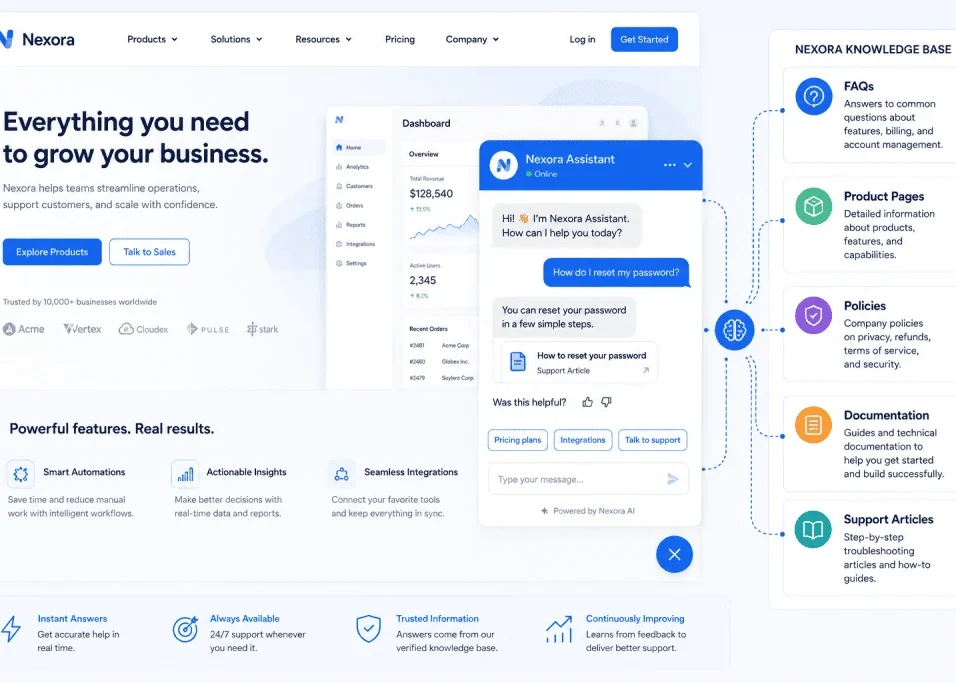
AI chatbots can provide automated assistance to website visitors.
For example, a visitor might ask:
What services do you provide?
The chatbot can provide an answer based on your website information.
Another visitor might ask:
How can I contact you?
The chatbot can explain the available contact options.
A chatbot can also help collect information such as:
- Name
- Service required
- Question
- Budget range
- Project type
The information can then be sent to a CRM or sales workflow.
But chatbot quality matters.
A chatbot that repeatedly says “I don’t understand” will damage the user experience.
Before deploying one, make sure it has access to reliable information and a clear way to transfer complicated questions to a human.
12. Use AI for Internal Linking
As your WordPress website grows, internal linking becomes more difficult to manage manually.
AI can help identify relationships between articles.
For example, an article about AI in WordPress might naturally connect to content about:
- AI tools
- AI automation
- AI chatbots
- Web design
- SEO
- Freelancing
- SaaS applications
The purpose of an internal link should be to help readers discover relevant information.
Do not insert links simply because two pages share a keyword.
The relationship between the pages should make sense.
A good internal linking structure can also help organize your website into clear topical areas.
13. Repurpose WordPress Content With AI
A long-form article can become multiple pieces of content.
For example:
WordPress article
↓
LinkedIn post
↓
Short social media posts
↓
Email newsletter
↓
Video script
↓
Podcast outline
↓
Short-form video ideas
AI can help transform one piece of content into multiple formats.
This is particularly useful for small teams.
Instead of researching and writing seven completely different pieces of content, you can create one comprehensive article and adapt the information for different channels.
The important part is to customize the content for each platform.
A LinkedIn post should not simply be a copied section of a blog article.
A video script should be written for spoken delivery.
An email should focus on the reader’s reason for opening the message.
AI can handle the first transformation, while you refine the final version.
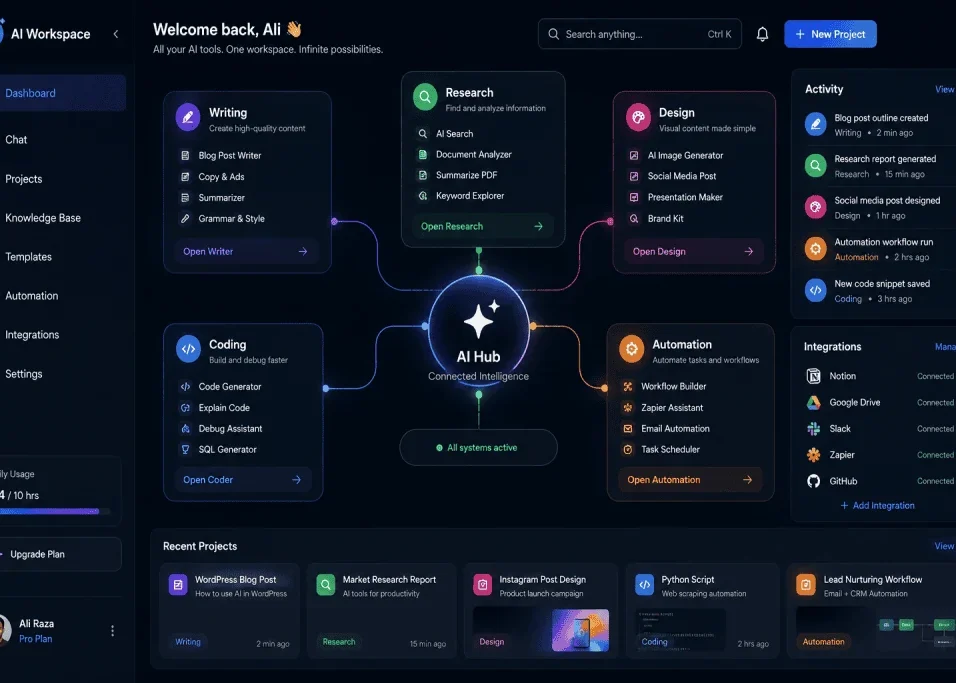
14. Automate Repetitive WordPress Workflows
AI becomes even more useful when combined with automation.
Consider this example:
New WordPress article published
↓
AI summarizes article
↓
AI creates social media drafts
↓
Drafts sent for review
↓
Approved posts scheduled
This workflow reduces repetitive work.
Another example:
New contact form submission
↓
AI identifies inquiry type
↓
CRM record created
↓
Notification sent
↓
Follow-up task created
The important distinction is:
AI is useful for interpretation.
Automation is useful for predictable actions.
Together, they can create powerful workflows.
15. Manage WordPress With AI Agents
One of the more interesting developments in AI and WordPress is the move toward AI agents that can interact with websites.
WordPress.com currently supports MCP, a protocol that allows external AI assistants to interact with supported WordPress.com websites. Depending on permissions and enabled tools, AI agents can retrieve information or perform actions involving content and other site functions.
WordPress.com also documents connections with ChatGPT that can be used to manage sites, create and edit content, manage comments, update media, and perform other tasks through natural-language instructions.
WordPress.com has also expanded AI-agent capabilities for creating and managing posts, pages, comments, categories, tags, and media metadata.
This represents an important change.
Instead of asking AI only:
“How do I change this?”
you can increasingly work toward:
“Make this change.”
That creates new possibilities for website management.
However, permissions and human oversight remain critical.
AI in WordPress for SEO
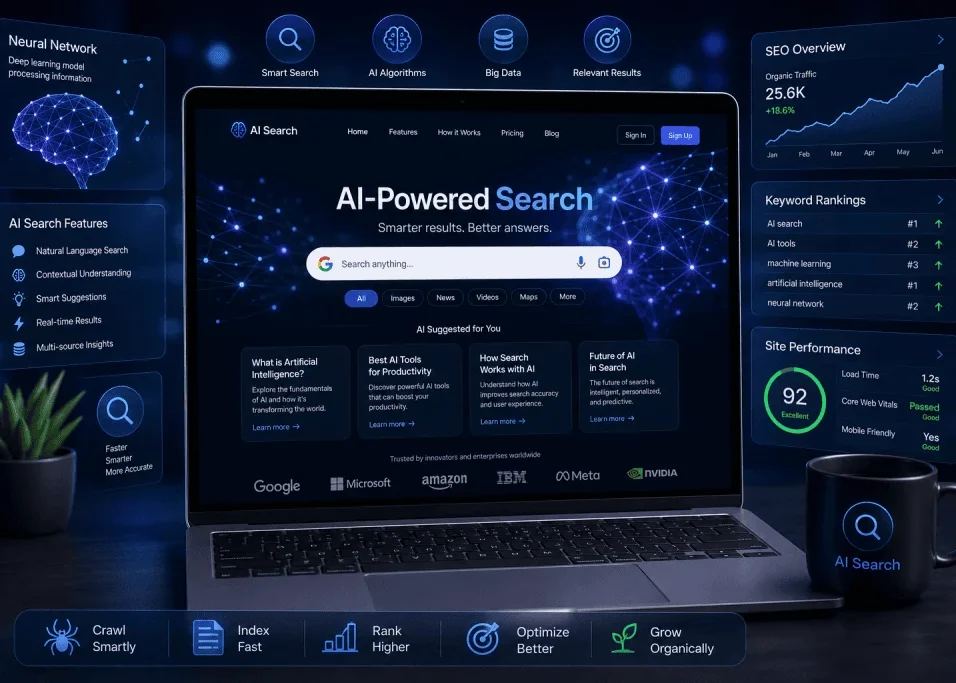
SEO is one of the strongest use cases for AI, but it is also one of the easiest areas to misuse.
AI can assist with:
- Topic clustering
- Keyword organization
- Search-intent analysis
- Article outlines
- Title ideas
- Meta descriptions
- FAQ ideas
- Internal-link suggestions
- Content updates
- Content gap analysis
A good SEO workflow could look like:
Keyword research
↓
Search intent
↓
Content outline
↓
AI-assisted draft
↓
Human editing
↓
Fact-checking
↓
On-page SEO
↓
Internal linking
↓
Publish
↓
Monitor performance
The mistake is assuming that generating more AI content automatically means generating more search traffic.
Quality matters.
Your article should answer the reader’s question better than simply repeating information that already exists elsewhere.
Should You Publish AI-Generated WordPress Articles?
AI can be used to create article drafts, but publishing raw AI output without review is not a strong content strategy.
A better process is:
Research
Understand the topic.
Outline
Create a logical structure.
Draft
Use AI where it saves time.
Add expertise
Include original examples, experience, and insights.
Fact-check
Verify important claims.
Edit
Improve tone, readability, and accuracy.
Optimize
Add useful headings, links, images, and metadata.
Publish
Only when the article is ready for readers.
Monitor
Review how the page performs and update it when necessary.
AI should help you produce better content, not merely more content.
AI for WordPress Ecommerce
AI can also help ecommerce websites.
For WooCommerce stores and other WordPress-based stores, possible applications include:
- Product descriptions
- Customer support
- Product recommendations
- Review analysis
- FAQ generation
- Email marketing
- Product categorization
- Promotional copy
Imagine a store with hundreds of customer reviews.
AI could categorize recurring comments into:
- Product quality
- Delivery
- Packaging
- Pricing
- Usability
- Customer service
The business can then investigate recurring issues.
AI becomes useful because it helps transform large amounts of unstructured information into organized insights.
AI for WordPress Freelancers
WordPress freelancers can use AI across the entire project lifecycle.
Before a project, AI can help turn a client’s requirements into a structured project plan.
During development, it can explain code, suggest solutions, and help troubleshoot problems.
For content projects, it can help generate drafts and content outlines.
For client communication, it can help prepare:
- Emails
- Proposals
- Meeting summaries
- Documentation
- Project updates
After launch, AI can help create support documentation and maintenance checklists.
The goal is not to let AI replace the freelancer.
The goal is to let the freelancer spend less time on repetitive work and more time on design, strategy, problem-solving, and client relationships.
AI for WordPress Agencies
Agencies can benefit even more because they often manage multiple websites.
An agency could build a workflow like:
Client request
↓
AI categorizes request
↓
Project-management task
↓
Team assignment
↓
Client notification
Another workflow could be:
Website update
↓
AI summarizes changes
↓
Report generated
↓
Human review
↓
Client report
The more standardized the agency’s processes become, the more opportunities there are to automate repetitive steps.
AI and WordPress Website Security
AI can introduce new capabilities, but security should never be ignored.
Before installing an AI plugin or connecting an AI service, investigate:
- Who developed it?
- How is it maintained?
- What permissions does it need?
- What information does it access?
- Where is data processed?
- Does it connect to external APIs?
- Is it compatible with your WordPress setup?
AI-generated code deserves particular attention.
Do not paste a code snippet into a production website simply because an AI assistant suggested it.
Understand the code and test it first.
For AI-agent integrations, permissions are equally important. WordPress.com’s MCP documentation explains that available actions are tied to user roles and configurable tool permissions.
That principle is important for any AI-powered website workflow:
Give an AI system only the access it actually needs.
AI and WordPress Performance
Website performance still matters.
Adding too many plugins, external scripts, API requests, or heavy assets can negatively affect a website.
Before adding an AI feature, ask:
What problem does this solve?
Does the benefit justify the additional complexity?
Will it affect page speed?
Does it need to run on every page?
You should also monitor your website after installing new functionality.
A useful AI feature is not worth much if it makes your website difficult to use.
Common Mistakes When Using AI in WordPress
Publishing Raw AI Content
AI output should be reviewed before publication.
Keyword Stuffing
Do not repeat the focus keyword unnaturally.
Installing Too Many AI Plugins
Every plugin adds maintenance considerations.
Trusting AI Facts Without Verification
AI can produce inaccurate information.
Using AI Code Without Testing
Generated code must be reviewed.
Ignoring Privacy
Know what data your AI tools receive.
Automating Everything
Some tasks still require human judgment.
Focusing on Quantity
Publishing more content does not automatically create a better website.
The goal should always be useful content and a good user experience.
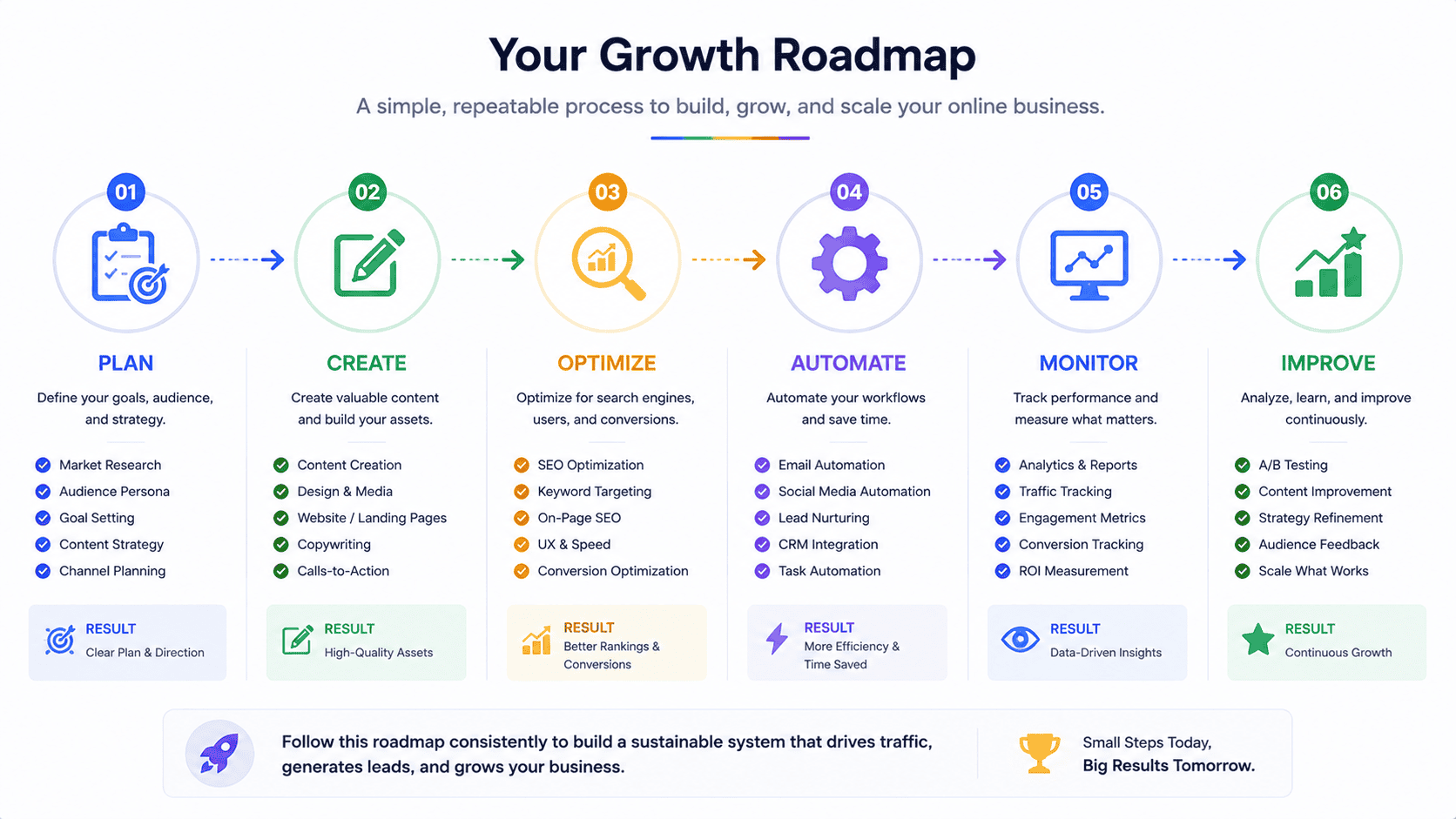
How to Start Using AI in WordPress
You do not need to transform your entire website overnight.
Start with one repetitive task.
For example:
Step 1: Identify something that takes too much time.
Step 2: Find an AI tool that can assist with it.
Step 3: Test it on a small task.
Step 4: Review the result.
Step 5: Measure whether it actually saves time.
Step 6: Improve the workflow.
Step 7: Automate it if appropriate.
This gradual approach is much safer than installing multiple AI plugins and creating complicated workflows immediately.
A Simple 30-Day AI WordPress Plan
Week 1: Content
Use AI for:
- Topic ideas
- Article outlines
- Title variations
- Meta descriptions
- Updating one old article
Focus on quality rather than volume.
Week 2: Design
Experiment with:
- Featured images
- Page layouts
- Visual concepts
- Calls to action
Keep your brand identity consistent.
Week 3: Automation
Choose one repetitive process.
For example:
Contact form → AI categorization → notification
Test it carefully.
Week 4: Optimization
Review:
- Time saved
- Content quality
- User experience
- Website performance
- Errors
- Costs
If the results are positive, expand the workflow.
The Future of AI in WordPress
AI is increasingly becoming part of the WordPress workflow rather than simply being a separate tool.
WordPress.com’s current AI website builder can create initial websites from prompts and then allow users to continue editing them through AI or manually.
The platform’s AI Assistant can work within the editing experience, helping users create and transform content.
AI agents are also gaining the ability to interact with WordPress websites through standardized interfaces such as MCP.
This could eventually change how website owners think about content management.
Instead of navigating through multiple menus for every small task, users may increasingly describe what they want in natural language.
For example:
“Create a new FAQ page using my existing website style.”
Or:
“Find articles about AI automation and add appropriate internal links.”
Or:
“Update the alt text for images that are missing descriptions.”
These workflows could make website management more accessible to non-technical users.
However, human judgment will remain important.
AI can assist with execution, but website owners still need to decide:
- What their audience needs
- What their brand represents
- Which information is accurate
- Which content deserves publication
- Which automation is appropriate
- What should remain under human control
Final Thoughts
AI in WordPress is much bigger than AI-generated blog posts.
It can help with:
- Content planning
- Article writing
- SEO
- Images
- Website design
- Coding
- Chatbots
- Internal linking
- Automation
- Ecommerce
- Analytics
- Website management
The smartest approach is not to automate everything.
Instead, identify repetitive tasks and use AI where it can provide genuine value.
Start small.
Test the workflow.
Review the result.
Then expand.
AI should help you save time while improving your website’s usefulness.
WordPress gives you the platform and flexibility.
AI gives you additional assistance.
Human judgment provides the quality control.
Together, these technologies can create a powerful workflow for bloggers, businesses, freelancers, agencies, and website owners.
The key principle is simple:
Use AI for efficiency.
Use WordPress for control.
Use humans for judgment.
Use data for improvement.
Frequently Asked Questions
What is AI in WordPress?
AI in WordPress means using artificial intelligence to help with website creation, content, SEO, design, coding, automation, customer support, and website management.
Can AI build a WordPress website?
Yes. WordPress.com currently provides an AI website builder that can generate an initial website from a user’s description and allow further customization through AI and manual editing.
Can AI write WordPress blog posts?
Yes. AI can create drafts, outlines, summaries, and other content. However, human review, editing, and fact-checking are important before publication.
Can AI improve WordPress SEO?
AI can assist with content planning, keyword organization, titles, meta descriptions, internal linking, content updates, and search-intent analysis.
Can AI create WordPress images?
Yes. AI image tools can generate graphics and other visuals. WordPress.com also documents AI-assisted image generation and image replacement within AI-created websites.
Can AI write WordPress code?
Yes. AI can assist with PHP, CSS, JavaScript, HTML, WordPress hooks, and debugging. Generated code should be reviewed and tested before being used on a live website.
Can I use an AI chatbot on WordPress?
Yes. AI chatbots can answer common questions, provide information, collect leads, and route complicated inquiries to humans.
Can AI automate WordPress?
Yes. AI can be combined with automation systems to classify information, generate content, process inquiries, and trigger other actions.
Is AI safe for WordPress?
AI does not automatically make a website safe or unsafe. Review plugins, permissions, integrations, data handling, and generated code carefully.
Can freelancers use AI with WordPress?
Yes. Freelancers can use AI for development, research, content, client communication, documentation, troubleshooting, and repetitive administrative tasks.