AI Search Optimization: A Practical Guide for Google AI Search
- by Muhammad Raza
- 0 Comments
- 16 minutes read
- 64 Views
AI search optimization helps you make website content easier for search engines and AI-powered experiences to understand, discover, and use as a useful source.
Google AI Overviews and AI Mode do not require a secret optimization trick or a separate SEO system. Strong foundational SEO still matters, including helpful content, clear structure, crawlability, relevant internal links, trustworthy sources, and good page experience.
This guide explains how to optimize content for AI-powered search while keeping it useful for people, including search intent, topic depth, original value, authorship, sources, technical SEO, visuals, internal linking, measurement, and common mistakes.
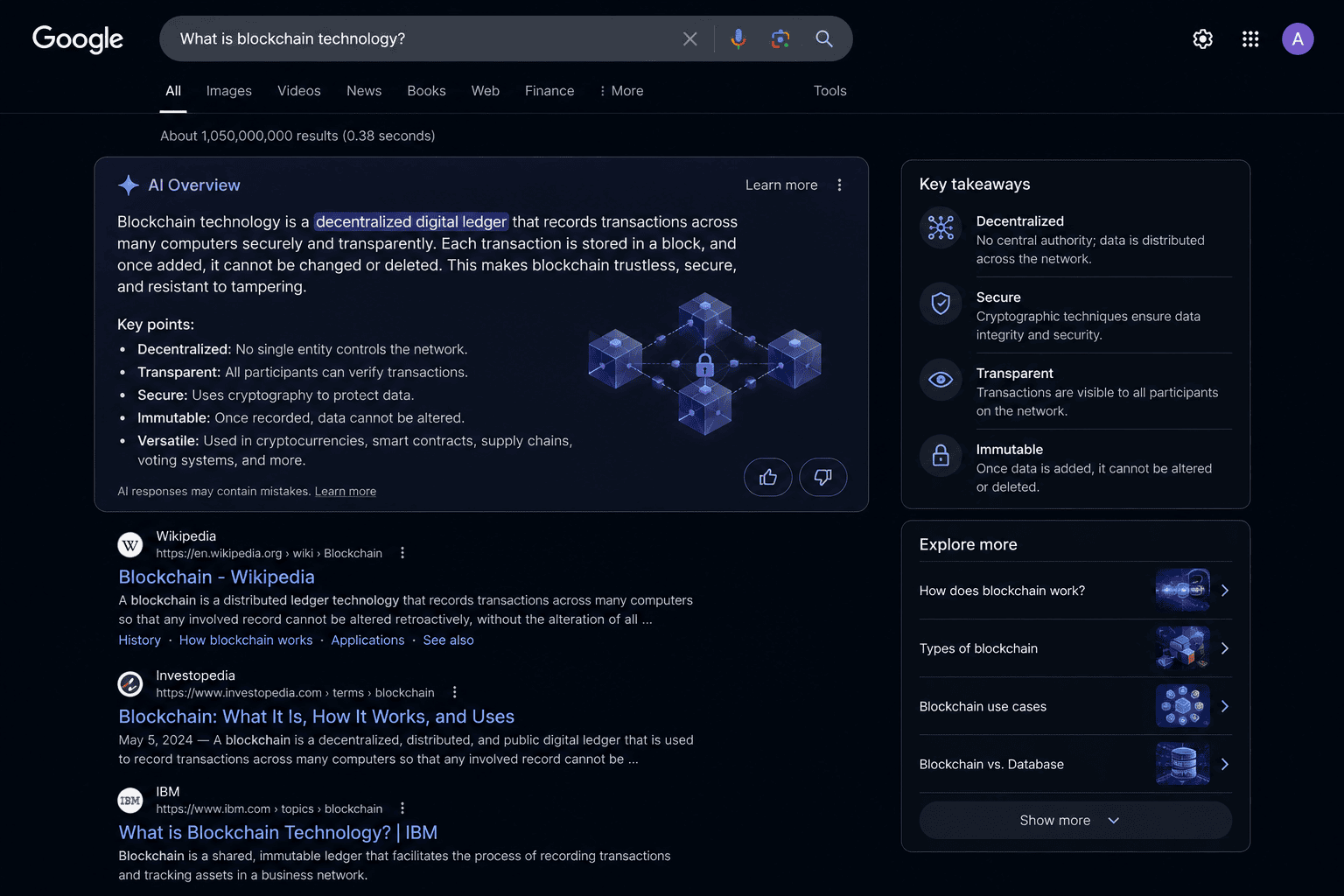
AI Mode is designed around more conversational and exploratory search experiences.
This can change the journey from:
Search → Click result → Read article
to something more like:
Question → AI-generated overview → Supporting sources → Deeper research
For publishers, this means the value of a page is not limited to its ability to rank for one exact keyword.
A page can potentially become useful because it contains a specific explanation, example, statistic, original perspective, comparison, image, video, or other information that helps answer a larger question.
Google’s current guidance emphasizes creating valuable, unique, non-commodity content for users rather than simply producing pages that repeat information already available elsewhere.
1. Start With Search Intent
Before writing an article, determine what the reader actually wants.
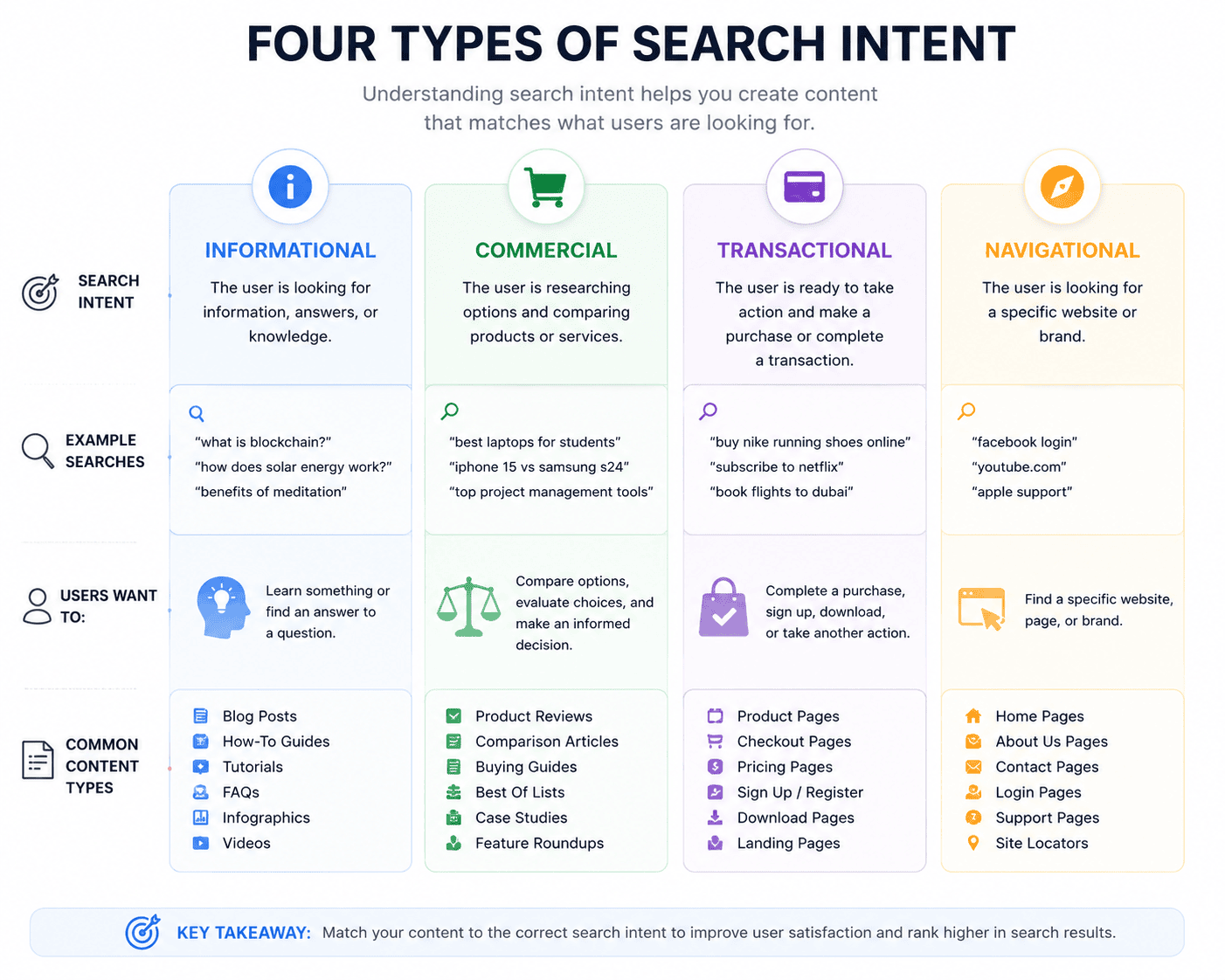
Search intent usually falls into broad categories such as:
Informational Intent
The user wants to learn something.
Example:
What is AI automation?
Commercial Investigation
The user is comparing options.
Example:
Best AI automation tools for small businesses
Transactional Intent
The user is close to taking an action.
Example:
Buy AI writing software
Navigational Intent
The user wants to find a particular website or service.
Example:
OpenAI ChatGPT
A strong article should match the user’s intent.
If someone searches for a beginner explanation, do not immediately give them a highly technical 5,000-word developer manual.
If someone wants a comparison, do not provide only a general definition.
Understanding intent is one of the most important foundations of AI search optimization.
2. Answer the Main Question Early
AI-powered search often involves users asking direct questions.
That makes clarity important.
Do not make readers scroll through ten paragraphs of background before explaining the central concept.
For example, if the question is:
What is AI search optimization?
answer it near the beginning.
Then expand.
A useful structure is:
Direct answer → Explanation → Examples → Practical steps → Mistakes → Advanced considerations → FAQs
This gives both humans and search systems a clear understanding of the page.
3. Build Topic Depth Instead of Creating Dozens of Thin Articles
Imagine you are writing about AI automation.
Instead of publishing:
- What is AI automation?
- AI automation definition
- AI automation meaning
- AI automation explained
- What does AI automation mean?
- AI automation basics
you could create one comprehensive guide that covers:
- Definition
- How it works
- Examples
- Benefits
- Limitations
- Tools
- Business applications
- Beginner setup
- Common mistakes
- Security considerations
- FAQs
That single resource can satisfy several related informational needs.
Google’s guidance emphasizes creating substantial, complete content and warns against producing many pages mainly to attract search-engine traffic.
Quality should come before quantity.
4. Add Original Value
This is one of the most important principles in modern SEO.
AI systems can summarize information that already exists across the web.
So why should your page be included?
You need to give users something valuable.
Original value can come from:
- First-hand experience
- Your own testing
- Original screenshots
- Unique examples
- Original data
- Case studies
- Expert commentary
- Practical workflows
- Comparisons
- Lessons learned
- Clear explanations
Google’s generative AI search guidance specifically recommends unique viewpoints and content that goes beyond simply restating information already available online.
This is especially important for websites publishing AI-related content.
If your article simply rewrites ten existing articles, it may not provide much additional value.
5. Demonstrate Who Created the Content
Trust matters.
Google’s people-first content guidance recommends making it clear who created content and encourages appropriate bylines and author information.
For a technology website, consider creating:
- Author profiles
- About page
- Editorial information
- Contact page
- Expertise descriptions
- Publication dates
- Updated dates when appropriate
An author profile does not magically improve rankings.
But it can help visitors understand who is behind the information.
This is particularly valuable for topics where accuracy matters.
6. Use Sources for Important Claims
When discussing:
- Statistics
- Regulations
- Security
- Financial information
- Technology specifications
- Scientific claims
- Current product capabilities
use trustworthy sources.
For example, Google itself is the appropriate primary source for explaining how Google Search features work.
Likewise, government agencies, official documentation, academic research, or established organizations may be appropriate sources depending on the subject.
Do not cite a random blog when an authoritative primary source is available.
And do not add citations simply to make an article look authoritative.
Each source should actually support the statement it follows.
7. Structure Articles With Useful Headings
Good structure benefits readers.
It also helps search systems understand the page.
Use a logical hierarchy.
For example:
Main Article Title
What Is AI Search Optimization?
Why AI Search Matters
How Google AI Search Works
AI Overviews
AI Mode
How to Optimize Your Content
Search Intent
Topic Depth
Original Value
This is much easier to understand than a wall of text.
Headings should describe what the section contains.
Avoid using headings simply because they contain keywords.
8. Use Images as Supporting Content
Google’s current guidance for generative AI search encourages website owners to support textual content with high-quality, relevant images and videos where appropriate.
Images should add value.
For example, an article about AI automation could include:
- Workflow diagrams
- Screenshots
- Tool interfaces
- Process illustrations
- Before-and-after examples
Do not add six unrelated stock images just because an article is supposed to contain six images.
Every visual should have a purpose.
9. Add Relevant Videos
Video can make complicated concepts easier to understand.
For an article about AI search optimization, a useful video could demonstrate:
- Google Search features
- SEO research
- Content structure
- Search Console workflows
- Website optimization
- AI search concepts
Google’s AI-search guidance specifically highlights the value of supporting textual content with high-quality images and videos for multimodal search experiences.
If embedding a third-party video, choose a relevant and trustworthy source.
Do not embed a video simply to satisfy an SEO checklist.
10. Improve Internal Linking
Internal links help readers discover related content.
They also provide context about relationships between pages.
Suppose you have articles about:
- AI Tools
- AI Automation
- AI Chatbots
- Web Design
- WordPress
- Freelancing
An article about AI search optimization could naturally connect to relevant content about AI tools or AI automation.
For example:
If you are building a content workflow, you may also want to explore our guide to AI automation tools.
The link should genuinely help the reader.
Avoid adding dozens of links simply to increase internal-link counts.
11. Optimize Your Title Without Making It Clickbait
Your SEO title should accurately describe the article.
A strong title:
AI Search Optimization: How to Get Found in Google AI Search
is better than:
THIS SECRET AI SEO TRICK WILL MAKE YOU #1 IN GOOGLE!
The second title makes a promise the article probably cannot guarantee.
Google’s people-first content guidance recommends descriptive, helpful titles and warns against exaggerated or shocking headings.
Honesty builds trust.
12. Write Better Meta Descriptions
A meta description should summarize the page and encourage a relevant click.
For this article:
Learn AI search optimization strategies to make website content more useful, discoverable, and ready for Google AI Overviews and AI Mode.
Notice that it:
- Explains the topic
- Includes the main concept
- Matches the page
- Avoids exaggerated promises
Do not promise:
“Guaranteed #1 Google ranking.”
There is no responsible way to guarantee that.
13. Optimize Images Properly
Image SEO is not just about adding alt text.
Consider:
- Relevant filenames
- Descriptive alt text
- Appropriate image dimensions
- Compression
- Modern formats
- Responsive display
- Context around images
For example:
Bad filename:
IMG_8292.jpg
Better:
ai-search-optimization-workflow.webp
Bad alt text:
image
Better:
AI search optimization workflow showing content research and technical SEO steps
The alt text should describe the image naturally.
Do not turn alt text into a keyword list.
14. Make Your Website Easy to Crawl
Excellent content cannot perform in Search if search engines cannot properly access it.
Google says pages appearing as supporting links in AI Overviews or AI Mode must meet the normal technical requirements for Google Search and be indexable. There are no separate technical requirements specifically for AI features.
Important technical areas include:
- Crawlability
- Indexability
- HTTP status
- Mobile usability
- Internal links
- XML sitemap
- Canonical URLs
- Robots directives
- Page performance
A WordPress website should also be monitored for technical issues such as accidental noindex settings or broken links.
15. Use Canonical URLs Correctly
A canonical URL helps indicate which version of a page should be treated as the preferred version when similar or duplicate URLs exist.
For example:
https://zynprint.com/ai-search-optimization/
should be used consistently as the preferred URL for this article.
Canonicalization is not an excuse to publish duplicate versions of the same article.
A clean URL structure is usually easier for users and search engines to understand.
16. Don’t Create AI Content at Scale Without Adding Value
This is especially important for an AI-focused website.
Using AI to assist with research, outlining, editing, or drafting does not automatically make content unacceptable.
Google’s guidance says generative AI can be useful for research and adding structure to original content, but generating many pages without adding value may violate its spam policies.
The difference is value.
Imagine two websites.
Website A
Publishes 500 AI-generated articles containing generic summaries.
Website B
Publishes 50 carefully researched articles containing:
- Original examples
- Screenshots
- Sources
- Expert commentary
- Practical workflows
- Relevant images
- Videos
- Clear authorship
Website B is following a much stronger people-first strategy.
More pages do not automatically mean more authority.
17. Use AI as an Assistant, Not as a Substitute for Expertise
AI tools can help with:
- Brainstorming
- Outlining
- Editing
- Summarizing research
- Finding content gaps
- Generating ideas
But human review remains important.
Before publishing, ask:
Is this factually correct?
Does this actually help the reader?
Is there anything original here?
Are the examples realistic?
Are the links trustworthy?
Does the article make unsupported claims?
Would I recommend this article to someone personally?
Google’s guidance encourages content creators to focus on accuracy, quality, and relevance, particularly when generative AI is involved.
18. Improve Content With First-Hand Experience
First-hand experience can make an article much more useful.
For example, instead of saying:
“This AI tool is easy to use.”
you could explain:
“The setup requires three main steps: connecting the account, creating the workflow, and testing the automation with a sample task.”
Even better, if you actually tested the tool, explain what happened.
For product or software content, you can include:
- Setup process
- Screenshots
- Strengths
- Limitations
- Problems encountered
- Actual use cases
- Who should use it
- Who should avoid it
Google’s current AI-search guidance specifically points to first-hand reviews and unique perspectives as examples of valuable content.
19. Think Beyond Keywords
Search systems have become much better at understanding language.
That means you do not need to create separate pages for every variation of a query.
For example, these might represent the same underlying topic:
- AI search optimization
- optimize for AI search
- SEO for AI search
- Google AI search optimization
- AI SEO strategy
- optimize content for AI Overviews
A comprehensive page can naturally address several of these concepts.
Google’s SEO Starter Guide explains that its language-matching systems can understand how pages relate to queries even when the exact query wording does not appear on the page.
Write for the topic.
Do not write for a spreadsheet of keywords.
20. Optimize for People Who Arrive From AI Search
Suppose a user clicks your page from an AI-generated search result.
What happens next?
If the visitor lands on a cluttered page with:
- Huge advertising blocks
- Autoplay videos
- Slow loading
- Tiny text
- No clear navigation
- Excessive pop-ups
they may leave.
Google emphasizes the importance of good page experience and making the main information easy to find.
Therefore, AI search optimization is also a user-experience problem.
The page should quickly communicate:
What is this article about?
Can it answer my question?
Where should I start?
AI Search Optimization vs Traditional SEO
| Traditional SEO Focus | AI Search Optimization Focus |
|---|---|
| Keywords | User questions and intent |
| Rankings | Visibility and useful discovery |
| Backlinks | Authority and trust |
| Text | Text + images + video |
| Exact queries | Topic understanding |
| Search snippets | Deeper exploration |
| Traffic | Meaningful visits |
| Content volume | Content quality |
| Generic information | Original value |
| Ranking tricks | People-first usefulness |
This does not mean traditional SEO is dead.
Google explicitly says foundational SEO practices remain relevant to AI search.
Think of AI search optimization as an extension of good SEO rather than a replacement.
Common AI Search Optimization Mistakes
Mistake 1: Writing Only for AI
Your audience is still people.
If an article is difficult for humans to read, optimization has gone too far.
Mistake 2: Publishing Hundreds of Similar Pages
More content is not automatically better.
Google warns against producing content at scale primarily to manipulate search rankings or AI responses.
Mistake 3: Copying Competitors
Rewriting another article with different wording does not necessarily create meaningful value.
Mistake 4: Keyword Stuffing
Repeating the same phrase makes content unnatural.
Mistake 5: Fake Expertise
Do not claim to have tested a product if you have not.
Mistake 6: Unsupported Claims
Avoid statements such as:
“This method guarantees Google AI visibility.”
There are no legitimate guarantees.
Mistake 7: Ignoring Technical SEO
A brilliant article still needs to be accessible and indexable.
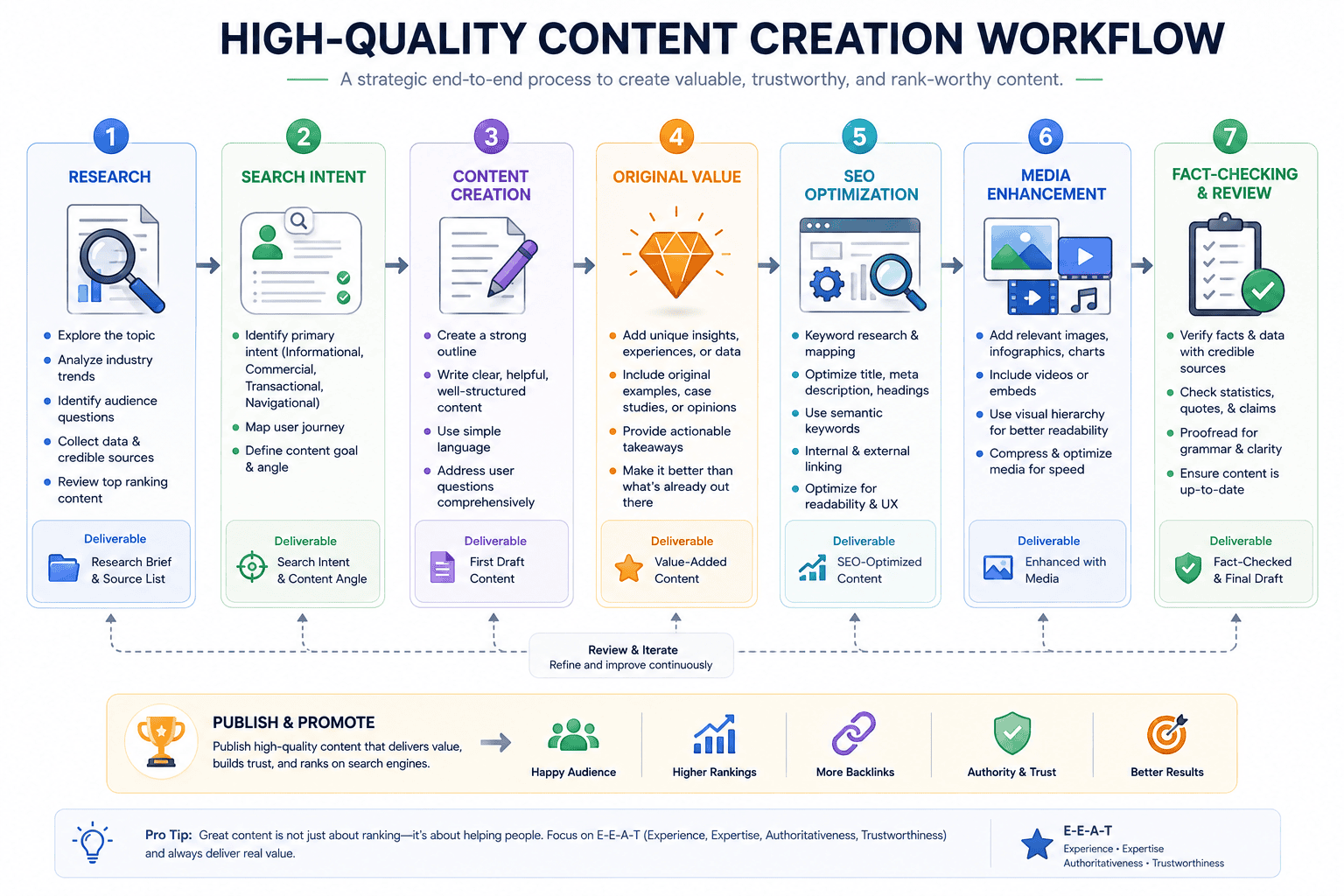
How to Create an AI-Ready Article
Here is a practical workflow you can use for future Zynprint articles.
Step 1: Select One Main Topic
Do not combine unrelated subjects.
Step 2: Identify the Search Intent
Understand what the reader wants.
Step 3: Research Reliable Sources
Use primary and authoritative sources whenever possible.
Step 4: Build a Comprehensive Outline
Cover the main question and important subtopics.
Step 5: Add Original Value
Include examples, experiences, comparisons, screenshots, or unique analysis.
Step 6: Write for Humans
Use simple language and logical structure.
Step 7: Optimize SEO
Add:
- Focus keyphrase
- SEO title
- Meta description
- Headings
- Internal links
- Descriptive URLs
- Image alt text
Step 8: Add Visuals
Use relevant images, diagrams, and videos where they improve understanding.
Step 9: Fact-Check
Verify important claims.
Step 10: Review Before Publishing
Ask whether the article genuinely satisfies the reader.
A Practical AI Search Content Framework
You can use this framework when planning future articles.
The ANSWER Framework
A — Answer the Main Question
Give readers the key answer quickly.
N — Narrow the Search Intent
Understand exactly what the audience needs.
S — Support Important Claims
Use trustworthy sources and evidence.
W — Write With Original Value
Add experience, examples, research, or analysis.
E — Enhance With Media
Use useful images, diagrams, and videos.
R — Review for Humans
Make sure the final page is clear, accurate, and satisfying.
This approach is more sustainable than trying to predict every possible AI-search query.
How AI Search Could Change Content Strategy
The rise of AI-powered search may encourage publishers to rethink how they organize content.
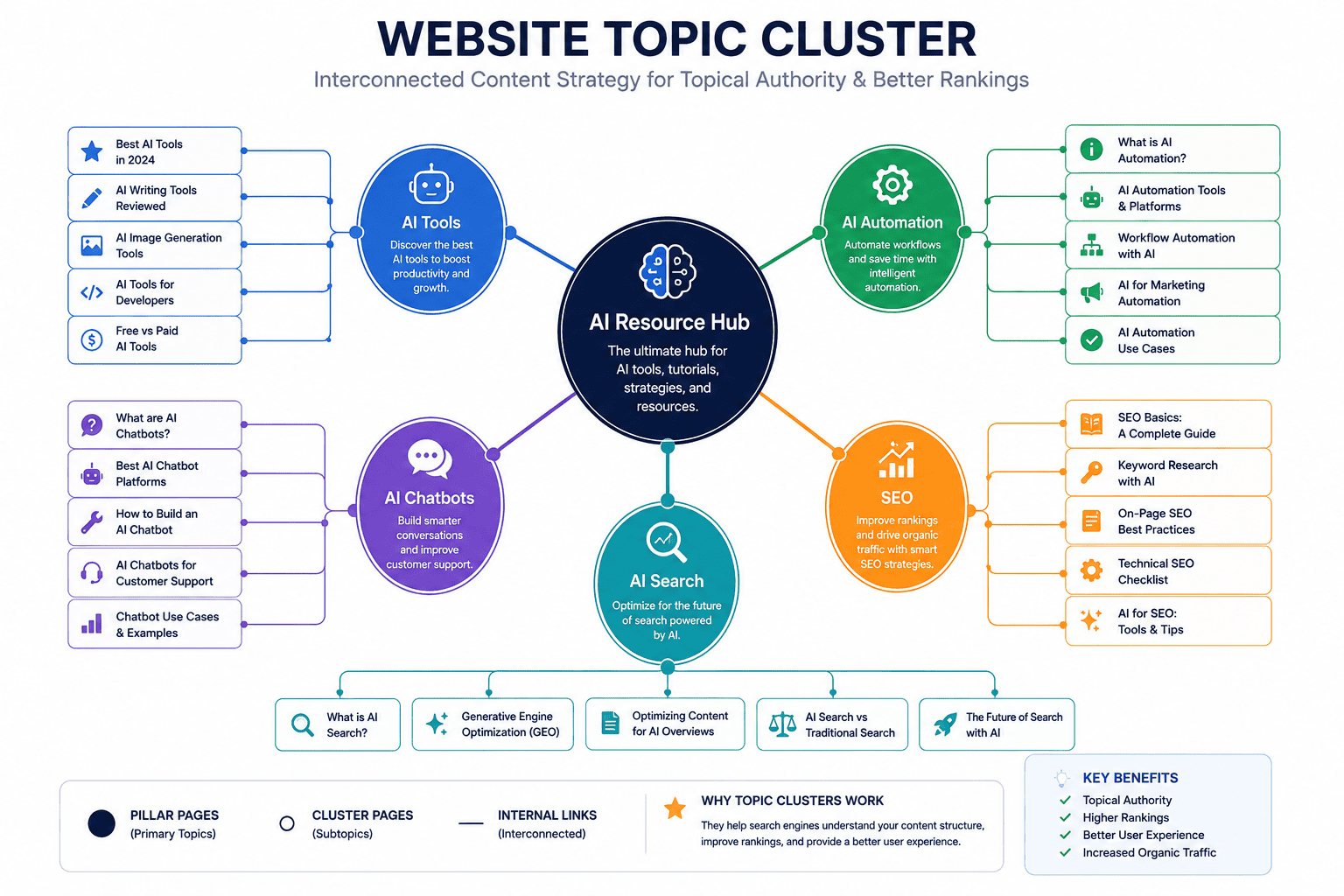
Instead of producing hundreds of short articles, a website might build a smaller number of strong topic hubs.
For example, Zynprint could eventually develop a comprehensive AI knowledge structure:
AI Tools
Individual tools and practical reviews.
AI Automation
Workflows and business automation.
AI Chatbots
Implementation, use cases, and comparisons.
AI New Inventions
Emerging developments and explanations.
Web Design
Website creation and user experience.
WordPress
WordPress tutorials and optimization.
Freelancing
Practical guides for independent professionals.
The goal is to make each category useful rather than simply filling it with posts.
Google’s people-first guidance asks whether a site has a primary purpose or focus and whether readers leave feeling they learned enough to achieve their goal.
That is a useful standard for content planning.
Should You Optimize Specifically for Google AI Overviews?
Yes—but not by abandoning traditional SEO.
Google’s official guidance is clear: there are no special technical requirements for AI Overviews or AI Mode beyond the normal requirements for appearing in Search.
So instead of searching for an “AI Overview hack,” focus on:
- Helpful content
- Original information
- Strong topical coverage
- Clear structure
- Good technical SEO
- Relevant images
- Useful videos
- Trustworthy sources
- Strong page experience
These fundamentals can benefit both traditional Search and AI-powered Search.
Does Schema Markup Help With AI Search?
Structured data can help search engines understand information on a page and may support eligibility for certain search features.
However, structured data should accurately represent visible page content.
Google’s AI-search guidance recommends ensuring structured data matches the visible content on the page and following applicable structured-data guidelines.
Do not add fake information to structured data.
For WordPress publishers, appropriate schema may include things such as:
- Article
- Breadcrumb
- Organization
- Person
- WebSite
depending on the page and implementation.
Schema is useful, but it cannot turn poor content into excellent content.
How Internal Topic Clusters Can Help
Imagine a visitor reads:What Is AI Search Optimization?They may then want to know:What are the best AI SEO tools?
Then:How does AI content generation work?
Then:How can I automate SEO research?
A well-organized website can connect these resources.This creates a journey.Instead of every article operating independently, the site becomes a knowledge system.
This is particularly valuable for technology websites because topics are interconnected.
For example:AI Tools → AI Automation → AI Chatbots → AI Search → SEOInternal linking can help users move through that knowledge structure.
How to Measure AI Search Success
Do not measure your content strategy only by total page views.
Consider:
- Organic traffic
- Search impressions
- Search clicks
- Engagement
- Returning visitors
- Time spent meaningfully consuming content
- Newsletter signups
- Contact requests
- Tool usage
- Downloads
- Conversions
Google’s guidance also encourages website owners to consider the broader value of visits rather than focusing only on clicks, particularly as AI search evolves.
A smaller number of highly engaged visitors may be more valuable than thousands of visitors who immediately leave.
Future of AI Search Optimization
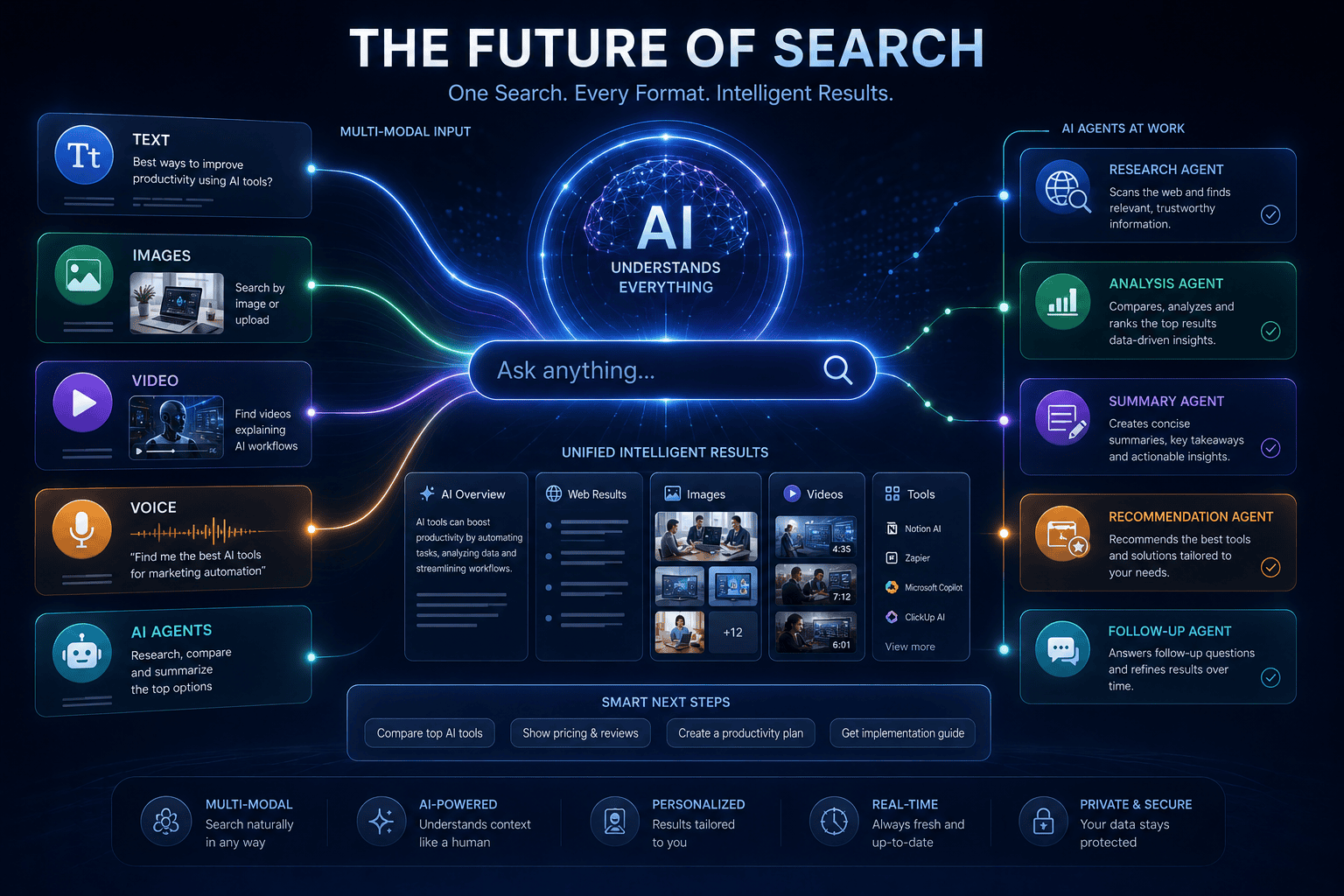
AI search will continue to evolve.Google has already published new guidance specifically addressing optimization for generative AI features and explains that traditional SEO remains foundational.Future search experiences may increasingly combine: Text Images Video Voice Conversational questions Personalized exploration AI agents Structured informationThis means websites should become more useful across formats.A page should not exist only because someone typed a keyword.It should exist because it solves a real information need.
Final Thoughts
AI search optimization is not about discovering a secret formula for appearing in AI-generated answers.
It is about becoming a genuinely useful source.
Google’s current guidance repeatedly points toward the same principle: create helpful, reliable, original, people-first content and maintain the technical foundations that allow search systems to access and understand it.
For website owners, that means:
- Understand your audience.
- Answer real questions.
- Create original content.
- Avoid unnecessary article duplication.
- Support important claims.
- Use clear headings.
- Add useful images and videos.
- Improve internal linking.
- Keep pages technically accessible.
- Make authorship and expertise understandable.
- Review AI-assisted content carefully.
- Focus on user satisfaction.
The biggest mistake would be to treat AI search as another keyword game.
Instead, think about the reason someone visits your website.
If they leave thinking:
“That answered my question.”
you are moving in the right direction.
If they leave thinking:
“I still need to search somewhere else to understand this.”
your content has more work to do.
That distinction is at the heart of sustainable SEO—and increasingly, AI search optimization.
Frequently Asked Questions
What is AI search optimization?
AI search optimization is the practice of creating useful, accessible, well-structured content that can be discovered and understood by AI-powered search experiences as well as traditional search engines.
Is AI search optimization different from SEO?
It is better understood as an extension of SEO. Google states that existing SEO fundamentals remain relevant for AI Overviews and AI Mode.
Can I guarantee that my article will appear in Google AI Overviews?
No. Meeting SEO best practices does not guarantee that Google will crawl, index, or display a page in AI features.
Does keyword stuffing help AI search?
No. Keyword stuffing creates poor user experiences. Focus on the topic, intent, useful terminology, and natural language instead.
Does AI-generated content automatically violate Google’s policies?
No. Google says generative AI can be useful for research and content creation, but generating many pages without adding value can violate spam policies.
Should I create a separate article for every AI search query?
Generally, no. Google specifically cautions against creating many pages for every possible query variation primarily to manipulate search rankings or AI responses.
Are images important for AI search?
Relevant, high-quality images can support content and help with multimodal discovery. Google recommends supporting textual content with useful images and videos where appropriate.
Does technical SEO still matter for AI search?
Yes. Google says pages need to meet the normal technical requirements for Search to be eligible as supporting links in AI Overviews or AI Mode.
What is the most important AI search optimization strategy?
Create genuinely useful, original, reliable, people-first content that satisfies the reader’s intent. Google identifies valuable, unique, non-commodity content as a key principle for generative AI search.