
Cryptocurrency Security Guide: How to Keep Your Crypto Wallet Safe
- by Muhammad Raza
- 0 Comments
- 15 minutes read
- 55 Views
This cryptocurrency security guide explains practical ways to protect your crypto, wallets, private keys, recovery phrases, devices, accounts, and transactions from common security risks.
Unlike traditional financial accounts, cryptocurrency often gives users more direct responsibility for protecting access to their assets. Losing a private key or recovery phrase, approving a malicious transaction, or sending funds to the wrong address can lead to permanent loss.
This guide covers practical cryptocurrency security best practices, including how to protect your crypto, secure wallets and recovery phrases, avoid phishing and scams, strengthen exchange accounts, verify transactions, and reduce the risk of unauthorized access.

The SEC recommends storing seed phrases securely and not sharing them with anyone.
Do not send your seed phrase through:
- Telegram
- Social media
- Cloud documents
- Online forms
- Screenshots
- Chat messages
Be especially suspicious if someone claims to be:
- Wallet support
- Exchange support
- A blockchain administrator
- A security expert
- A crypto recovery specialist
and asks for your recovery phrase.
Legitimate support should not need your private recovery phrase to “verify” ownership.
2. Understand the Difference Between Public and Private Information
Crypto users often see wallet addresses, public keys, private keys, and seed phrases and assume they are all equally sensitive.
They are not.
A public wallet address can generally be shared when you want someone to send assets to you.
A private key is different.
According to the SEC, a private key allows a user to authorize transactions, while a public key is used to help identify and receive assets.
A simple analogy is:
Public address = destination
Private key = authorization
Seed phrase = recovery access
You should treat private keys and seed phrases as highly sensitive information.
3. Use Strong Passwords for Exchange Accounts
If you use a centralized crypto exchange, protect the account with a strong and unique password.
Do not reuse the same password for:
- Banking
- Social media
- Crypto exchange
- Cloud storage
If one account is compromised, reused credentials can put other accounts at risk.
A strong password should be:
- Long
- Unique
- Difficult to guess
- Not based on personal information
A password manager can also help you create and store unique credentials.
The SEC’s current online-account security guidance recommends strong passphrases where available as part of protecting investment accounts.
4. Turn On Multi-Factor Authentication
Multi-factor authentication, commonly called MFA or 2FA, adds another security layer.
Instead of relying only on a password, your account may require another verification factor.
Depending on the service, this could involve:
- An authenticator application
- A security key
- A verification code
- Another approved authentication method
If someone discovers your password, MFA can provide an additional barrier.
For important crypto accounts, enable the strongest authentication options supported by the platform.
The SEC specifically recommends using strong passwords and multi-factor authentication for online crypto asset accounts.
5. Be Careful With Phishing Links
Phishing is one of the biggest risks facing online account users.
A scammer may send a message claiming:
“Your wallet is locked.”
“Your account needs verification.”
“Your transaction failed.”
“Connect your wallet to restore access.”
The message may include a link that looks legitimate.
The link could lead to a fake website designed to steal login credentials or trick you into approving a malicious transaction.
Never trust a link simply because:
- It has a familiar logo.
- The message uses professional language.
- The sender claims to be support.
- The website looks authentic.
- Other users appear to recommend it.
Instead, navigate to the official website yourself.
The FTC advises consumers not to click unexpected links in messages and warns about cryptocurrency-related scams.
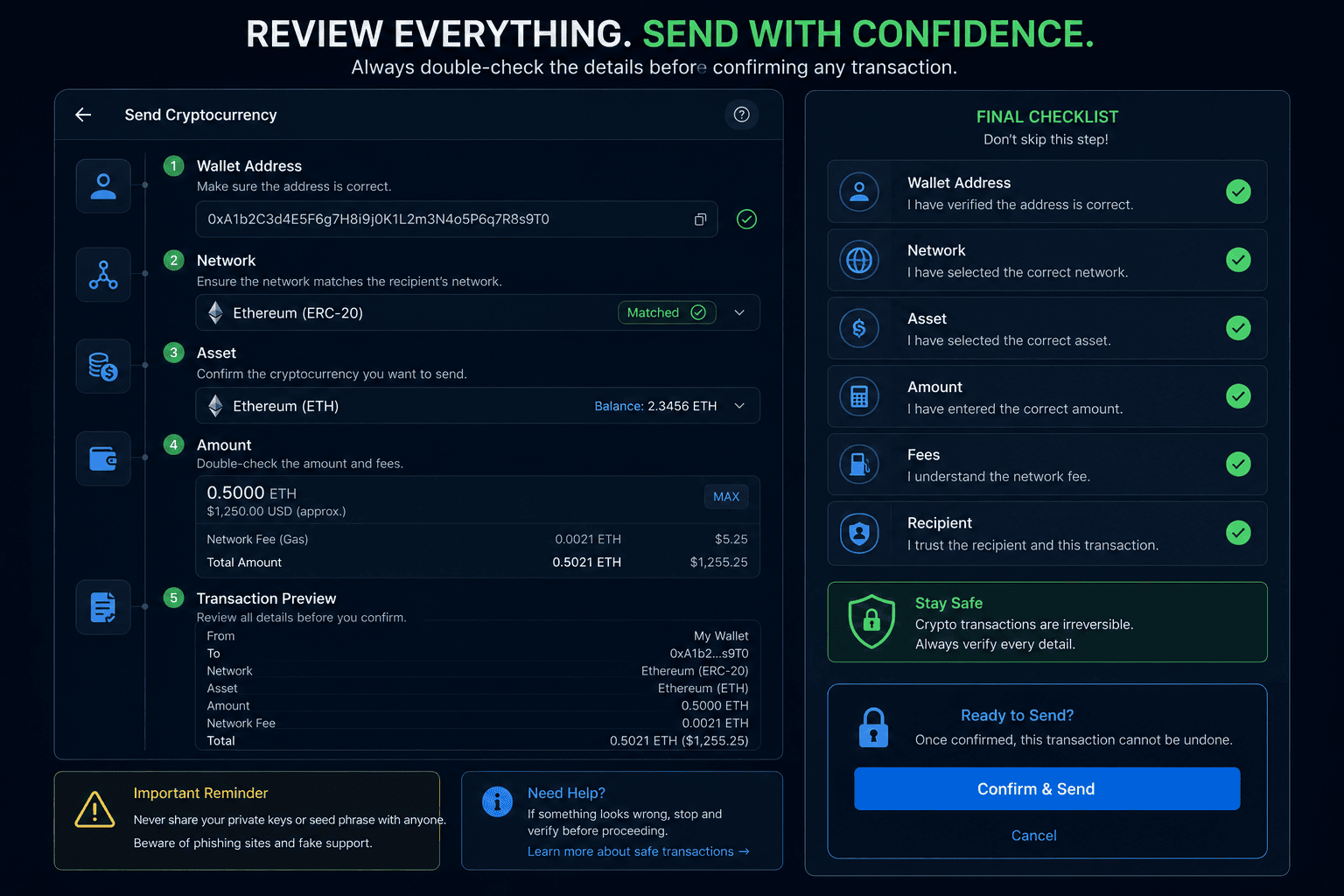
6. Verify Wallet Addresses Before Sending Crypto
A cryptocurrency transaction can go wrong simply because the wrong address was entered.
Before confirming a transaction, carefully check:
- Network
- Recipient address
- Asset
- Amount
- Transaction fee
- Destination
Do not assume that an address is correct just because the first few characters look familiar.
Some malware can manipulate copied wallet addresses.
A safer process is:
Copy address → paste address → verify address → verify network → verify amount → confirm
For larger transfers, consider making a small test transaction first when appropriate.
That extra step may take a little longer, but it can provide an additional opportunity to catch an error.
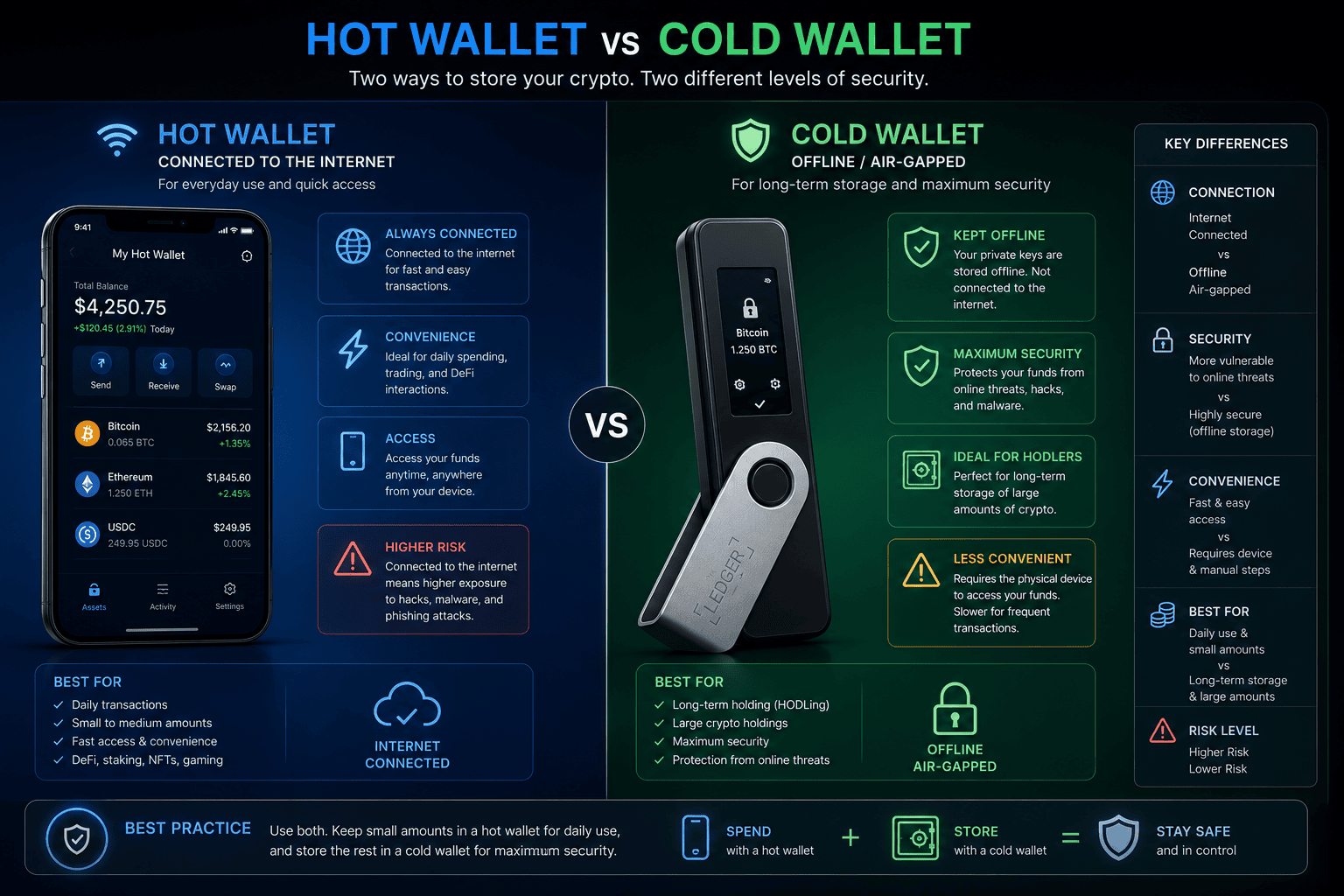
7. Understand Hot Wallets and Cold Wallets
The SEC distinguishes between hot and cold wallets.
A hot wallet is connected to the internet and can be convenient for transactions.
A cold wallet is generally kept offline, often through a physical device or another offline storage method. The SEC notes that cold wallets can reduce exposure to online cyberthreats, although they introduce other risks such as loss, damage, or theft of the physical device.
The choice depends on your situation.
For example:
Hot Wallet
Useful for:
- Frequent transactions
- Decentralized application interactions
- Smaller operational balances
Cold Storage
Often considered for:
- Longer-term holdings
- Reduced online exposure
- Users who understand self-custody
There is no universal solution.
The more important question is whether you understand how the chosen storage method works.
8. Do Not Trust Guaranteed Crypto Profits
One of the strongest scam warning signs is a guaranteed return.
Be skeptical of claims such as:
“Guaranteed 20% every week.”
“Zero-risk crypto investment.”
“Double your Bitcoin.”
“Guaranteed passive income.”
“Insider opportunity.”
The FTC warns that promises of guaranteed crypto profits are scam indicators.
Cryptocurrency markets can be extremely volatile.
No legitimate investment strategy can guarantee a specific return simply because someone says it will happen.
If someone promises enormous returns with little or no risk, stop and investigate before sending money.
9. Be Careful With Crypto Investment Groups
Online investment communities can appear convincing.
You may see:
- Telegram groups
- WhatsApp groups
- Discord servers
- Social media communities
- Private chat rooms
- “VIP” investment groups
Some may contain real discussions.
Others can be designed specifically to create trust before promoting fraudulent investments.
The SEC has warned that investment-related group chats can be used to lure people into scams and advises investors not to rely solely on investment advice from strangers in group chats.
Do your own research.
Do not assume that a person is trustworthy because:
- They post screenshots of profits.
- They have thousands of followers.
- They appear successful.
- Other accounts praise them.
- They claim to have insider information.
Social proof can be manufactured.
10. Never Pay a Stranger in Crypto to “Unlock” Your Money
A common scam involves someone claiming that you must pay an additional fee before receiving your money.
For example:
“Pay the tax first.”
“Pay the verification fee.”
“Send crypto to unlock the withdrawal.”
“Pay the security deposit.”
This can be a second-stage scam.
The victim has already sent money, and the scammer tries to extract more.
The FTC has warned that scammers often demand cryptocurrency because such payments can be difficult to recover.
If someone unexpectedly contacts you and demands crypto payment, stop.
Verify the claim independently.
11. Research Crypto Platforms Before Using Them
Before depositing money or crypto with a platform, investigate it.
Look for:
- Company information
- Official website
- Regulatory information where relevant
- Security practices
- Withdrawal policies
- Fees
- Reputation
- History
- Supported assets
- Customer support
- Geographic availability
Do not rely only on influencer promotions.
The SEC warns that investors should carefully research third-party crypto custodians and understand the risks associated with custody arrangements.
Also remember:
A professional-looking website does not prove that a company is legitimate.
Scammers can create impressive websites.
12. Keep Your Crypto Information Private
You do not need to publicly announce:
- How much crypto you own
- Where you store it
- Your wallet setup
- Your recovery process
- Your account balances
Sharing financial information can make you a more attractive target.
The SEC specifically advises crypto users to keep their crypto assets private and avoid sharing information about the amount or types of crypto assets they own.
Be careful with screenshots.
A screenshot of a wallet interface may accidentally reveal:
- Wallet addresses
- Balances
- Account names
- Transaction information
- QR codes
- Sensitive notifications
Think before posting.
13. Keep Devices and Software Updated
Cryptocurrency security is also device security.
Keep your:
- Smartphone
- Computer
- Browser
- Operating system
- Wallet application
- Security software
updated.
Updates can include important security fixes.
You should also avoid installing unknown applications simply because someone online recommends them.
A scammer might claim:
“Install this security app to protect your wallet.”
The application could instead compromise your device.
Only install software from trusted sources and verify that you are using the genuine application.
14. Separate Your Crypto Email From Everyday Accounts
For people who actively use cryptocurrency platforms, separating important accounts can reduce exposure.
For example, you might use one email address for:
- Newsletters
- Shopping
- Social media
and another carefully protected address for:
- Financial accounts
- Crypto services
- Important security notifications
This does not make an account invulnerable.
It simply reduces unnecessary exposure.
Your email account itself should have:
- Strong unique password
- MFA
- Recovery options
- Updated security settings
If someone gains access to your email, they may be able to target password-reset processes for other services.
15. Create a Crypto Security Routine
Security works best when it becomes a habit.
Create a simple checklist before every significant transaction.
Before Sending
Ask:
Am I using the correct website?
Is the wallet address correct?
Is the network correct?
Is the asset correct?
Is the amount correct?
Did I initiate this transaction?
Does anything seem unusual?
If something feels wrong, stop.
You do not have to complete a transaction immediately.
Scammers often create urgency because they want you to act before you have time to think.
Self-Custody vs Third-Party Custody
One of the major decisions crypto users face is whether to control their assets themselves or use a third-party custodian.
Self-Custody
With self-custody, you control the wallet credentials.
Advantages can include:
- Direct control
- No dependence on a third-party custodian for access
- Ability to interact directly with supported networks
But the responsibility is also significant.
If you lose access credentials, recovery may be difficult or impossible.
The SEC explains that self-custody places responsibility for managing and protecting private keys on the user.
Third-Party Custody
With third-party custody, a company manages the assets or access credentials on your behalf.
This may be more convenient for some users.
But it introduces counterparty considerations.
You should understand:
- Who controls the assets
- Withdrawal rules
- Fees
- Security policies
- Legal structure
- What happens if the provider experiences financial problems
The SEC has warned that crypto platforms may present risks that differ from traditional financial institutions and that users should carefully consider custody arrangements.
What Is a Seed Phrase and Why Is It So Important?
A seed phrase is a sequence of words generated by a crypto wallet that can be used to restore access to the wallet.
Think of it as a powerful recovery mechanism.
If your device breaks, a compatible wallet may allow you to restore access using the recovery phrase.
But that same capability creates a security risk.
Anyone who obtains the phrase may potentially be able to restore the wallet elsewhere.
The SEC recommends storing the seed phrase securely and never sharing it.
Never Store It Casually
Avoid storing it in:
- Public notes
- Social media
- Email drafts
- Cloud documents
- Screenshots
- Chat messages
The exact best storage method depends on your threat model and circumstances.
The key principle is:
Your recovery phrase should remain private and protected from unauthorized access, loss, and physical damage.
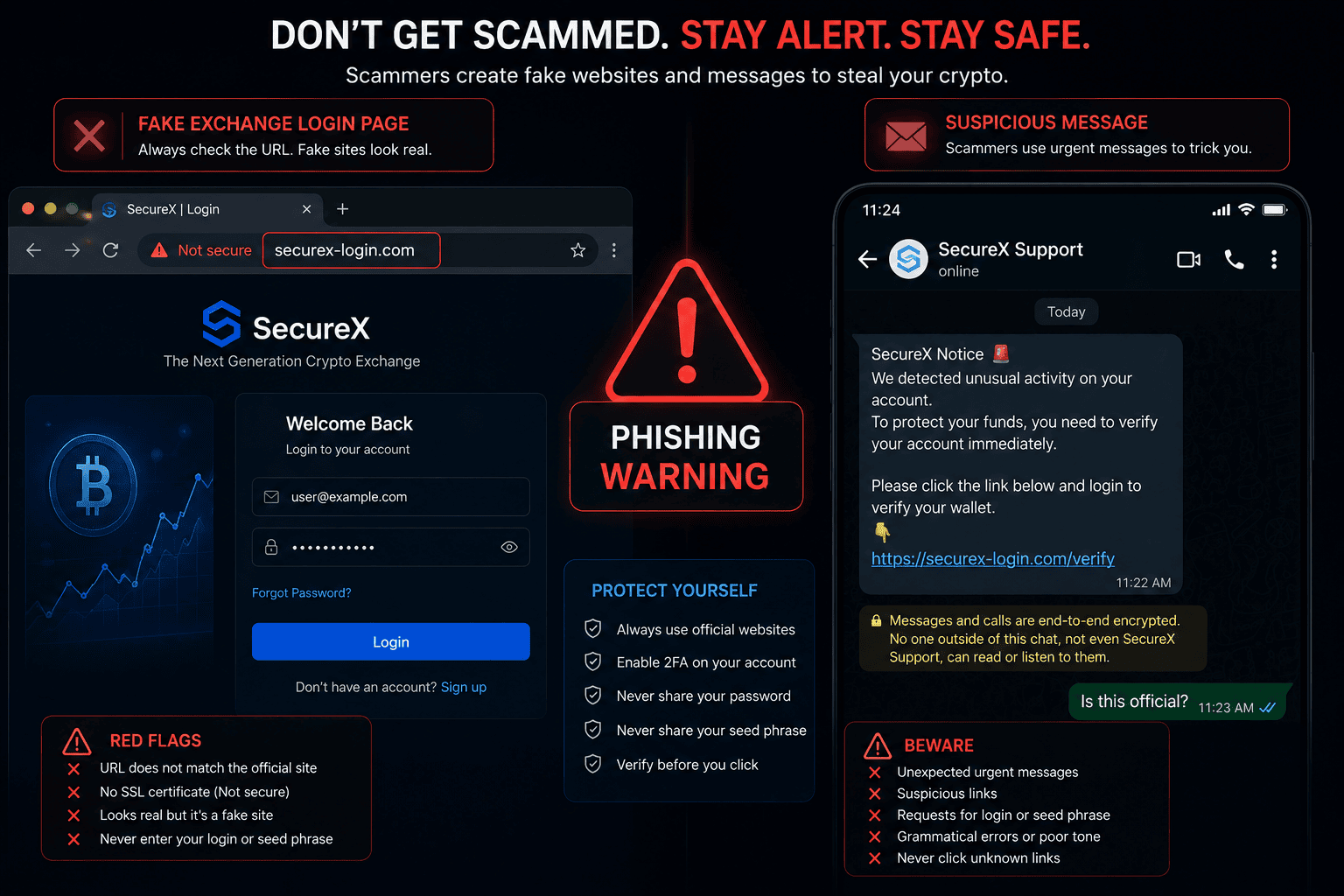
What Is a Crypto Phishing Scam?
A phishing scam attempts to trick you into providing information or approving an action.Crypto phishing can take several forms.
Fake Exchange Website
The website copies the appearance of a legitimate platform.
Fake Wallet Support
Someone contacts you claiming they can fix a wallet problem.
Fake Airdrop
You are promised free tokens but asked to connect a wallet or sign a suspicious transaction.
Fake Security Alert
You receive a message saying your wallet is at risk and must be “verified.”
Fake Customer Support
A scammer impersonates support through social media.
The FTC specifically warns consumers about unexpected cryptocurrency payment demands and other crypto scams.
How to Verify a Crypto Website
Before entering sensitive information:
Check the Domain
Look carefully at the website address.
Scammers may use domains that resemble legitimate websites.
Avoid Unexpected Links
Instead of clicking a message link, type the known website address yourself or use a trusted bookmark.
Check the Connection
A secure connection is useful, but HTTPS alone does not prove that a website is legitimate.
Scammers can also use HTTPS.
Check Official Sources
Verify announcements through official channels.
Be Suspicious of Urgency
Messages such as:
“Your account will be deleted in 10 minutes.”
should make you slow down rather than panic.
Why Cryptocurrency Scams Are So Dangerous
Crypto scams combine several psychological techniques.
Urgency
“Act now.”
Greed
“Earn guaranteed profits.”
Fear
“Your account will be closed.”
Authority
“I’m from support.”
Social Proof
“Thousands of people are investing.”
Trust
“We are a private investment community.”
The scammer’s objective is often to prevent you from stopping and verifying the situation.
Your strongest defense is simple:
Slow down.
Cryptocurrency Security for Beginners
If you are completely new to crypto, do not attempt to learn everything at once.
Start with five fundamentals:
1. Understand the Wallet
Know what the wallet does.
2. Understand the Recovery Phrase
Know why it is sensitive.
3. Learn Transactions
Understand addresses, networks, fees, and confirmations.
4. Learn Scam Patterns
Recognize fake support and guaranteed-return schemes.
5. Start Small
If you are learning how a new wallet or network works, avoid risking a large amount while experimenting.
Education should come before complexity.
Cryptocurrency Security for Experienced Users
Experienced users can also make mistakes.
In fact, greater activity can create more opportunities for errors.
If you regularly interact with decentralized applications, consider reviewing:
- Connected applications
- Token approvals
- Wallet permissions
- Browser extensions
- Hardware wallet settings
- Backup procedures
- Device security
- Transaction habits
Do not assume that experience makes you immune to phishing.
Scams become more sophisticated over time.
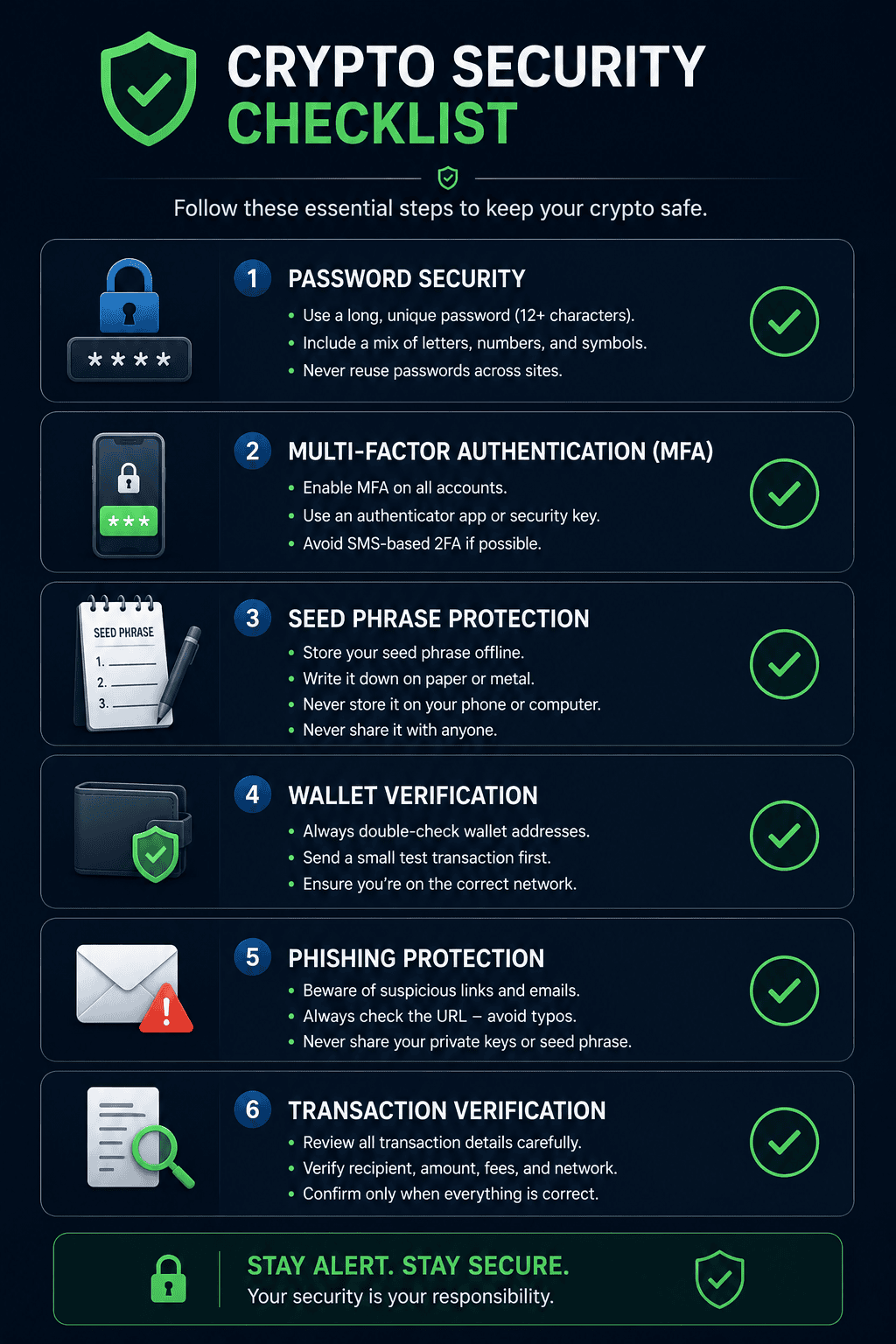
Crypto Security Checklist
Before making an important crypto transaction, run through this checklist.
Account
- Is my password unique?
- Is MFA enabled?
- Is my email secure?
Wallet
- Do I understand the wallet?
- Is my recovery phrase protected?
- Am I using the correct wallet application?
Website
- Is this the official website?
- Did I navigate there independently?
- Does anything look unusual?
Transaction
- Is the recipient address correct?
- Is the network correct?
- Is the asset correct?
- Is the amount correct?
- Have I reviewed the transaction details?
Scam Protection
- Did someone contact me unexpectedly?
- Am I being pressured?
- Is someone promising guaranteed returns?
- Am I being asked for a seed phrase?
- Am I being asked to pay crypto to unlock money?
If the answer to any of these raises concern, stop and investigate.
What To Do If You Think You Were Scammed
If you believe you have sent cryptocurrency to a scammer, act quickly.
Do not send additional money simply because the scammer says another payment will recover the first payment.
Save evidence such as:
- Transaction IDs
- Wallet addresses
- Emails
- Messages
- Website addresses
- Screenshots
- Payment details
Contact the relevant platform if appropriate.
Report suspected fraud to the appropriate authorities in your country.
In the United States, the FTC provides guidance for reporting cryptocurrency scams, while Investor.gov provides investor-fraud resources.
Be especially cautious of “crypto recovery” services that contact you after a scam.
Someone who promises to recover your funds for an upfront cryptocurrency payment may be attempting to scam you again.
Cryptocurrency Security and Regulation
Crypto regulations can differ significantly depending on:
- Country
- State or province
- Asset type
- Platform
- Activity
- Custody arrangement
A crypto asset can have different characteristics from another crypto asset.
The SEC notes that crypto assets can vary significantly in design and characteristics and may present different risks.
Do not assume that because one crypto product has a particular legal or regulatory treatment, every other crypto product has the same treatment.
If you are making a significant financial decision, consider obtaining advice from a qualified professional who understands the rules applicable to your location and circumstances.
Cryptocurrency Security Is About More Than Hacking
When people hear “crypto security,” they often think about hackers.
But many losses can result from simpler problems:
- Sending to the wrong address
- Falling for phishing
- Losing a recovery phrase
- Using a fake website
- Trusting fake support
- Approving an unintended transaction
- Sharing too much information
- Using weak passwords
- Ignoring suspicious messages
This is why security education matters.
You do not need to be a cybersecurity expert to develop safer habits.
You need a repeatable process.
The Future of Cryptocurrency Security
As cryptocurrency ecosystems evolve, security practices will continue to change.
Wallets, authentication systems, hardware devices, smart contracts, decentralized applications, and transaction interfaces can all introduce different risks.
AI is also changing the security landscape.
AI can help scammers create more convincing:
- Messages
- Websites
- Social profiles
- Voice impersonations
- Customer-support conversations
That means users should not judge legitimacy based only on writing quality.
A perfectly written message can still be fraudulent.
At the same time, AI can potentially help users identify suspicious patterns and improve security workflows.
The important principle is that technology does not eliminate the need for verification.
It makes verification more important.
Final Thoughts
Cryptocurrency security starts with responsibility.Whether you use a hot wallet, cold wallet, exchange account, or another custody method, you need to understand what controls access to your assets.Protect your recovery phrase.Protect your private keys.Use strong passwords.Enable multi-factor authentication.Verify websites.Check wallet addresses.Be suspicious of guaranteed profits.Do not trust unsolicited support messages.Do not let strangers pressure you into sending cryptocurrency.The SEC's current guidance emphasizes careful selection of custodians, protection of private keys and seed phrases, strong passwords, MFA, and awareness of phishing.The FTC likewise warns that cryptocurrency scams often involve promises of guaranteed returns, impersonation, unexpected payment demands, and other tactics designed to make victims send funds that may be difficult to recover.The most important habit is therefore simple:Stop. Verify. Then act.When money is involved, taking an extra minute to confirm a website, wallet address, transaction, or investment opportunity can be far more valuable than rushing to complete it.
Frequently Asked Questions
What is cryptocurrency security?
Cryptocurrency security is the practice of protecting crypto assets, wallets, private keys, recovery phrases, accounts, devices, and transactions from theft, fraud, unauthorized access, and accidental loss.
What is the most important cryptocurrency security rule?
Never share your private key or seed phrase. The SEC specifically recommends protecting seed phrases and not sharing them.
Is cryptocurrency safe?
Cryptocurrency involves significant risks, including market volatility, scams, hacking, technical problems, and custody risks. Security practices can reduce some risks but cannot eliminate all risks.
What is a seed phrase?
A seed phrase is a sequence of words that can allow a crypto wallet to be restored. It should be kept private and securely stored.
Should I use a hot or cold wallet?
That depends on your needs. Hot wallets provide convenience but are connected to the internet. Cold wallets can reduce online exposure but introduce physical-loss and recovery risks.
Can someone steal crypto with my wallet address?
A public wallet address is generally used to receive assets and is not equivalent to a private key. However, wallet activity can be publicly visible on many blockchains, so users should still consider their privacy.
Can crypto transactions be reversed?
Many cryptocurrency transactions are designed to be final once confirmed. This is why checking the recipient address, network, and amount before approving a transaction is extremely important.
Are guaranteed crypto profits legitimate?
Guaranteed crypto profits should be treated as a major warning sign. The FTC specifically warns about scams promising guaranteed returns.
Should I give my seed phrase to customer support?
No. Never share your seed phrase simply because someone claims to be customer support.
What should I do if I clicked a suspicious crypto link?
Stop interacting with the website, do not provide additional credentials or approve transactions, and secure affected accounts. If you believe funds were compromised, document the incident and contact the relevant service and appropriate fraud-reporting authorities.