

Freelance Retainer Business: A Practical Guide to Recurring Income
- by Muhammad Raza
- 0 Comments
- 17 minutes read
- 54 Views
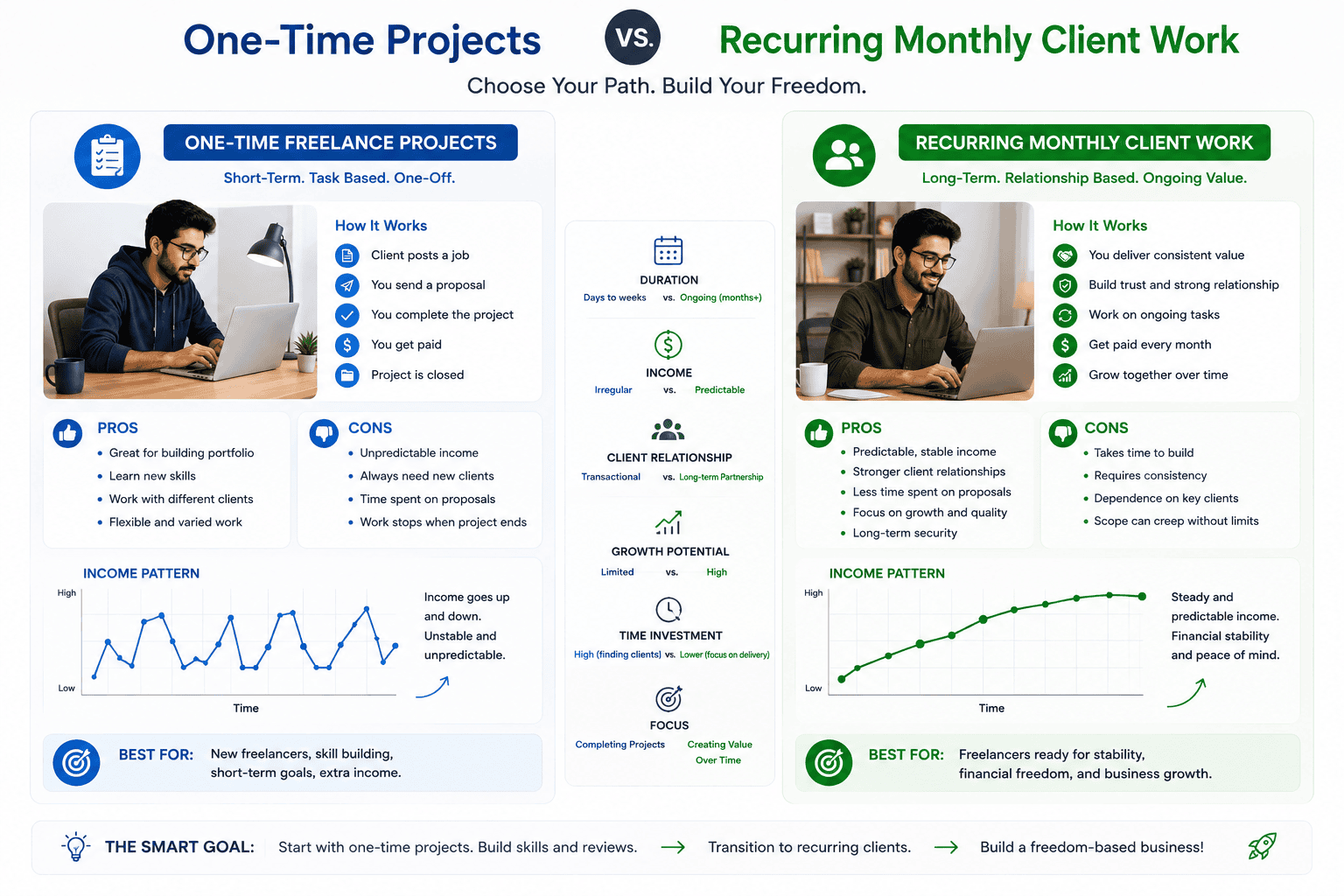
Building a freelance retainer business can help you move from unpredictable project-by-project work toward recurring client relationships and more predictable monthly revenue.
A strong retainer defines the service, deliverables, limits, pricing, communication process, and payment terms before recurring work begins. It should solve a genuine ongoing client need without turning into unlimited work.
This guide explains how to choose retainer-friendly services, create monthly packages, price your offer, convert suitable clients, control scope creep, manage recurring workflows, and build a sustainable freelance retainer model.
Which Freelance Services Work Well as Retainers?
Not every freelance service is suitable for a retainer.
The strongest candidates are services where the client has an ongoing need.
Content Writing
Businesses constantly need fresh content.
A retainer might include:
- Blog articles
- Content briefs
- SEO updates
- Product content
- Website copy
- Editing
For example:
Eight articles per month plus two content refreshes.
The scope should be clearly defined.
Social Media Management
Social media requires recurring activity.
A monthly package could include:
- Content planning
- Post creation
- Captions
- Scheduling
- Basic reporting
The exact number of posts and platforms should be specified.
Graphic Design
Businesses regularly need marketing materials.
A retainer could provide:
- Social media graphics
- Advertisements
- Presentation slides
- Promotional banners
- Marketing assets
Avoid promising unlimited design work.
Instead, define the monthly capacity.
Video Editing
Creators and companies may need video editing every week.
A package could include:
- Four long-form videos
- Eight short-form videos
- Captions
- Basic motion graphics
Again, specify what counts as one deliverable.
Website Maintenance
Websites require ongoing attention.
A WordPress maintenance retainer could include:
- Updates
- Backups
- Basic troubleshooting
- Security checks
- Small content changes
- Technical support
The freelancer should clearly distinguish maintenance from major development work.
SEO Services
SEO is often an ongoing activity rather than a single task.
A retainer could include:
- Keyword research
- Content planning
- On-page optimization
- Content updates
- Internal linking
- Technical recommendations
- Monthly reporting
However, avoid guaranteeing specific rankings or traffic results.
The Most Important Rule: Define Scope
One of the biggest risks in a freelance retainer business is scope creep.
Scope creep happens when a client gradually asks for more work without a corresponding adjustment in the agreement.
For example, you agree to provide:
Four blog articles per month.
The client later asks for:
Four articles, social media captions, email newsletters, website updates, competitor research, and graphic designs.
If all of that is included under the original price, the retainer can become unprofitable.
A clear scope protects both parties.

Create Deliverable Limits
Instead of saying:
Monthly content support.
say:
Four SEO articles of up to 2,500 words each per calendar month.
Instead of:
Website support.
say:
Up to five minor content or layout changes per month, excluding new page development and custom coding.
Instead of:
Graphic design support.
say:
Up to ten standard social media graphics per month.
Specificity makes the agreement easier to manage.
Consider Time-Based Retainers Carefully
Some freelancers sell a certain number of hours every month.
For example:
Ten hours of consulting support per month.
This can work well when client requirements vary.
However, track the time accurately.
If the client repeatedly uses more than the agreed hours, you need a process for handling additional work.
You could establish:
- Additional hourly billing
- An upgraded monthly package
- A separate project quotation
Do not quietly absorb unlimited additional hours.
Create Three Retainer Packages
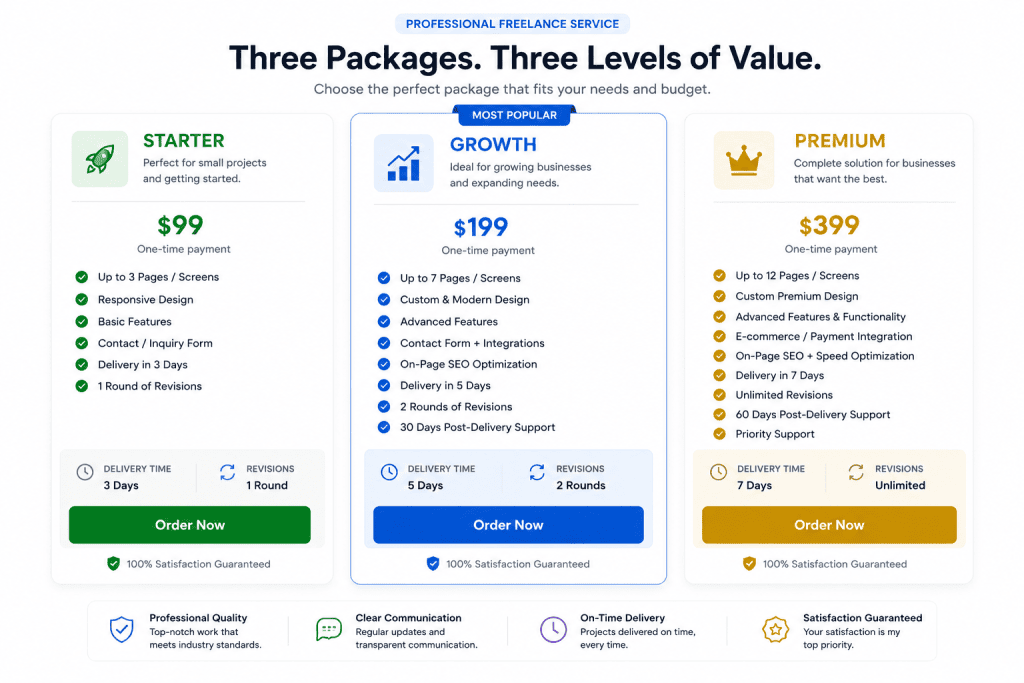
Packages can simplify your offer.
For example, a content writer could create:
Starter
Four articles per month.
Growth
Eight articles per month plus content updates.
Premium
Twelve articles plus strategy support and content optimization.
The numbers are examples only.
Your actual packages should be based on your capacity, expertise, production time, and target market.
Packages also allow clients to choose a service level instead of asking you to customize every small requirement.
Calculate Your Retainer Price
Pricing should begin with your actual workload.
Suppose you want to earn a certain monthly amount from your freelance business.
You need to account for:
- Production time
- Communication
- Meetings
- Research
- Revisions
- Administrative work
- Software
- Taxes
- Platform fees where applicable
- Business expenses
- Downtime
For example, imagine a retainer requires approximately 20 hours of actual work every month.
You should not price it as if every hour spent on the client is your only business cost.
There is also time spent running the business.
A simple calculation is:
Estimated monthly workload × sustainable hourly value = baseline service value
Then adjust based on:
- Expertise
- Complexity
- Client value
- Urgency
- Responsibility
- Included deliverables
This is more sustainable than randomly choosing a low monthly price.
Don’t Sell Unlimited Revisions
Unlimited revisions sound attractive to clients but can create serious problems for freelancers.
Imagine a client pays for four articles but requests:
- First revision
- Second revision
- Third revision
- Complete restructuring
- New research
- Different angle
- New introduction
- New conclusion
The original project can consume far more time than expected.
Instead, define a reasonable revision policy.
For example:
Each monthly deliverable includes up to two reasonable revision rounds.
You can define what constitutes a revision and what constitutes a new assignment.
Decide Whether Unused Work Rolls Over
Suppose a client has five design requests available during a month but uses only two.
What happens to the remaining three?
There are different ways to handle this.
You could specify:
- Unused deliverables expire monthly.
- A limited number can roll over.
- Hours expire at the end of each billing period.
- Unused capacity can be carried forward for one month.
There is no universal rule.
The important part is communicating it clearly before the retainer starts.
How to Convert Existing Clients Into Retainers
Your existing clients are often the first people to consider for a retainer.
Why?
Because they already know your work.
You already understand their business.
You have already established communication.
And you have evidence that you can deliver.
Look at previous clients and ask:
Does this client have a recurring problem that I can solve every month?
For example, if you built a website for a business, they may later need:
- Website updates
- Maintenance
- Landing pages
- Blog publishing
- SEO improvements
That can create an opportunity for ongoing work.
Don’t Force a Retainer on Every Client
A retainer only makes sense when there is recurring value.
If the client has no continuing need, forcing a monthly agreement can make the relationship unnecessarily complicated.
A good retainer solves a recurring problem.
It should not exist simply because the freelancer wants recurring payments.
Think from the client’s perspective.
Ask:
What problem will continue to exist next month?
If you can answer that question, you may have a potential retainer service.
Start the Retainer Conversation Naturally
You do not need a complicated sales pitch.
You can explain the recurring need.
For example:
We’ve completed the initial website work, but there are several areas that could benefit from ongoing monthly updates. Instead of handling each request separately, I can provide a monthly support package that covers routine updates and minor improvements.
This frames the retainer around a business need.
Show the Client the Value of Continuity
A client may ask:
Why should I pay every month?
Explain what ongoing support provides.
It might offer:
- Faster response
- Consistent output
- Familiarity with the business
- Predictable workload
- Regular maintenance
- Ongoing optimization
- Priority support
Do not promise benefits you cannot actually provide.
The value should be based on the service you deliver.
Create a Simple Retainer Proposal
Your proposal should be easy to understand.
Include:
Service Overview
What you will provide.
Deliverables
Exactly what the client receives.
Frequency
Weekly, monthly, or another agreed schedule.
Timeline
When work will be delivered.
Communication
How the client can submit requests.
Revisions
What is included.
Price
The recurring fee.
Additional Work
How work outside the scope is handled.
Cancellation
How either party can end the arrangement.
Payment
When and how payment is due.
A written agreement can prevent misunderstandings.
Use a Request System
Retainer clients may send requests through email, messaging apps, project management software, or other systems.
Choose a method that keeps work organized.
For example, a design retainer could use a simple request format:
Request title
Objective
Required assets
Deadline
Reference examples
This prevents important information from being scattered across conversations.
Set a Monthly Workflow
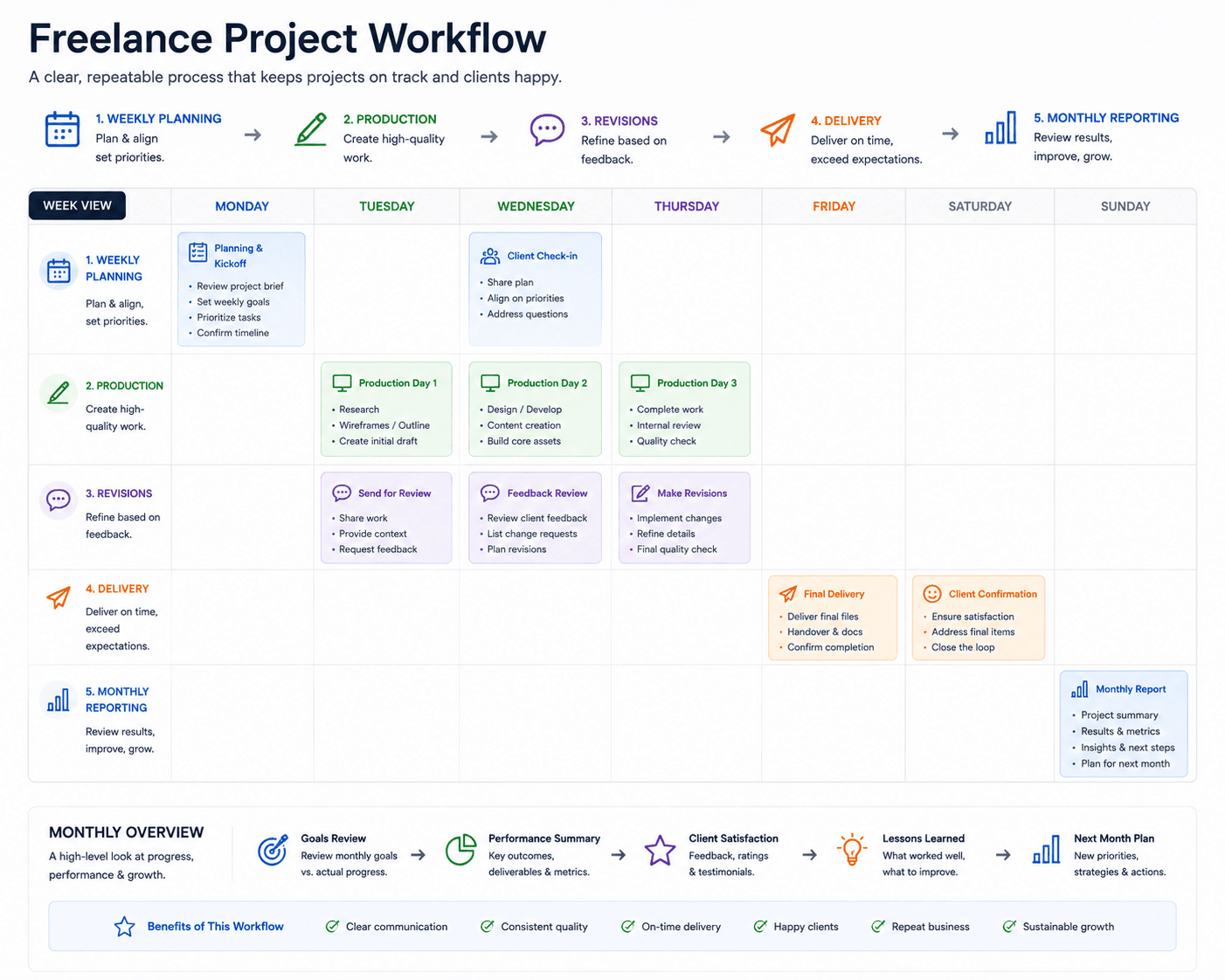
A recurring service becomes easier to manage when it follows a repeatable process.
For example:
Week 1
Plan the month’s work.
Week 2
Produce the first batch.
Week 3
Complete revisions and additional deliverables.
Week 4
Finish remaining work and prepare next month’s plan.
The exact schedule depends on your service.
The purpose is to create predictability.
Create Client Onboarding Documents
Once a client signs a retainer agreement, collect the information you need.
This might include:
- Brand guidelines
- Login access
- Preferred communication channel
- Existing assets
- Target audience
- Content preferences
- Approval process
- Important deadlines
- Contact information
Good onboarding can reduce repeated questions later.
Build Templates for Recurring Work
A retainer becomes more profitable when you improve your workflow.
Create reusable templates for:
- Proposals
- Briefs
- Reports
- Content outlines
- Design requests
- Meeting notes
- Monthly reviews
- Invoices
- Project checklists
Templates do not mean producing low-quality generic work.
They simply reduce repetitive administrative effort.
Track Your Time
Even if you charge a fixed monthly fee, time tracking can be valuable.
Suppose your retainer is priced at a certain monthly amount.
After three months, you discover that you are consistently spending twice as much time as expected.
That is important information.
You can then decide whether to:
- Reduce deliverables
- Increase the price
- Improve your workflow
- Move the client to another package
- Separate additional services
Without tracking your workload, you may not realize that a retainer is becoming unprofitable.
Watch for Scope Creep
Common scope-creep phrases include:
“Can you quickly do this too?”
“It should only take five minutes.”
“Since you’re already working on it…”
One small request may not matter.
But dozens of small requests can significantly increase your workload.
A professional response can be:
That request falls outside the current monthly scope. I can add it as an additional task or include it in an upgraded package.
This is clear without being confrontational.
Build a Change Request Process
When a client wants additional work, give them a clear path.
For example:
Current scope: Four articles per month.
Additional request: Four more articles.
Option: Upgrade the monthly package or purchase the additional articles separately.
This prevents awkward negotiations.
Retainers Need Regular Reviews
A retainer that works today may not work six months later.
The client’s needs can change.
Your services can change.
Your workload can change.
The business may grow.
Therefore, review the arrangement periodically.
Ask:
- Are the deliverables still useful?
- Is the workload sustainable?
- Are there recurring problems?
- Does the client need more support?
- Does the package need adjustment?
A review can lead to a better arrangement for both sides.
Don’t Become Available 24/7
Some freelancers confuse retainers with unlimited availability.
They are not the same thing.
A retainer can include priority support without requiring you to respond at every hour.
Define:
- Working hours
- Response expectations
- Emergency requests
- Weekend availability
- Expected turnaround times
For example:
Standard requests are addressed during business days with an agreed turnaround time.
If emergency support is offered, price and define it separately.
Use Retainers to Improve Your Schedule
One major benefit of recurring work is planning.
Suppose you have several monthly clients.
You can allocate specific blocks of time for each.
For example:
Monday: Client A
Tuesday: Client B
Wednesday: Client C
Thursday: New projects
Friday: Administration and business development
Your schedule will naturally vary, but recurring commitments can make capacity planning easier.
Don’t Fill Your Entire Calendar With Retainers
Recurring work is valuable, but locking every available hour into retainers can create another problem.
You may have no capacity for:
- New opportunities
- Higher-value projects
- Business development
- Learning
- Rest
- Unexpected work
Leave some capacity available.
Your ideal client mix may include a combination of recurring retainers and project-based work.
Build a Client Concentration Strategy
Depending entirely on one client can create risk.
Imagine one client provides almost all of your monthly revenue.
If that client suddenly ends the contract, your business may be affected significantly.
Diversification can reduce this risk.
Instead of relying entirely on one client, consider building several healthy client relationships.
However, do not accept so many retainers that quality declines.
The goal is balanced recurring revenue, not maximum client count.
How to Retain Clients for the Long Term
Getting a retainer is only the beginning.
Keeping the client requires consistent value.
Focus on:
- Reliable delivery
- Clear communication
- Organized workflows
- Meeting deadlines
- Understanding priorities
- Reporting completed work
- Suggesting useful improvements
- Managing expectations
Clients should not have to constantly chase you for updates.
Send Monthly Reports
A simple monthly report can reinforce the value of your work.
Depending on your service, it might include:
- Completed deliverables
- Work in progress
- Recommendations
- Upcoming tasks
- Relevant performance information
- Next month’s priorities
For example:
Completed this month:
- 8 articles
- 3 content updates
- 2 internal-link improvements
Next month:
- 6 new articles
- 4 content refreshes
- New content cluster planning
This gives the client visibility.
Communicate Problems Early
If you know a deadline will be missed, do not disappear.
Tell the client early.
Explain:
- What happened
- What is affected
- What you are doing
- When the revised delivery will happen
Transparent communication is usually better than silence.
Increase Retainer Value Without Doing More Work
You can sometimes improve the perceived value of a retainer by improving the process rather than simply adding more deliverables.
For example:
- Better reporting
- Better organization
- Faster request handling
- More strategic recommendations
- Clear monthly planning
- Better documentation
You do not always need to add another ten deliverables to justify your service.
When Should You Raise Your Retainer Price?
A price review may become appropriate when:
- Your workload increases
- The scope expands
- Your expertise grows
- The client’s requirements become more complex
- Your operating costs increase
- The original pricing no longer reflects the work
Do not surprise the client.
Discuss changes professionally and explain what has changed.
How to Handle Retainer Cancellation
Retainers can end.
A client may reduce spending, change strategy, hire internally, or simply no longer need the service.
Do not treat every cancellation as a personal failure.
A professional agreement should define the cancellation process.
If the relationship ends, complete outstanding work properly, organize files, document relevant information, and leave the relationship professionally.
A former client may become a future client or referral source.
Can a Beginner Start a Retainer Business?
Yes, but it is usually easier when you already have evidence that clients need your service.
A beginner should first develop:
- A marketable skill
- A clear service
- Portfolio examples
- Professional communication
- A repeatable workflow
You do not need ten years of experience.
But you do need to be capable of reliably delivering the service you sell.
Never promise a recurring service that you cannot consistently provide.
A Practical Example of a Freelance Retainer
Imagine you are an SEO content writer.
A project-based client might hire you for:
Three articles.
After successful delivery, you identify that the company needs ongoing content.
You propose:
Monthly Content Retainer
- Eight SEO-focused articles
- Four content refreshes
- Monthly topic planning
- Internal-link recommendations
- One monthly strategy call
- Two revision rounds per article
Now the client has a predictable content system.
You have a predictable workload.
The relationship becomes more valuable than repeatedly negotiating individual articles.
A Second Example: WordPress Support
Suppose you build a WordPress website for a small company.
After launch, the company needs occasional help.
Instead of charging separately for every minor request, you could offer a monthly maintenance package.
It might include:
- Routine updates
- Backup monitoring
- Minor content changes
- Basic troubleshooting
- Monthly website review
Major redesigns and custom development remain separate projects.
This creates a clear boundary between maintenance and development.
A Third Example: Video Editing
A creator publishes content every week.
Instead of selling individual videos, you could offer a monthly package.
For example:
- Four long-form edits
- Eight short clips
- Basic captions
- Thumbnail support
The exact package depends on your production capacity.
The creator gets consistent editing support.
You get recurring work.
Common Retainer Mistakes
Mistake 1: Unlimited Work
Never sell unlimited work without extremely clear boundaries.
Mistake 2: Underpricing
A monthly payment can look attractive until you calculate the actual hours involved.
Mistake 3: No Written Agreement
Verbal expectations can easily become different expectations.
Mistake 4: No Revision Limits
Repeated revisions can consume your capacity.
Mistake 5: Poor Communication
Recurring clients need predictable communication.
Mistake 6: Taking Too Many Clients
Overbooking can damage quality.
Mistake 7: Depending on One Client
Concentration creates business risk.
Mistake 8: No Performance Review
Without reviewing workload and value, a retainer can slowly become unprofitable.
Mistake 9: Treating Retainers as Passive Income
Retainers still require active work and responsibility.
Mistake 10: Never Improving the Offer
Client needs evolve. Your packages should evolve when appropriate.
A 30-Day Plan to Start a Freelance Retainer Business
Week 1: Identify the Service
Choose one service that clients genuinely need repeatedly.
Examples:
- Content
- Design
- Editing
- Website maintenance
- SEO
- Marketing support
Then define your ideal client.
Week 2: Create Your Retainer Package
Define:
- Deliverables
- Quantity
- Frequency
- Revision limits
- Communication process
- Turnaround
- Additional-work policy
- Monthly price
Write everything clearly.
Week 3: Approach Existing Relationships
Look at previous clients and ask:
What recurring problem could I solve for this client?
Start conversations with clients who have demonstrated ongoing needs.
Do not pitch every former client.
Choose relevant relationships.
Week 4: Improve and Systemize
Once you have interest, refine your workflow.
Create:
- Onboarding checklist
- Client brief
- Request system
- Monthly report
- Delivery checklist
- Retainer agreement
The more organized the process becomes, the easier it is to manage recurring work professionally.
How to Make a Retainer Sustainable
A successful retainer business is based on three things:
Predictable client need
The client has a genuine recurring requirement.
Clear scope
You know exactly what you are responsible for.
Sustainable economics
The price reflects the actual work and business costs.
If any one of these is missing, the arrangement can become difficult.
For example, a client may need your service every month but only want to pay for a tiny amount of work.
Another client may pay well but constantly expand the scope.
Another may have excellent requirements but only need the service once.
Your goal is to find the intersection of recurring need, appropriate scope, and sustainable pricing.

Final Thoughts
A freelance retainer business can be a powerful way to move from unpredictable project-by-project work toward a more organized freelance model.
The key is not simply convincing clients to pay you every month.
The key is creating a service that genuinely provides ongoing value.
Start by identifying a problem that continues after the initial project.
Then turn that problem into a clearly defined recurring service.
Set realistic deliverables.
Create reasonable limits.
Price according to the real workload.
Put expectations in writing.
Track your time.
Communicate professionally.
Review the relationship regularly.
And never confuse a retainer with unlimited access to your time.
The strongest freelance retainers benefit both sides.
The client gets dependable professional support without repeatedly searching for a new freelancer.
The freelancer gets recurring work and a more predictable business pipeline.
You can still maintain project-based clients while gradually developing recurring contracts.
In fact, a balanced freelance business can combine both models.
Use projects to take on specialized assignments and retainers to create ongoing relationships.
Over time, your goal should not simply be to collect as many clients as possible.
It should be to build a manageable group of clients who value your expertise, understand your scope, communicate clearly, and have legitimate recurring needs.
That is what can turn freelancing from a constant search for the next project into a more structured and sustainable professional business.
Frequently Asked Questions
What is a freelance retainer?
A freelance retainer is an ongoing agreement where a freelancer provides defined services to a client on a recurring basis, usually in exchange for recurring payment.
Is a retainer the same as unlimited freelance work?
No. A professional retainer should have clearly defined deliverables, hours, availability, or service limits.
Which freelance services work best with retainers?
Services with recurring business needs are usually the best candidates, including content writing, SEO, social media management, graphic design, video editing, website maintenance, consulting, and technical support.
How do I get my first retainer client?
Start with existing or previous clients who already have a recurring problem that matches your service. Demonstrate how a monthly arrangement could make their workflow easier.
Should I offer unlimited revisions on a retainer?
Generally, no. Define a reasonable revision policy to prevent scope creep and protect your capacity.
How much should I charge for a freelance retainer?
There is no universal price. Calculate the expected workload and business costs, then consider your expertise, complexity, client requirements, and value when determining the price.
Can beginners offer freelance retainers?
Yes, provided they have the skills and capacity to deliver the promised service reliably. Beginners should avoid selling recurring services they cannot consistently fulfill.
Should unused retainer hours roll over?
That depends on your agreement. If you allow rollover, define how much can be carried forward and for how long.
Can I have both project clients and retainer clients?
Yes. Combining recurring retainers with project-based work can provide both ongoing commitments and flexibility for larger assignments.
What happens if a client wants more work than the retainer includes?
Explain that the additional work falls outside the agreed scope and offer an additional fee or upgraded package.