Personal Branding for Freelancers: A Practical Guide
- by Muhammad Raza
- 0 Comments
- 16 minutes read
- 39 Views
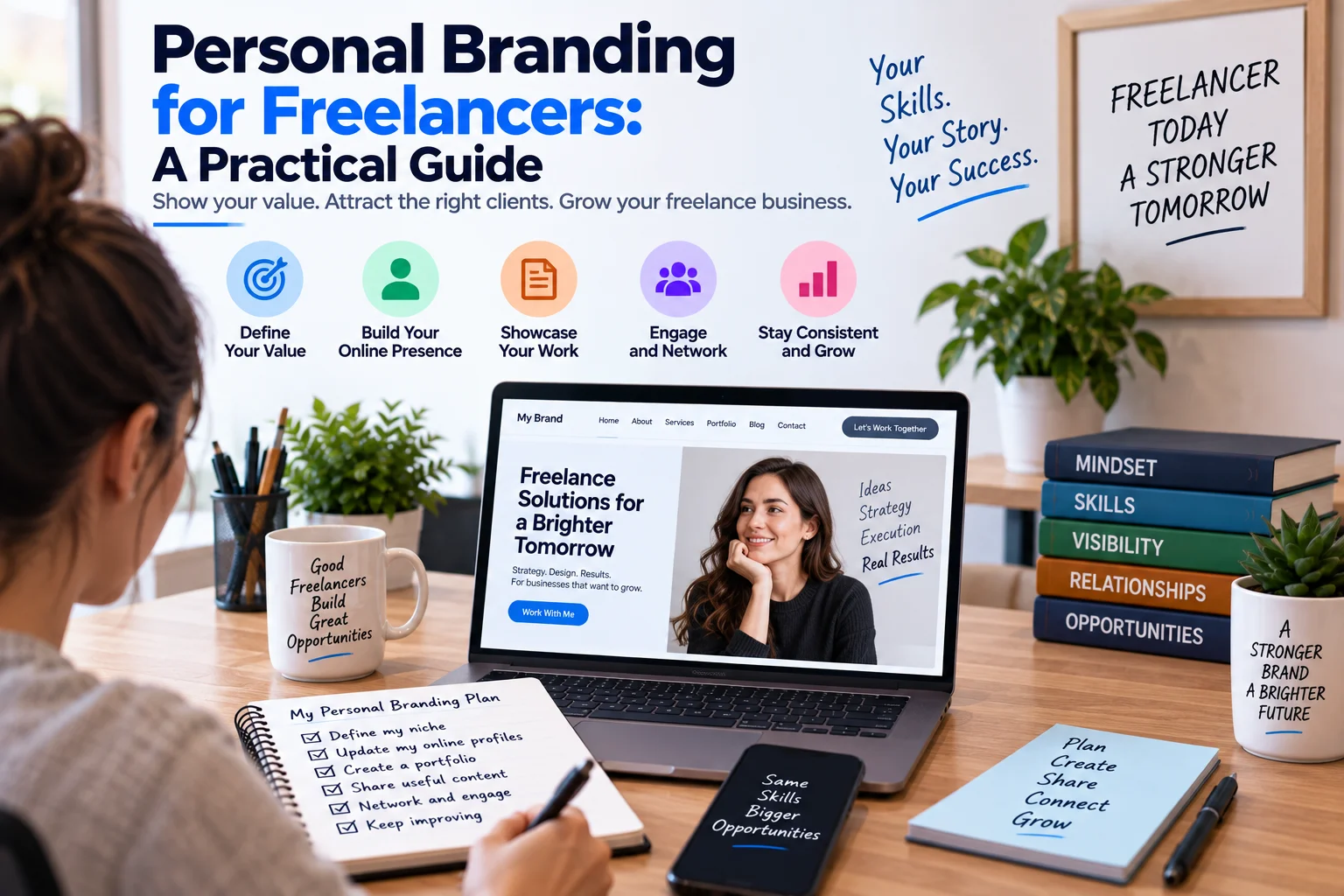
Effective personal branding for freelancers starts with being easy to remember for the right reason, not with becoming an online influencer.
A strong freelance brand makes it clear what you do, which problems you solve, who you help, and what evidence supports your work. Your portfolio, communication, client relationships, and professional presence all reinforce that identity.
This guide shows how to build a recognizable freelance brand through clear positioning, useful proof, consistent professional touchpoints, and a sustainable routine that does not require constant posting.
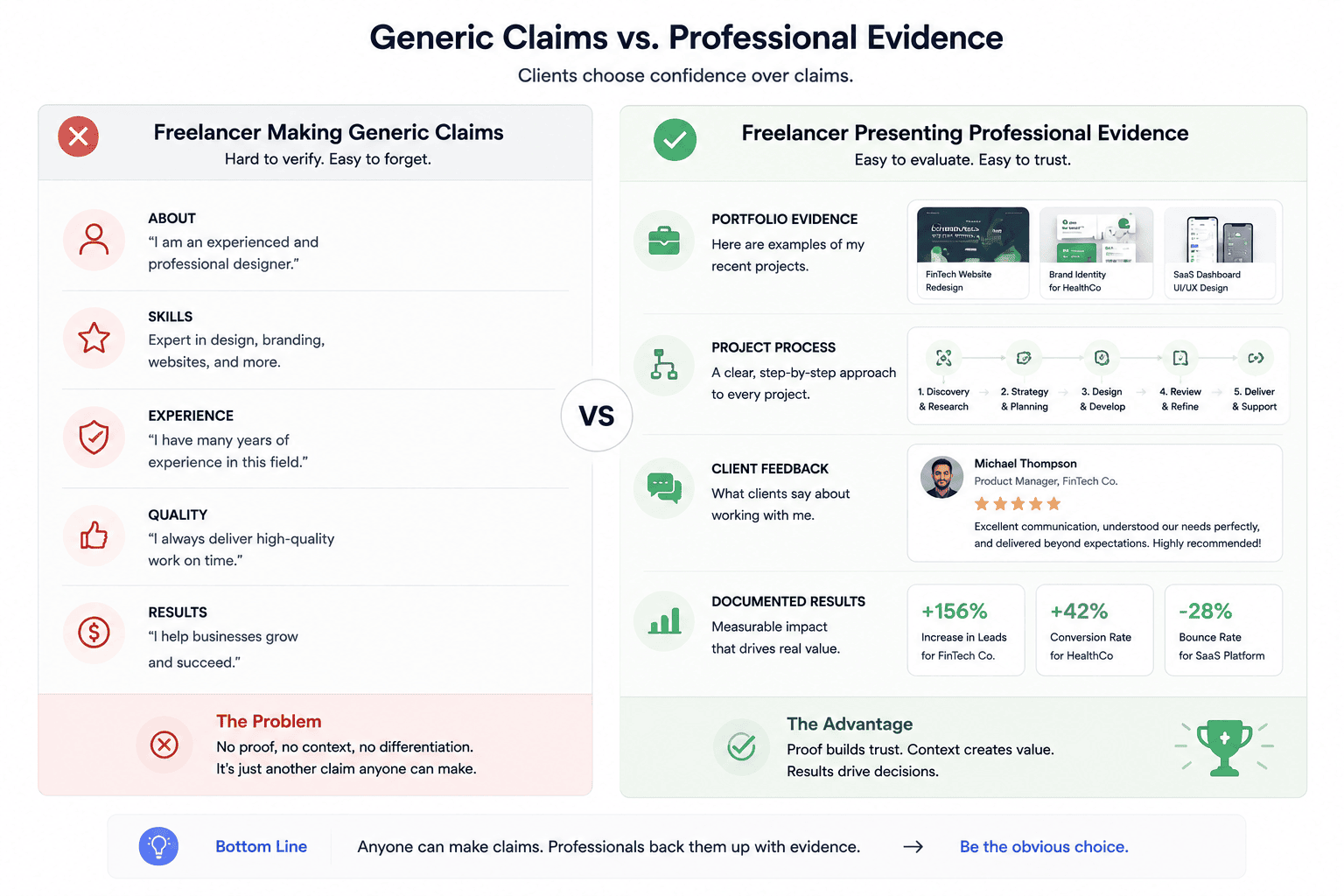
One Project Can Create Several Useful Assets
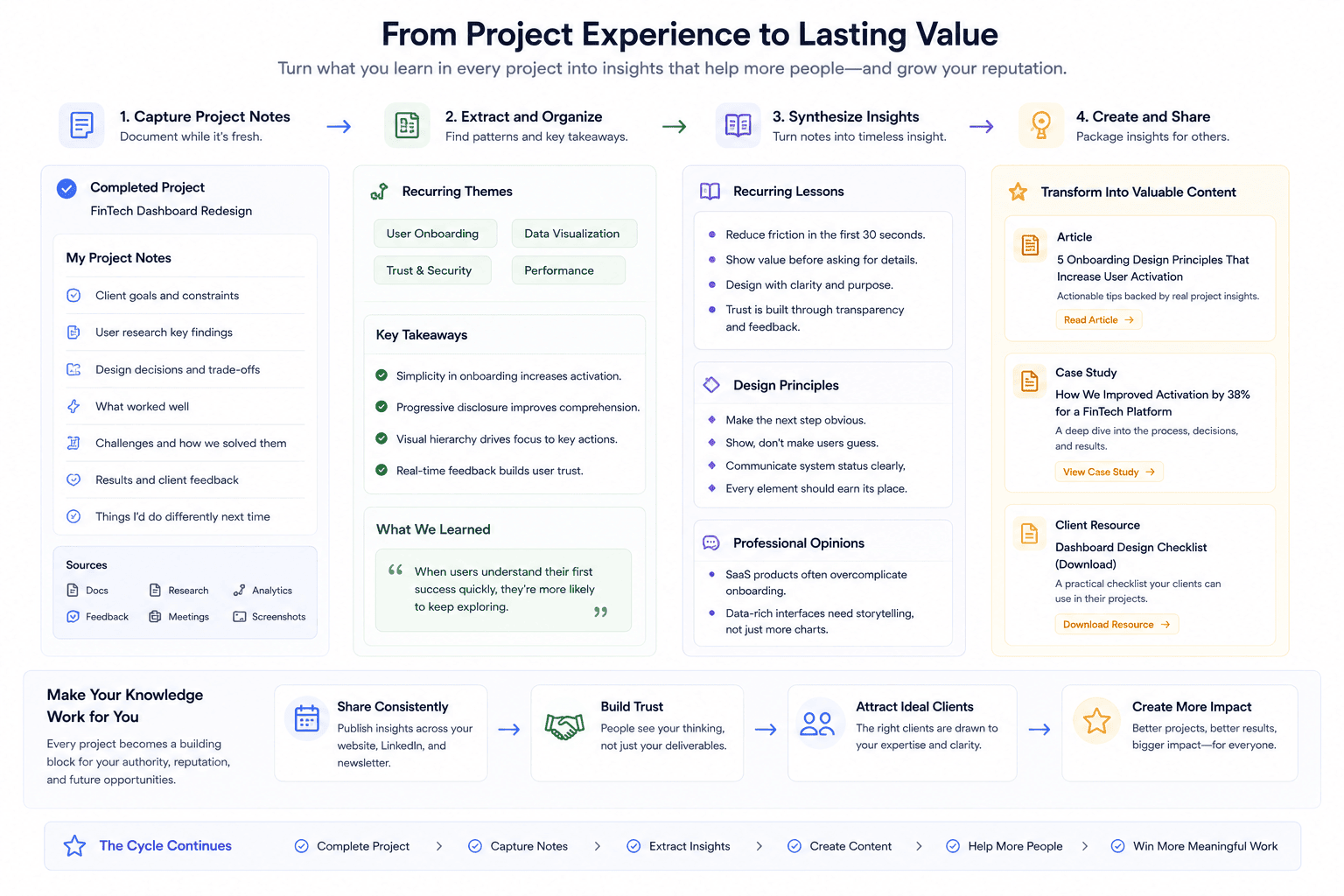
A finished project does not have to disappear into an archive.
Suppose a freelance developer completes a difficult website migration.
The project could produce:
Asset 1: Portfolio case study
Asset 2: Migration checklist
Asset 3: Article explaining the most difficult part
Asset 4: Short explanation for future prospects
Asset 5: Internal process document
Asset 6: Example used during a sales conversation
The freelancer is not inventing six unrelated pieces of content.
They are extracting useful information from one real experience.
This approach also makes publishing easier.
Instead of asking:
“What should I post today?”
you can ask:
“What did I learn from the work I already completed?”
That question usually produces better material.
Build a Reputation Around Your Working Style
Technical ability is only one part of a freelance experience.
Clients also notice the way the work happens.
Consider two freelancers who deliver equally good designs.
Freelancer A:
- Disappears for several days
- Gives vague progress updates
- Makes assumptions without asking
- Sends files without explanations
Freelancer B:
- Confirms important decisions
- Gives predictable updates
- Flags risks early
- Organizes deliverables clearly
- Explains what changed
The final designs may be equally good.
The experiences are not.
Clients often remember the second freelancer as “easy to work with.”
That description is valuable.
It can become part of your professional identity.
Turn Good Habits Into Brand Signals
You do not have to announce every strength.
Demonstrate it.
If you want to be known for organization:
Send organized project summaries.
If you want to be known for clarity:
Explain decisions in plain language.
If you want to be known for reliability:
Make your deadlines realistic and communicate early when something changes.
If you want to be known for technical depth:
Document the difficult parts of your work.
If you want to be known for strategic thinking:
Explain why you selected one approach instead of another.
The important principle is:
The behavior should support the message.
If your website says “clear communication” but your client emails are confusing, the branding will not survive contact with reality.
Ask Yourself What Clients Would Say About You
This is one of the most useful branding exercises.
Imagine a former client is talking to someone who needs a freelancer.
What sentence would you like them to say?
Maybe:
“She is very good at making complicated information easier to understand.”
Or:
“He is the person I call when our website becomes difficult to manage.”
Or:
“They are extremely methodical when handling large content projects.”
That sentence is more valuable than a collection of impressive adjectives.
Once you know what you want people to say, look for ways to make that quality visible in your work.
Make Testimonials More Informative
A testimonial such as:
“Amazing work. Highly recommended!”
does not tell a future client much.
A useful testimonial gives context.
It might explain:
- What the client needed
- What was difficult
- What you handled
- What they appreciated
- What changed after the work
For example:
“Our documentation had grown over several years and customers struggled to find the information they needed. The new structure made the guides much easier for our support team to navigate.”
That tells a future prospect something specific.
It also gives your brand a real-world association.
Always use genuine client feedback and obtain appropriate permission before publishing it.
Your Reputation Exists Outside the Internet
A freelancer’s brand is not limited to search engines or social networks.
It can appear in:
- A former client’s recommendation
- A private business group
- A professional community
- A referral email
- A colleague’s introduction
- A conference conversation
- A previous client mentioning your name
- A message forwarded between business owners
This is why relationships matter.
A person who knows exactly what you do can become a much stronger source of opportunity than a random viewer who happened to see one post.
Make your work easy to describe.
If someone has to say:
“He does a lot of different digital things, I’m not exactly sure which one you need…”
your positioning is difficult to refer.
If they can say:
“She specializes in cleaning up complicated product documentation.”
the referral becomes easier.
Make Referrals Easy
You can quietly help former clients remember your specialty.
After a successful project, your follow-up might include a simple line such as:
“If you know another SaaS team dealing with documentation that has become difficult to manage, feel free to pass along my details.”
That is clearer than:
“Please refer me to anyone who needs freelance services.”
Specific requests are easier to act on.
You are giving the person a category to remember.
Keep Your Professional Touchpoints Aligned
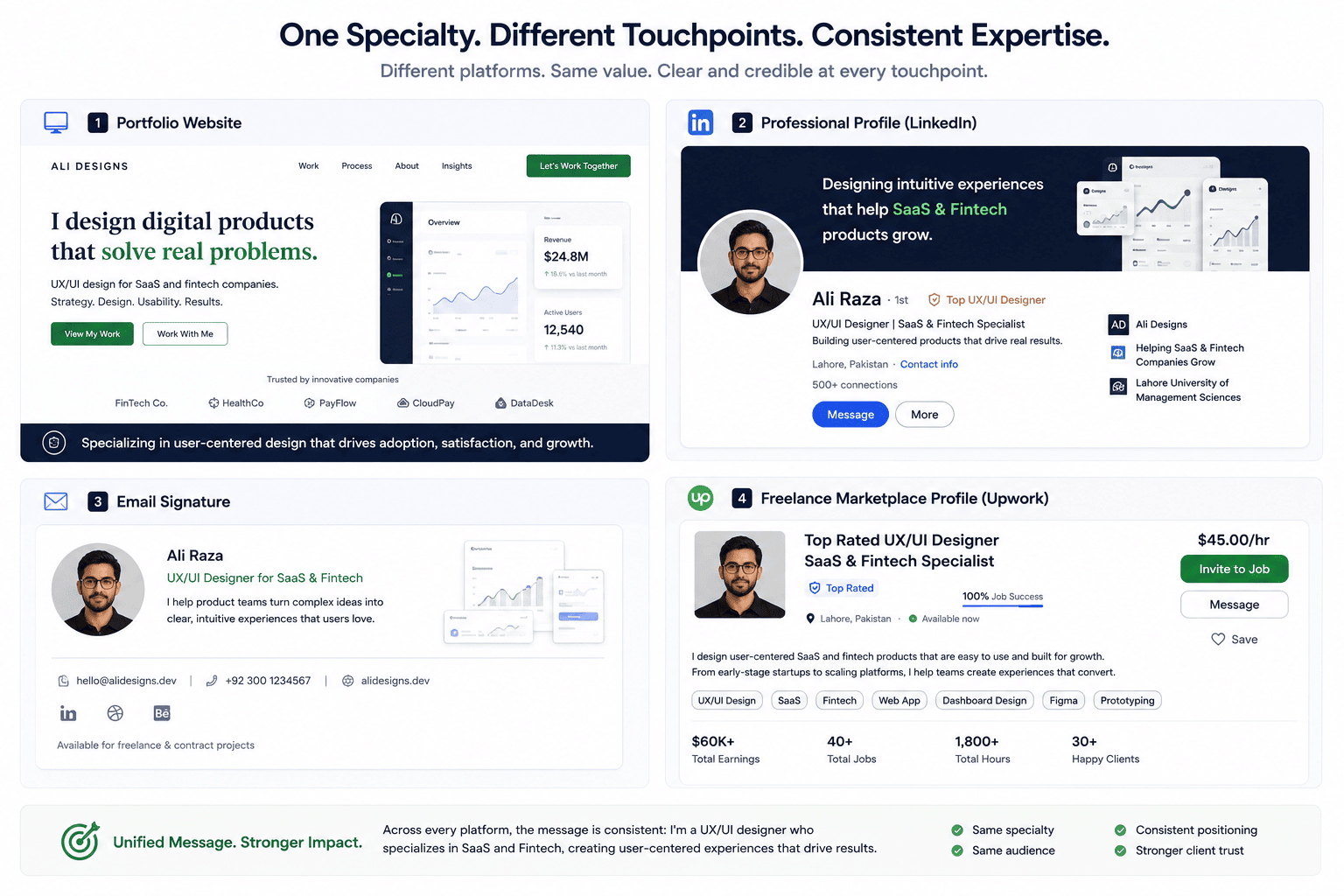
Your website does not need identical wording to your freelance marketplace profile.
Your email signature does not need to copy your LinkedIn biography.
Different platforms have different purposes.
But the underlying professional direction should make sense.
For example:
Website:
Helping small software companies improve difficult product interfaces.
Portfolio:
Mostly SaaS onboarding, dashboards, and product flows.
Email signature:
Product interface designer for small software teams.
Professional profile:
Focuses on interface and usability work for software products.
These do not repeat the same sentence.
They reinforce the same idea.
That is useful consistency.
Don’t Spend Your Branding Budget on Decoration First
Visual design has a role.
A clean website can make information easier to consume.
A professional photograph can make a profile feel complete.
A consistent visual system can make your materials look connected.
But decoration cannot compensate for weak evidence.
Before spending hours choosing:
- Brand colors
- Logo variations
- Decorative graphics
- Social media templates
- Fancy animations
ask whether your portfolio actually explains your best work.
A simple website containing six strong project explanations can be more useful than a beautiful website containing six vague thumbnails.
Improve the substance first.
Polish it afterward.
Replace Impressive Words With Useful Specifics
Freelancers often use phrases such as:
- High-quality
- Results-driven
- Innovative
- Professional
- Premium
- Creative
- Experienced
- Dedicated
- Strategic
These words are not automatically bad.
The problem is that almost everyone can use them.
Specific language gives the reader something to understand.
Instead of:
“I provide innovative digital marketing solutions.”
try:
“I help small online stores improve abandoned-cart email sequences.”
Instead of:
“I create premium websites.”
try:
“I redesign service-business websites when visitors struggle to understand the offer.”
Specificity is often more persuasive than self-description.
You Can Be a Generalist and Still Be Recognizable
Being a generalist does not automatically mean having a weak brand.
A freelancer might offer several services because their clients need connected work.
For example, a marketer may handle:
- Email campaigns
- Landing pages
- Copy
- Analytics
The positioning could focus on the broader problem:
Helping small online businesses turn more existing visitors into customers.
The services support the outcome.
This is different from presenting every skill as a separate identity.
The goal is not to hide your abilities.
It is to organize them around something people can understand.
Build Around Problems You Understand Well
One way to develop a recognizable position is to look backward.
Review your last 10 projects.
Write down:
- Why the client hired you
- What was difficult
- What you ended up doing most often
- Which part you enjoyed
- Which projects produced the strongest work
- Which clients were easiest to help
- What clients thanked you for
Now look for repetition.
Perhaps you thought you were “a web designer,” but most of your strongest projects involved rescuing websites that had become confusing after years of changes.
Perhaps you thought you were “a writer,” but most clients actually hire you to turn technical notes into customer-facing material.
The pattern may already exist.
Your job is to notice it.
Use Client Questions as a Source of Ideas
Your inbox contains useful information.
If three prospects ask:
“What is included in your website redesign?”
your service page probably needs a clearer explanation.
If clients repeatedly ask:
“Why does this migration take so long?”
that question could become an educational article.
If prospects constantly misunderstand your process, explain the process publicly.
Questions reveal friction.
And friction is useful information.
Your content becomes more relevant when it answers questions that real people are already asking.
You Don’t Need to Publish Every Day
There is nothing inherently wrong with frequent publishing.
But it is not a requirement for building a freelance reputation.
A freelancer who publishes once every few weeks but has strong project evidence can still create a useful professional presence.
A practical rhythm might look like:
After a meaningful project
Save one lesson.
Once a month
Improve one portfolio entry.
Once a month
Publish one useful explanation.
Every few months
Review your profiles and service descriptions.
After successful work
Request honest feedback where appropriate.
This is a slower system.
It is also easier to maintain alongside paid work.
Create an Evidence Folder
Open a folder on your computer called:
Freelance Evidence
Inside it, create folders for:
- Finished projects
- Client feedback
- Before-and-after examples
- Interesting problems
- Process notes
- Questions from prospects
- Lessons learned
- Screenshots
- Useful explanations
- Results you are permitted to discuss
Do not worry about publishing everything.
The purpose is to preserve material.
Six months later, you may discover that one project contains the foundation for a strong case study.
Without the notes, you may forget the details.
With the notes, you have an archive of your professional development.
Teach From Experience Instead of Trying to Sound Like a Thought Leader
You do not need to make grand predictions.
You can simply explain something you have learned.
For example:
Instead of:
“The future of web design will completely transform how businesses operate.”
write:
“Three things made our last website migration harder than expected.”
The second idea is smaller.
It is also easier to support.
You can explain:
- What happened
- What caused it
- What you changed
- What you would repeat
- What you would avoid next time
This style of communication can demonstrate expertise without requiring a dramatic personality.
Develop a Professional Point of View
Experience becomes more recognizable when you can explain your reasoning.
Suppose two designers both know how to create landing pages.
One frequently says:
“Every landing page should be short.”
Another says:
“I prefer reducing unnecessary sections, but complicated offers sometimes need more explanation. The real problem is usually poor information order rather than page length.”
The second person has a position.
Clients may agree or disagree.
But the freelancer’s thinking is easier to recognize.
You can develop your own professional viewpoint by noting:
- Approaches you repeatedly use
- Approaches you avoid
- Mistakes you see often
- Trade-offs clients underestimate
- Advice you disagree with
- Lessons repeated across projects
- Decisions that have become important in your work
Your viewpoint does not have to be controversial.
It simply needs to be considered.
Don’t Borrow Someone Else’s Personality
You can learn from successful freelancers without copying their identity.
Study what works.
Maybe they:
- Explain projects exceptionally well
- Use strong examples
- Have a clear specialty
- Teach complicated subjects simply
- Document their work
- Maintain excellent client relationships
Those are useful principles.
But you do not need to copy their jokes, writing voice, lifestyle, posting habits, or personal stories.
A freelancer who hates recording videos should not build a business around pretending to be a video creator.
A quiet technical professional may be much better suited to:
- Articles
- Documentation
- Case studies
- Tutorials
- Private referrals
- Community answers
- Detailed portfolio work
The method should fit the person doing the work.
Build Something That Works While You Are Busy
A useful test for your freelance brand is this:
What continues working when you stop posting?
If the answer is “nothing,” you may be relying too heavily on active visibility.
Now imagine you disappear from social media for a month because you are busy with a major client project.
Can someone still find:
- Your portfolio
- Your service description
- Your case studies
- Your previous articles
- Your client recommendations
- Your professional profile
- Your contact information
If yes, your professional presence has some durability.
That matters because freelance work itself takes time.
Your marketing system should not require you to be online every hour.
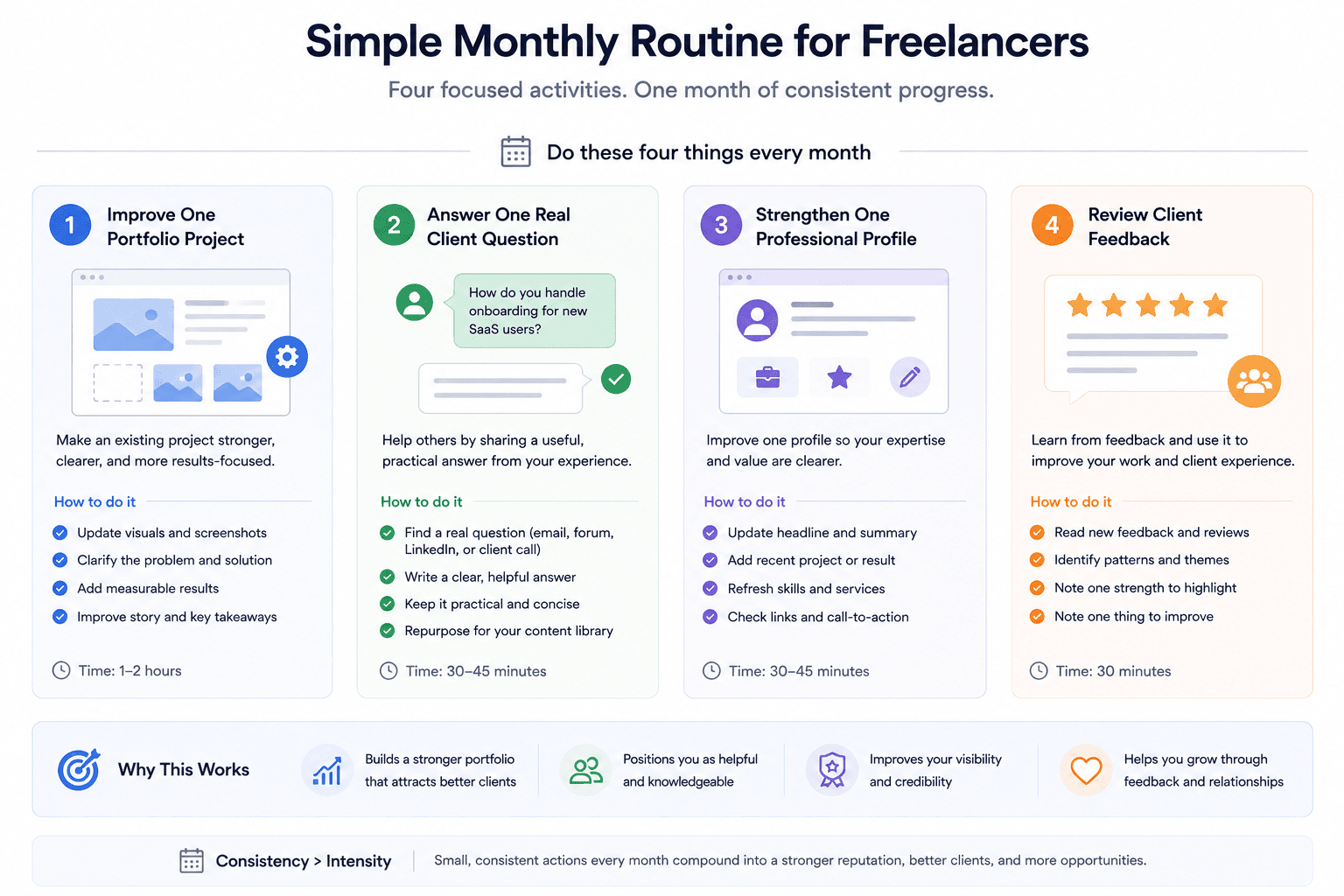
A Simple Four-Part Monthly System
If you want a manageable routine, use four tasks.
Week 1: Improve One Project
Choose one portfolio item.
Add context.
Explain the problem.
Describe your decisions.
Show what you learned.
Week 2: Answer One Question
Find a real question from a client or prospect.
Answer it publicly if appropriate.
It could become:
- A short article
- A guide
- A checklist
- A social post
- A short video
- An FAQ
Week 3: Improve One Professional Touchpoint
Update one of these:
- Homepage introduction
- Profile description
- Service page
- Email signature
- Portfolio introduction
Do not redesign everything.
Improve one thing.
Week 4: Review Your Reputation
Look through:
- Client feedback
- Referral messages
- Recent project notes
- Common prospect questions
Ask:
“What do people seem to value most about working with me?”
That answer may reveal something worth emphasizing.
Then repeat the cycle.
A Fictional Example: A Freelancer Who Rarely Posts
Consider a fictional developer named Hamza.
He does not enjoy social media.
He has no interest in becoming a creator.
For several years, however, he has repeatedly worked on difficult front-end projects for small software companies.
His specialty gradually becomes obvious.
He is often called when:
- A front-end codebase has become difficult to maintain
- A product interface has accumulated inconsistent components
- A development team needs help cleaning up an older interface
- A small SaaS company needs a practical UI improvement without rebuilding everything
Hamza’s website reflects that type of work.
His portfolio contains detailed project explanations.
His professional profile describes the same area.
His email signature mentions it.
Former clients know what type of developer to recommend him for.
He occasionally writes about lessons from difficult front-end projects.
He does not have to publish every morning.
He does not need to share his personal life.
He does not need to act like a media personality.
If someone asks:
“Do you know a developer who can help us clean up a messy SaaS interface?”
Hamza has a reasonable chance of being remembered.
That is the useful outcome.
Measure Recognition Instead of Vanity Metrics
Follower count can be interesting.
It is not the only measurement that matters.
For a freelancer, more useful signals may include:
Referral quality
Are people sending you projects that actually fit your specialty?
Inquiry relevance
Are prospects contacting you about the type of work you want?
Portfolio conversations
Do prospects mention specific projects they saw?
Client language
Do clients describe you using a particular strength?
Repeat work
Do previous clients return for related projects?
Professional recall
Do people introduce you as the person who handles a certain problem?
These signals tell you whether your professional identity is becoming clearer.
Signs Your Positioning Is Working
You may notice small changes before anything dramatic happens.
A prospect says:
“I saw your case study about this.”
A former client says:
“I recommended you because you are good at this type of project.”
Someone contacts you specifically about the problem you want to solve.
A client says:
“Your process seemed very organized.”
A referral arrives with a clear description of why they were sent to you.
These are useful signals.
They mean people are not merely seeing your name.
They are attaching meaning to it.
Signs You Need to Simplify
Your positioning may need work if prospects constantly ask:
- What exactly do you offer?
- Which service should I hire you for?
- Are you a designer or developer?
- Do you work with this type of client?
- What is your main specialty?
- What kind of projects do you normally handle?
Questions are not automatically bad.
Clients should ask questions before hiring you.
But if everyone needs the same explanation, your public message may be too broad.
Before publishing more content, improve the explanation.
More visibility does not automatically fix unclear positioning.
Common Mistakes in Freelancer Personal Branding
Trying to Build an Audience Before Building Evidence
An audience cannot replace good work.
Create something worth showing first.
Treating Every Platform as a Separate Identity
Different platforms can have different formats, but your professional direction should remain understandable.
Using Adjectives Instead of Examples
“Experienced” tells less than a strong project explanation.
Turning Every Project Into a Sales Pitch
Sometimes a useful lesson is more valuable than a direct promotion.
Copying Another Freelancer’s Personality
Borrow useful methods, not someone else’s identity.
Showing Every Skill Equally
Multiple abilities can be useful, but your main specialty should remain visible.
Ignoring the Client Experience
Your brand is affected by what happens after someone hires you.
Publishing Without Learning From Your Work
Your strongest material may already exist inside completed projects.
Overdesigning Your Presence
A polished appearance helps, but substance comes first.
Changing Your Positioning Constantly
If your message changes every few weeks, people have less opportunity to associate your name with anything specific.
Making Everything About Yourself
Your expertise matters.
But clients ultimately care about whether that expertise helps solve their problem.
Frequently Asked Questions
What does personal branding mean for a freelancer?
For a freelancer, personal branding is the professional identity people associate with your name. It develops through your work, positioning, communication, portfolio, reputation, relationships, and public material.
Do I need to become an influencer?
No. A freelancer can build recognition through portfolio work, referrals, case studies, professional relationships, useful articles, and consistent communication without becoming a public creator.
Can I build a freelance brand without posting on social media?
Yes. Social media is one possible visibility channel, not the entire system. A freelancer can use a website, portfolio, referrals, professional communities, search-friendly articles, testimonials, and direct relationships.
How can introverted freelancers build a personal brand?
Choose methods that suit your communication style. Writing, documentation, case studies, portfolio explanations, referrals, and one-to-one relationships can all contribute to professional recognition.
Should I choose a niche?
A niche can make your positioning easier to understand, but it does not have to be extremely narrow. You can specialize around a recurring problem, type of project, audience, or transformation.
What should I include in my portfolio?
Include enough context for visitors to understand the project. Explain the problem, your role, important decisions, challenges, and final work while respecting confidentiality and client agreements.
How often should I publish?
There is no universal number. A sustainable schedule is better than forcing yourself to publish constantly. One useful piece of material can be more valuable than several generic posts.
Can client work become branding content?
Often yes, as long as you respect confidentiality, contracts, privacy, and client permissions. You can discuss general lessons without exposing sensitive information.
Are testimonials important?
Useful testimonials can support credibility, especially when they explain what the freelancer actually did and what the client appreciated. Avoid vague or fabricated testimonials.
Does a personal brand guarantee more clients?
No. A recognizable professional identity can support trust and referrals, but it cannot guarantee client acquisition, income, or specific business results.
How long does it take to become recognizable?
There is no fixed timeline. Recognition develops through repeated exposure to consistent work, useful evidence, professional relationships, and a clear area of expertise.
Final Thoughts
A freelancer does not need to become famous.
They need to become understandable.
That may sound like a small distinction, but it changes the entire approach to personal branding.
You do not have to document your breakfast.
You do not have to publish seven times a week.
You do not have to create a personal-media business around your freelance career.
You can build recognition through your actual work.
A useful portfolio shows what you can handle.
A good case study explains how you think.
A clear service description helps people understand where you fit.
A well-run project shapes what clients say about you.
A genuine testimonial adds outside evidence.
A helpful article answers a question that your prospects already have.
A referral carries your professional reputation from one person to another.
Together, these small pieces form something valuable.
Not celebrity.
Not internet fame.
Professional recall.
When the right person encounters a problem and your name comes to mind, your branding has done its job.
So instead of asking:
“How do I become more visible online?”
try asking:
“What should the right client remember about me?”
Then look at everything you control:
Your portfolio.
Your project process.
Your website.
Your profile.
Your communication.
Your case studies.
Your client relationships.
Your useful content.
Make those pieces point in the same general direction.
You may never become an influencer.
You do not need to.
A freelancer can build a durable professional reputation while remaining relatively quiet online.
The goal is not to make everyone remember you.
It is to make the right people remember what you are particularly good at.