Small Business Client Continuity Checklist: A Practical Guide
- by Muhammad Raza
- 0 Comments
- 12 minutes read
- 40 Views
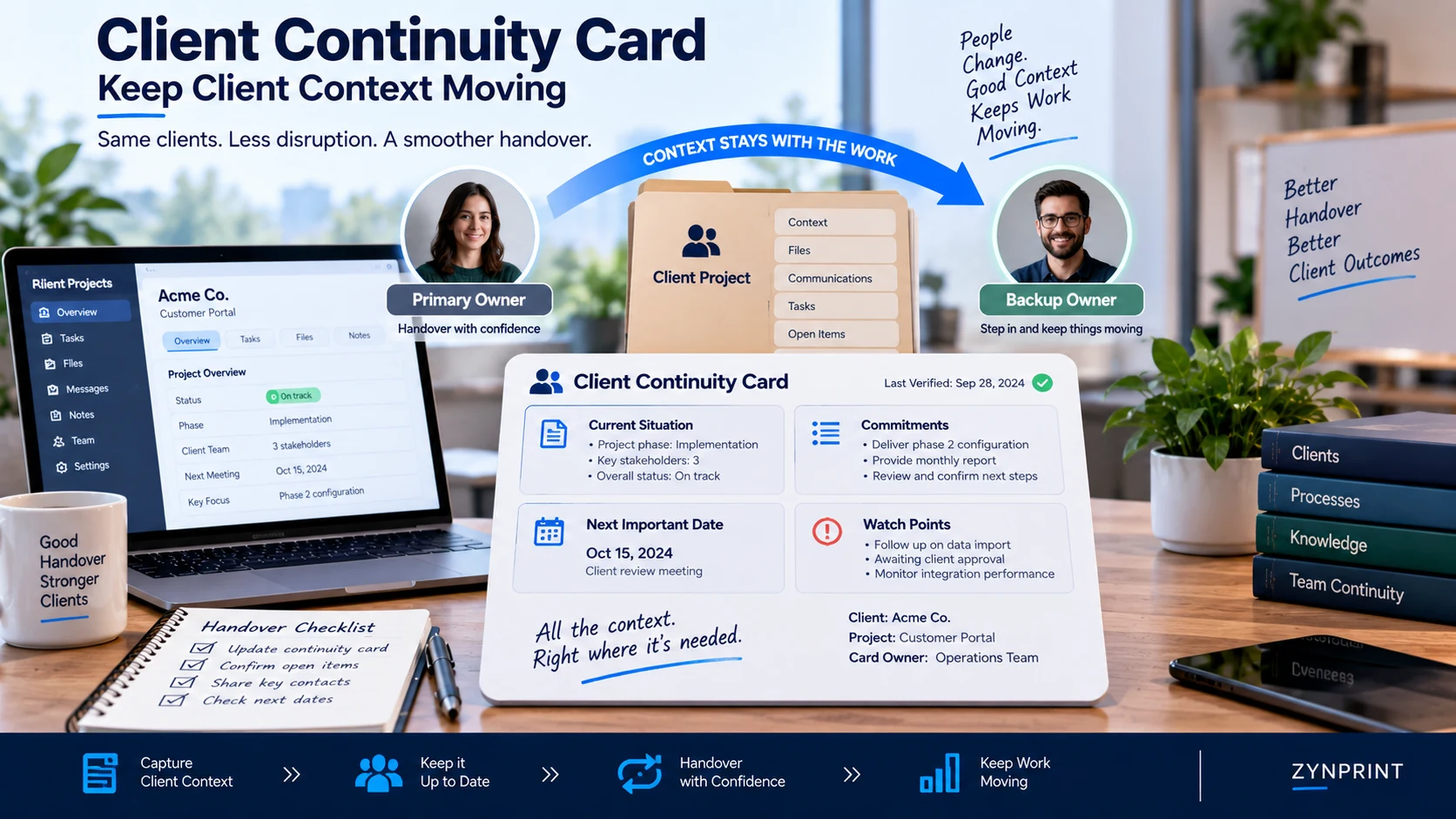
A small business client continuity checklist helps teams keep client relationships and commitments moving when a key team member is unavailable.
Instead of relying on one person’s memory, a practical checklist captures the client’s current situation, important deadlines, commitments, backup owner, watch points, and next actions.
This guide shows how to build a simple Client Continuity Card that gives a backup team member enough context to step in without guessing or recreating the entire client history.
Record the “Do Not Guess” Areas
Some clients have decisions where guessing creates unnecessary risk.
Write them down.
Examples:
Pricing: Do not offer discounts without approval.
Scope: Confirm additional work before promising it.
Technical issue: Escalate rather than improvising a production change.
Legal wording: Do not approve legal language without the designated reviewer.
Refunds: Follow the company’s approval process.
Deadline changes: Confirm internally before committing.
This gives the backup owner permission to say:
“I need to confirm that before I promise it.”
That is better than making a confident but incorrect commitment.
Capture Client-Specific Vocabulary
Sometimes a small detail prevents unnecessary confusion.
A client may use:
- Internal project names
- Product abbreviations
- Department names
- Specific terminology
- Unique file names
- Internal approval labels
For example:
“Launch Pack” means the final set of campaign assets, not the project itself.
Or:
“Blue review” refers to the client’s internal legal approval stage.
This information may seem trivial.
During a handoff, it can prevent a lot of misunderstanding.
Create a “People Around the Client” Map
The primary contact is rarely the only person who matters.
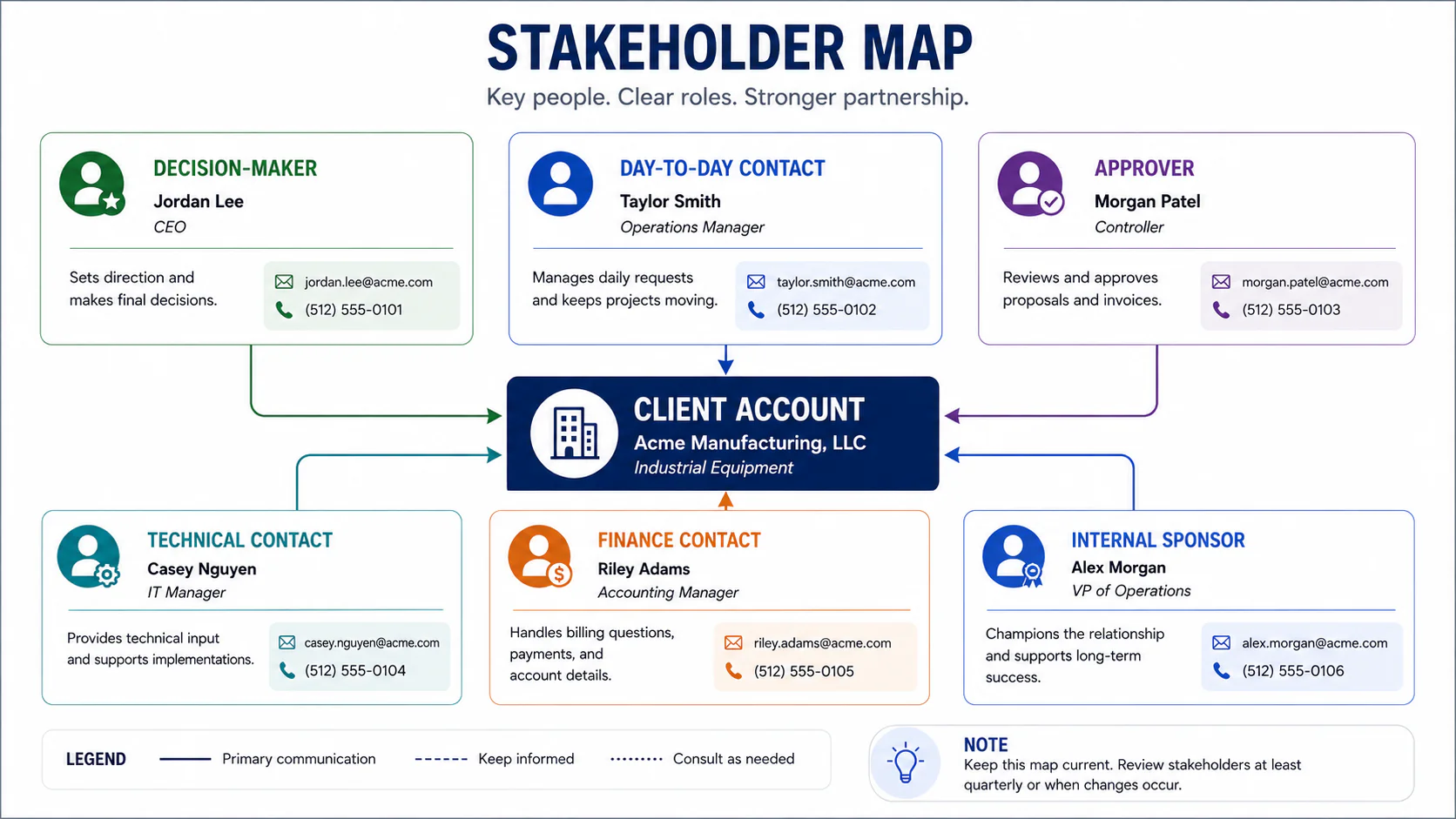
A useful client card can show:
Economic decision-maker
Who controls the commercial decision?
Day-to-day contact
Who manages the work?
Approver
Who signs off?
Technical contact
Who handles implementation questions?
Finance contact
Who handles billing?
Internal sponsor
Who originally pushed for the project?
This does not need to become a full organizational chart.
It simply helps the backup owner understand who plays which role.
Track Dependencies, Not Just Tasks
A task says:
“Send final brochure.”
A dependency-aware note says:
“Final brochure can only be sent after the client approves the updated pricing table.”
The second version is much more useful.
When building the continuity card, look for phrases like:
- Waiting for
- Depends on
- Requires approval from
- Blocked by
- After confirmation from
- Cannot proceed until
These relationships are often more important than the task list itself.
A replacement employee may be able to complete a task.
They may not know that completing it too early would create a problem.
Use a “Waiting On” Section
Create a tiny section:
Waiting On
Client: final logo file
Internal: technical review
Vendor: print quotation
Finance: payment confirmation
This creates an immediate picture of what is preventing progress.
It also makes follow-up easier.
The backup employee does not have to read every project comment to discover why something is still open.
Include the Next Two Important Dates
You do not need a full calendar.
Highlight only the dates that matter during the coverage period.
For example:
September 5: Client review
September 8: Final content deadline
September 12: Planned launch
This is enough to give the backup owner a sense of timing.
If the absence lasts longer, update the card.
Build a Short “Client Tone” Note
This section should remain professional.
Instead of:
“The client gets angry easily.”
write:
“If a deadline changes, communicate as early as possible and explain the revised sequence rather than waiting until the original deadline passes.”
Instead of:
“They ask too many questions.”
write:
“The client prefers detailed explanations before approving major changes.”
The difference is important.
You are documenting a useful working instruction rather than labeling a person.
Make Sensitive Information Deliberately Limited
Continuity documents may contain client information.
Do not include information simply because you have access to it.
Avoid unnecessary:
- Personal data
- Passwords
- Authentication codes
- Payment credentials
- Private personal details
- Sensitive health information
- Unrelated internal gossip
- Confidential information that is not required for continuity
Use the minimum information needed for the backup owner to perform their role.
If a sensitive document is necessary, link to the controlled source rather than copying sensitive content into a general continuity card.
Add an Expiration Date to Temporary Coverage
A continuity arrangement should not quietly become permanent.
Write:
Coverage period: September 10–14
Primary owner returns: September 15
Backup review: September 13
This prevents the backup owner from assuming they own the account indefinitely.
It also gives the primary owner a clear return point.
The “Return to Owner” Step
The handoff is not finished when the original employee returns.
The backup person should provide a short update.
For example:
During absence
- Client approved revised homepage
- One new question arrived
- Deadline unchanged
- No scope changes
- Finance confirmed invoice status
Returning owner
- Ayesha resumes account
- Bilal closes temporary coverage
- Updated card archived
This creates a clean loop.
Without it, the primary owner may return to an account where things changed while they were away.
Build a Handoff Window
If possible, create a short overlap before planned leave.
It does not need to be an hour-long meeting.
Fifteen minutes may be enough for a small account.
Use the time to explain:
- What is happening now
- What matters next
- What could go wrong
- What the client is waiting for
- What the backup should escalate
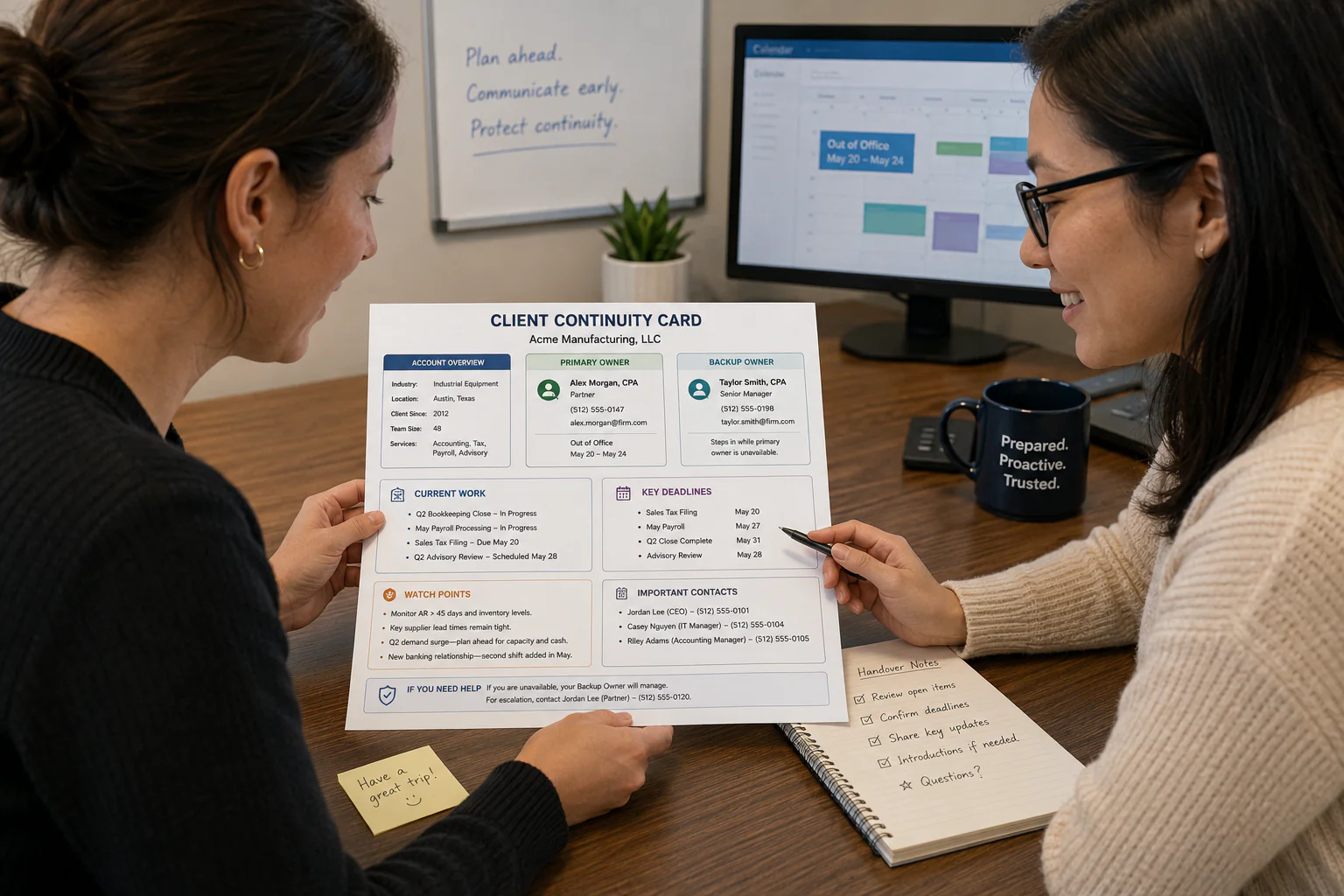
The card becomes the shared reference.
The conversation handles the nuance.
Use a “Coverage Level” Instead of Treating Every Client the Same
Not every client requires the same amount of preparation.
Create three simple levels.
Level A — Stable
Routine work.
No major deadlines.
Normal communication.
A short card is enough.
Level B — Active
Important project underway.
Multiple stakeholders.
Upcoming deadline.
The backup should review the account before coverage begins.
Level C — Sensitive
Major launch, dispute, renewal, payment issue, or high-impact deadline.
The backup should receive a direct handoff and know the escalation path.
This prevents small businesses from spending an hour preparing continuity notes for an account that needs five minutes.
Don’t Wait for Vacation to Use the System
The best test may be a normal working day.
Ask an employee:
“If you were unavailable tomorrow, could someone else handle your most important client without asking you 20 questions?”
If the answer is no, the continuity gap already exists.
Vacation simply exposes it.
The system should therefore be useful throughout the year.
A good continuity card can also help when:
- A manager changes roles
- A client moves between departments
- A project is reassigned
- A team member is promoted
- Someone is unexpectedly absent
- A business grows faster than its documentation
Use Client Continuity as a Quality-Control Tool
There is another benefit.
When you write down the account context, gaps become visible.
You may discover:
- Nobody knows who has final approval
- A deadline was never formally confirmed
- The client has been waiting for a response
- Two employees gave different answers
- An important commitment exists only in email
- A project depends on one person’s knowledge
The continuity exercise becomes a small operational audit.
You are not only preparing for absence.
You are finding weak points in the account.
A Fictional Example: The Three-Day Gap
Consider a fictional design studio called Harbor & Pine.
Its senior account manager, Nadia, manages eight active clients.
She plans to take three days off.
For years, Nadia has simply told clients:
“I’ll be away next week. Bilal can help if anything urgent comes up.”
Bilal knows the company.
He does not know Nadia’s accounts.
The studio creates a Client Continuity Card for each active client.
One card says:
Client: Meadow & Co.
Current situation: Final packaging concepts are under review.
Waiting on: Client’s legal team to approve one product statement.
Next date: Thursday review call.
Client preference: Consolidated feedback from marketing lead.
Watch point: Do not finalize print files until legal approval is confirmed.
Backup: Bilal
Escalation: Studio director
Bilal now has a clear operating picture.
During Nadia’s absence, the client sends a question about the packaging timeline.
Bilal does not guess.
He checks the card.
He sees that legal approval is still pending.
He replies that he will confirm the updated timeline and returns internally for confirmation.
No unnecessary promise is made.
When Nadia returns, Bilal gives her a short update:
Legal approval is still pending. Client asked about the print date. No scope changes.
The client relationship did not depend on Nadia being physically available for every question.
That is the purpose of continuity planning.
This example is fictional and is included only to demonstrate the workflow.
What Makes a Good Continuity Card?
A useful card should be:
Short
A backup employee should not need to read a novel.
Current
Old information is worse than missing information because it creates false confidence.
Specific
“Important client” is less useful than “Final approval comes from the marketing director.”
Neutral
Describe working facts rather than personal judgments.
Actionable
Tell the reader what happens next.
Linked
Point to deeper source documents when more detail is required.
Owned
Someone should be responsible for keeping it accurate.
The 10-Minute Client Continuity Review
For each important account, ask:
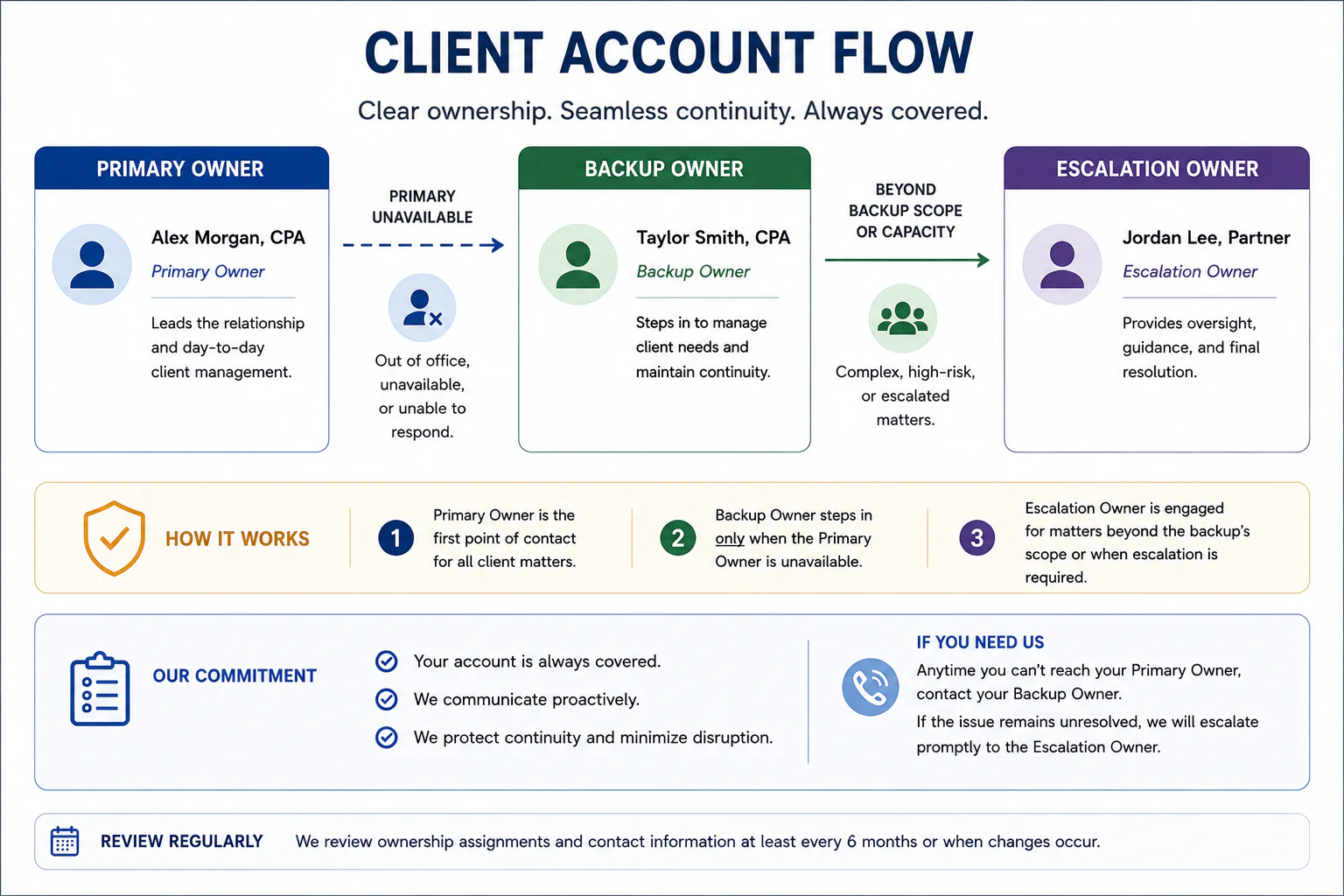
- Who owns this relationship?
- Who is the backup?
- What is happening right now?
- What is the next important deadline?
- What are we waiting for?
- What has already been promised?
- Who has final approval?
- What should the backup avoid promising?
- What could cause a problem?
- Who should be contacted if something unexpected happens?
If those answers fit on a single page, you probably have enough context for temporary coverage.
If they require ten pages, ask whether all of that information really belongs in the continuity card.
Review the Card After the Client Moves Forward
Continuity documentation should evolve with the account.
When a major milestone occurs, update:
- Current situation
- Next deadline
- Waiting items
- Watch points
- Stakeholder roles
- Outstanding commitments
Do not wait for the next vacation.
A stale continuity card can create more confusion than no card at all.
Give the Card a “Last Verified” Date
Add:
Last verified: September 2, 2026
This tells the backup owner how much confidence to place in the information.
If the card was updated yesterday, it may be highly useful.
If it has not been reviewed for eight months, the backup should verify important details before acting.
This is a small field with significant practical value.
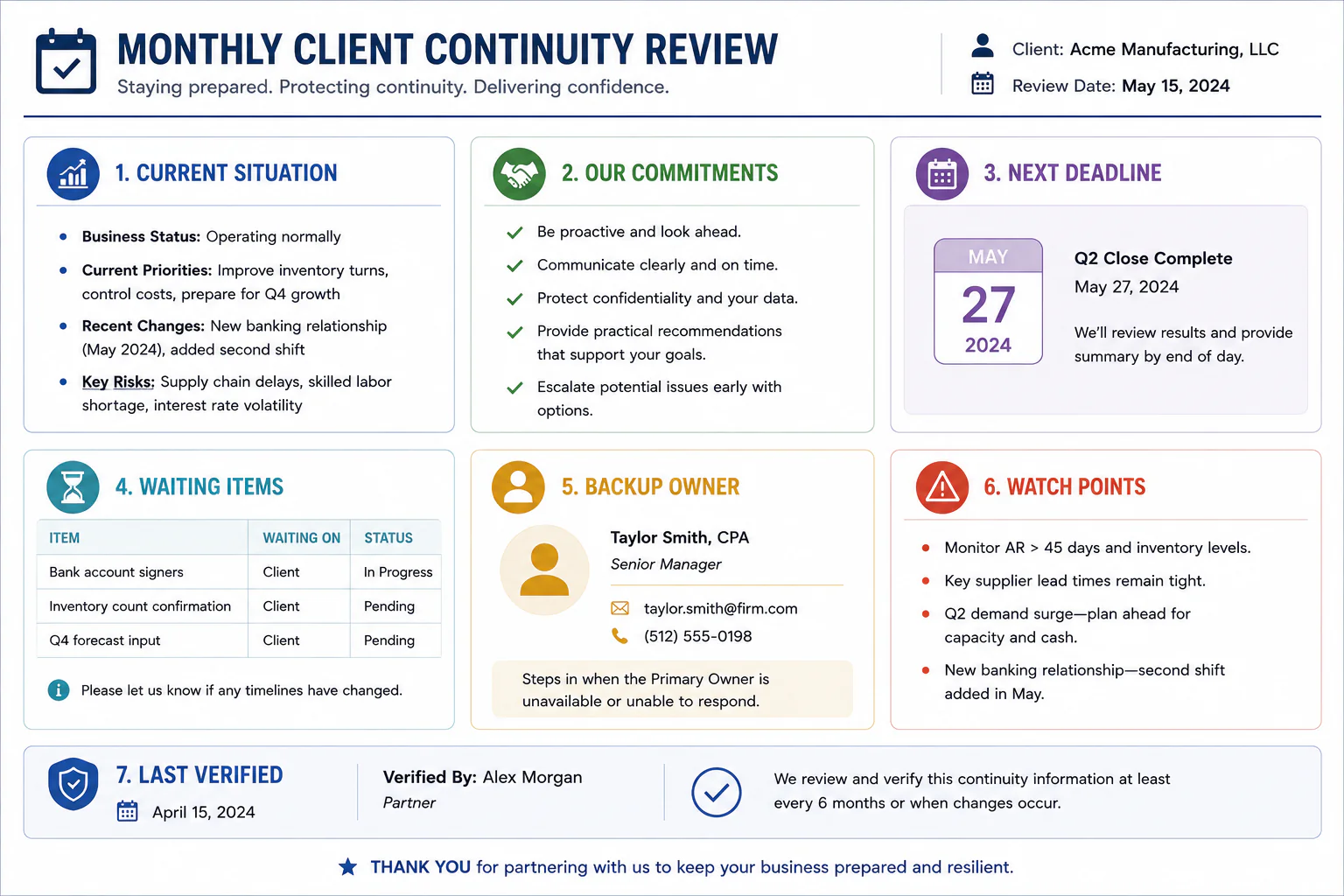
A Simple Client Continuity Card Template
You can start with this structure.
CLIENT CONTINUITY CARD
Client: __________________________
Primary Owner: ___________________
Backup Owner: ____________________
Escalation Owner: ________________
Coverage Period: _________________
Last Verified: ____________________
CURRENT SITUATION
What is happening with this client right now?
NEXT IMPORTANT ACTION
Action: __________________________
Owner: ___________________________
Due: _____________________________
WAITING ON
CURRENT COMMITMENTS
CLIENT PREFERENCES
Main communication channel: ______
Primary contact: _________________
Final approver: ___________________
Important working preference: _____
WATCH POINTS
DO NOT GUESS
What decisions require internal confirmation?
KEY LINKS
Project: _________________________
Contract: ________________________
Latest approved material: _________
Account history: _________________
RETURN TO OWNER
Expected return: _________________
Coverage summary required: Yes / No
This is intentionally small.
The card should guide someone toward the right information rather than attempt to contain the entire client relationship.
Common Client Continuity Mistakes
Writing a Biography Instead of a Working Summary
The backup needs current operational context, not the client’s entire history.
Copying the Entire Inbox
More information does not automatically create more understanding.
Recording Opinions as Facts
Describe observable working patterns instead of labeling people.
Forgetting Current Commitments
The biggest risk during coverage is accidentally breaking an existing promise.
Not Naming a Backup
A document without an owner does not create coverage.
Allowing the Backup to Make Unapproved Promises
Temporary responsibility does not always mean full decision authority.
Hiding Important Dependencies
A deadline that depends on another approval should be clearly visible.
Leaving the Card Outdated
Old information can create false confidence.
Creating a Separate System Nobody Uses
If the card lives somewhere nobody checks, it becomes another abandoned document.
Including Unnecessary Sensitive Information
Only include information needed to perform the coverage role.
Skipping the Return Handoff
The original owner needs to know what changed while they were away.
Treating Every Client the Same
Stable accounts need less preparation than high-risk or deadline-heavy accounts.
Frequently Asked Questions
What is a client continuity checklist for a small business?
It is a practical set of information that helps another team member temporarily manage a client relationship when the normal account owner is unavailable.
What should a client continuity card contain?
At minimum, include the current situation, next action, important commitments, client preferences, stakeholders, watch points, backup owner, escalation route, and links to deeper records.
Should every client have a continuity card?
Not necessarily. Start with important or active accounts where the absence of one person could disrupt delivery, communication, or deadlines.
How long should a client continuity card be?
For many small-business accounts, one page is a useful target. More complex clients may require additional supporting documentation, but the core card should remain easy to scan.
Where should I store the card?
Use a system your team already trusts and can access appropriately, such as a CRM, project workspace, shared business documentation system, or controlled client folder.
Should the card include client personal information?
Only include information that is genuinely necessary for the backup role. Avoid unnecessary personal or sensitive information.
How often should I update the card?
Update it when important account circumstances change. A quick review before planned leave is also useful, especially if the account has active deadlines or unresolved issues.
What if there is no obvious backup person?
Choose someone who can handle the first level of communication and clearly define what must be escalated. The backup does not need to replace the primary owner’s full expertise.
Should a backup employee contact the client directly?
If they are authorized to do so, yes. The continuity card should make clear which communications the backup can handle and which require approval.
How do I avoid making clients feel like they are being passed around?
Keep the transition simple. Where appropriate, introduce the backup before the absence and explain that they are the designated contact during the coverage period.
Is a continuity card the same as a client handoff document?
Not exactly. A handoff document can describe a formal transfer of responsibility. A continuity card is lighter and is designed to give temporary coverage enough context to keep work moving.
Can this work for freelancers?
Yes. A solo freelancer can create a smaller version for a trusted backup, subcontractor, business partner, or emergency contact who may need to understand important client commitments while the freelancer is unavailable.
Final Thoughts
Small businesses often think they have a documentation problem.
Sometimes they actually have a context problem.
The task exists.
The file exists.
The email exists.
The project plan exists.
But the person who knows what all of it means is temporarily unavailable.
That is the gap a Client Continuity Card is designed to close.
You do not need to document every conversation.
You do not need a massive client-management manual.
You do not need to make every employee capable of replacing every other employee.
You need enough shared context for another responsible person to step in without guessing.
Start with your most important accounts.
Write down:
What is happening?
What happens next?
What have we promised?
What are we waiting for?
What should the backup avoid?
Who makes the final decision?
Then name the backup.
Review the card before planned absences.
Update it when the account changes.
And when the primary owner returns, close the loop with a short coverage summary.
The real value is not the document itself.
The value is reducing the number of things that exist only inside one person’s head.
A client should not experience a business as if its entire relationship disappeared because one employee took three days off.
Your team should be able to maintain continuity without pretending that the backup person knows everything.
That is the balance to aim for:
enough context to act, enough boundaries to avoid guessing, and enough structure to keep the client experience steady.