
Prevent Scope Creep From Client Requests: Small Business Guide
- by Muhammad Raza
- 0 Comments
- 16 minutes read
- 34 Views
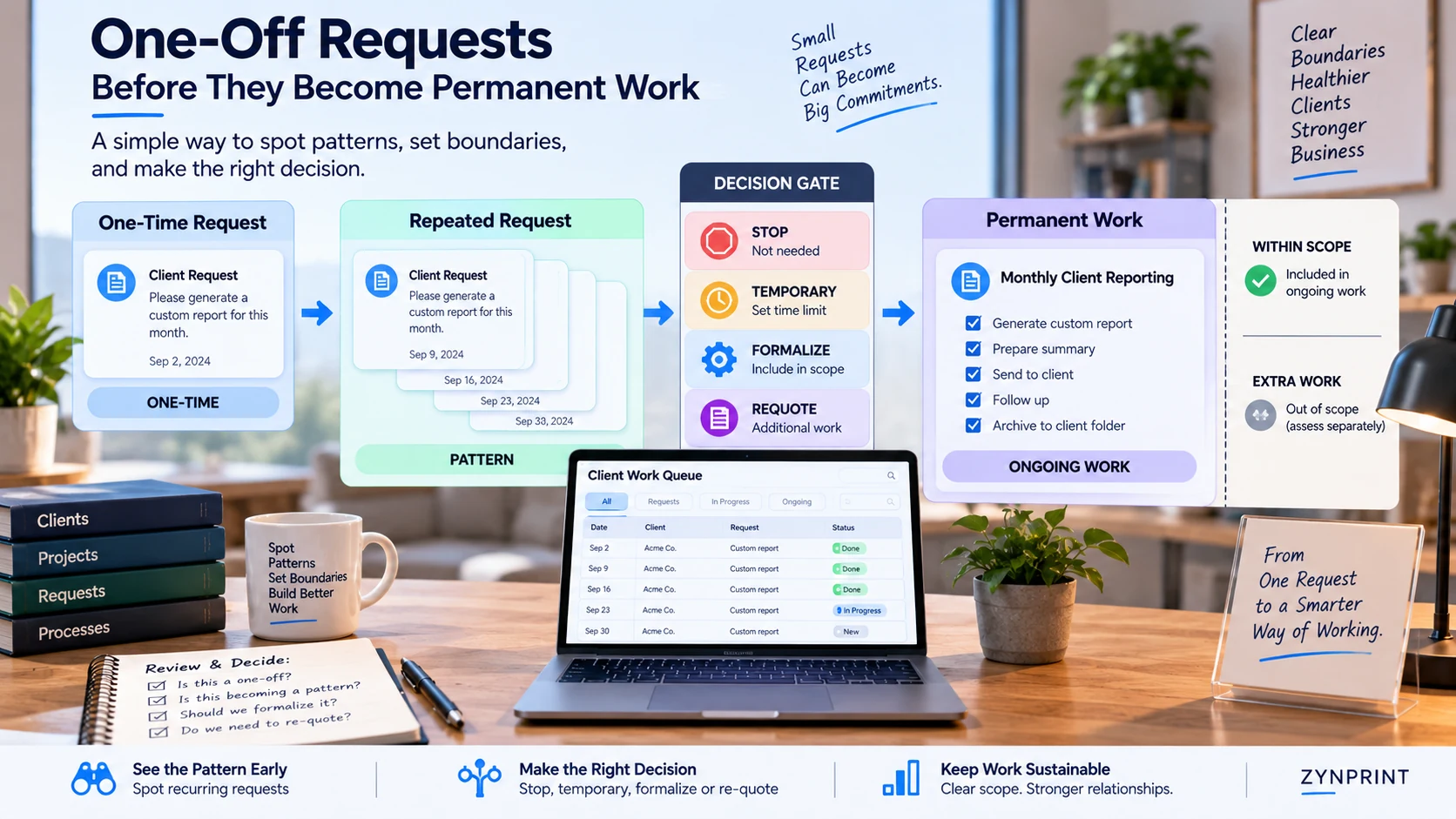
Learning how to prevent scope creep from client requests starts with recognizing that small favors can quietly become permanent work.
A request that takes ten minutes today can create a recurring expectation tomorrow if nobody defines what the exception means.
This guide shows how to classify one-time, temporary, and recurring requests, set clear boundaries, and review repeated exceptions before they become an accidental part of the service.
Use a Small Exception Register
If unusual requests happen frequently, create a simple register.
It might contain:
| Date | Client | Request | Decision | Boundary | Repeat? |
|---|---|---|---|---|---|
| Sept 3 | Northstar Foods | Extra report | One-time | Current month | No |
| Sept 12 | Northstar Foods | Extra report | One-time | Current month | Yes |
| Sept 19 | Northstar Foods | Extra report | Review | Pending decision | Yes |
The register does not need to become a complicated project-management system.
Its purpose is to reveal patterns that are difficult to see inside individual conversations.
Look for Repeated Work, Not Just Repeated Words
A client may ask for the same outcome using different language.
For example:
- “Can you prepare this list?”
- “Could you send us the updated version?”
- “Can you pull this information again?”
- “Would you mind generating the same report?”
The wording changes.
The underlying work does not.
Therefore, review the actual activity rather than searching only for identical phrases.
Ask:
“Are we repeatedly performing the same kind of work?”
That is a better indicator of an emerging service obligation.
Create Three Boundaries: Time, Quantity, and Outcome
A one-time exception becomes much clearer when the boundary is specific.
Time Boundary
“We will do this through September 15.”
Useful for temporary support.
Quantity Boundary
“We will prepare these five additional files.”
Useful when the request has a defined volume.
Outcome Boundary
“We will provide one additional report for this launch.”
Useful when the work is tied to a specific business event.
Avoid vague boundaries such as:
“We can help for now.”
Nobody knows what “for now” means.
Make the Boundary Visible to the Team
A client may understand that something is temporary.
The internal team may not.
Suppose the account manager agrees to:
“We’ll prepare this report for the next two weeks.”
The designer sees only:
“Prepare weekly report.”
Three months later, the report is still being produced.
The exception existed in one person’s conversation.
The workflow treated it as permanent.
Whenever a temporary agreement affects another team member, record the boundary where the work happens.
For example:
Temporary — ends September 15.
That tiny label can prevent a lot of confusion.
Give Someone Ownership of the Exception
Every exception should have one person responsible for checking its status.
Not necessarily the person doing the work.
For example:
Request owner: Account Manager
Work owner: Designer
Approval owner: Operations Manager
This distinction matters.
The person performing the task may not be the person who decides whether the exception should continue.
Create a “Do Not Assume Renewal” Rule
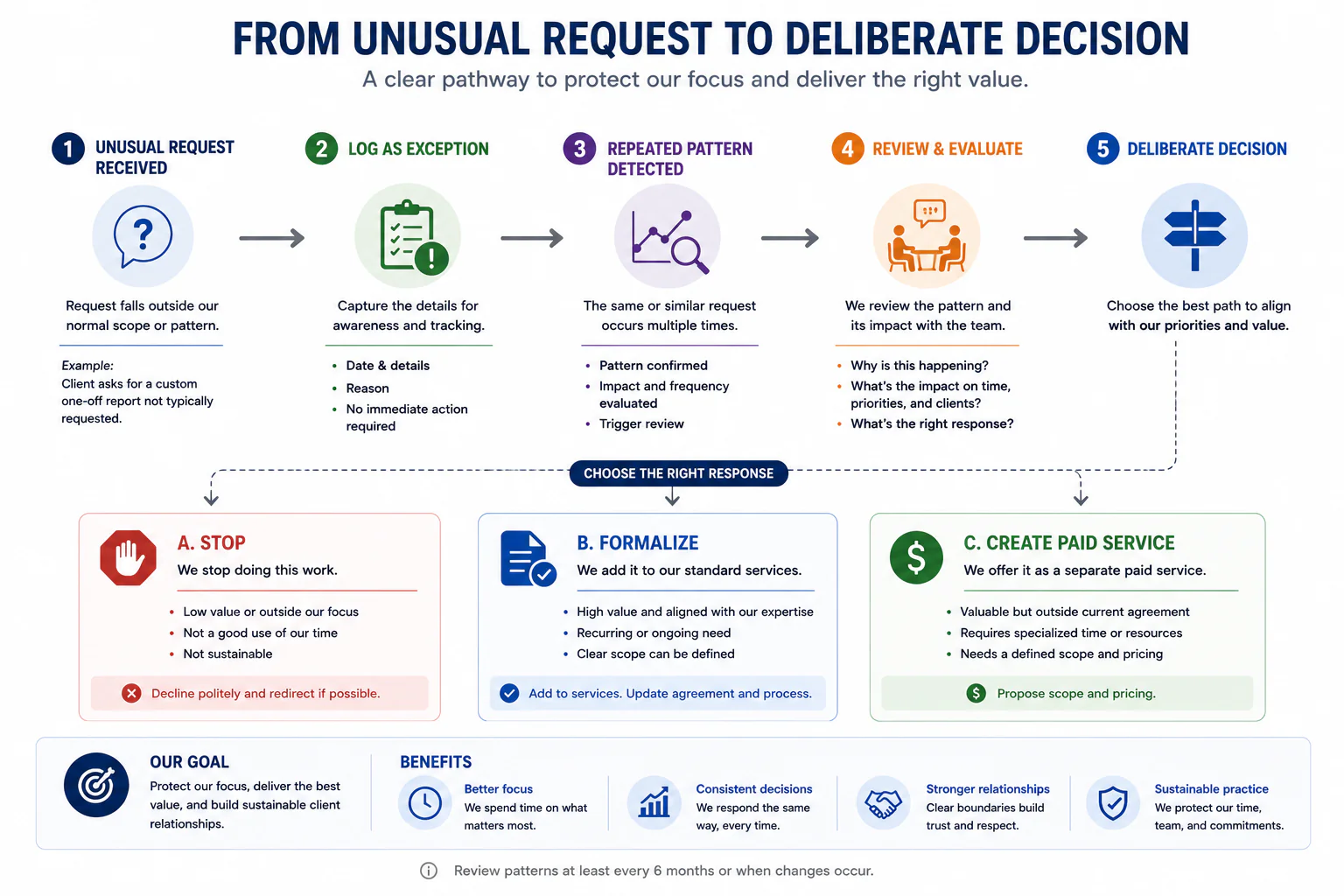
A temporary exception should expire unless someone deliberately extends it.
That means:
Silence does not equal renewal.
If a temporary reporting arrangement ends on September 15, the business should not automatically continue it on September 16 simply because nobody discussed it.
At the end point, someone should decide:
- Stop it
- Extend it
- Change it
- Formalize it
- Price it separately
This turns expiration into a decision point.
Avoid Making the Client Manage Your Internal Boundaries
A business should not say:
“You asked for this three times, so now it is out of scope.”
That may be technically true, but it puts the burden on the client to understand an internal process they were never shown.
A better approach is to manage the boundary professionally.
For example:
“We’ve handled this as a temporary addition for the current project. Since it is becoming a recurring requirement, we’d like to confirm the best way to include it going forward.”
That opens a business conversation without creating unnecessary friction.
Use a “Goodwill Budget” Carefully
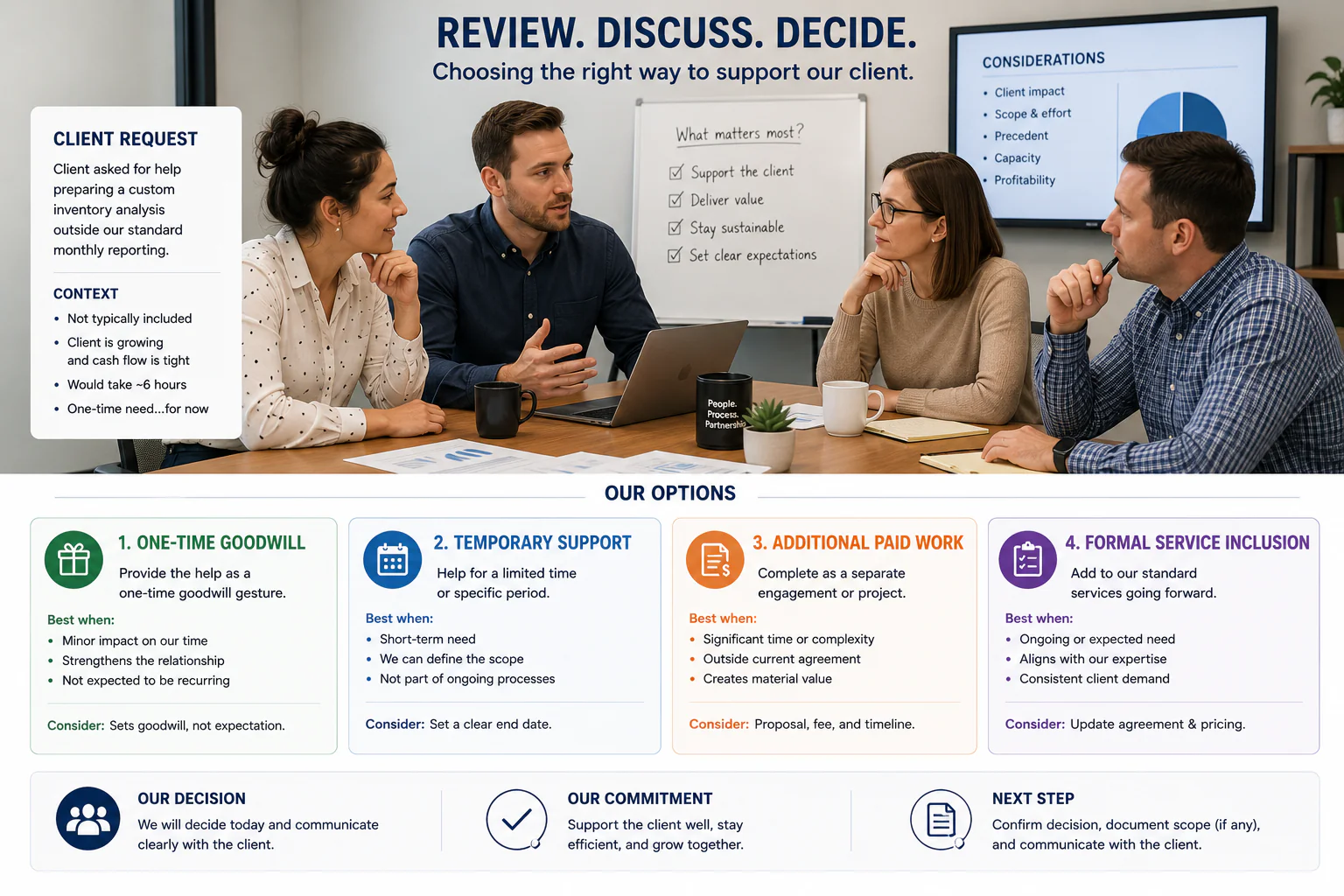
Some businesses intentionally accept small extras as goodwill.
That can be reasonable.
The problem is when goodwill has no boundary.
Instead of:
“We sometimes do little extras for clients.”
define an internal rule.
For example:
Goodwill exception: Small request, low risk, no more than once per project phase.
The exact rule depends on the business.
The important part is that goodwill is a decision.
It is not an unlimited subscription.
Distinguish Convenience From Obligation
Sometimes employees say yes because the request is easy.
That is understandable.
But ease does not determine whether the work should become part of the service.
A five-minute task can still create:
- A recurring expectation
- A quality-control requirement
- A support burden
- A deadline obligation
- A new dependency
- A customer expectation
Ask:
“What will this create if we repeat it?”
That question is more useful than:
“How long will this take today?”
Watch for the “Just Add It” Pattern
A project may slowly accumulate small additions.
For example:
- One extra page
- One extra revision
- One extra meeting
- One extra export
- One extra report
- One extra support channel
Individually, each request seems harmless.
Together, they can change the shape of the service.
This is why businesses should occasionally review the pattern of exceptions, not just the size of individual requests.
Create an Exception Review Score
For businesses that receive many unusual requests, use a lightweight score.
Give each request one point for every condition that applies:
- Happens repeatedly
- Takes meaningful staff time
- Requires a new process
- Creates a new deadline
- Requires specialist knowledge
- Affects another team
- Requires ongoing communication
- Creates customer expectations
- Has financial impact
- Would be difficult to stop later
A higher score does not automatically mean “charge more.”
It means:
This request deserves an explicit business decision.
This keeps the system practical without pretending that every extra request has the same importance.
Create a “Permanent Work Test”
Before adding a repeated request to the normal workflow, ask:
Is it predictable?
Can the team expect it regularly?
Is it owned?
Does someone have responsibility for it?
Is it resourced?
Can the business perform it consistently?
Is it documented?
Does the team know how to handle it?
Is it commercially understood?
Does the business know whether it is included, separately billed, or otherwise approved?
If several answers are no, do not quietly add the request to the standard workflow.
Don’t Turn Every Exception Into a New Procedure
There is an opposite problem.
A business can become so concerned about scope that it creates a 12-page policy for every unusual request.
That is unnecessary.
The goal is not to document every strange thing a client might ask.
The goal is to capture exceptions that:
- Repeat
- Consume meaningful time
- Change responsibilities
- Affect deadlines
- Create commercial consequences
- Require approval
- Create operational risk
Small exceptions can stay small.
The documentation should match the significance of the decision.
Use the “Pattern Before Policy” Principle
Do not create a permanent process because one unusual request happened.
Watch the pattern first.
For example:
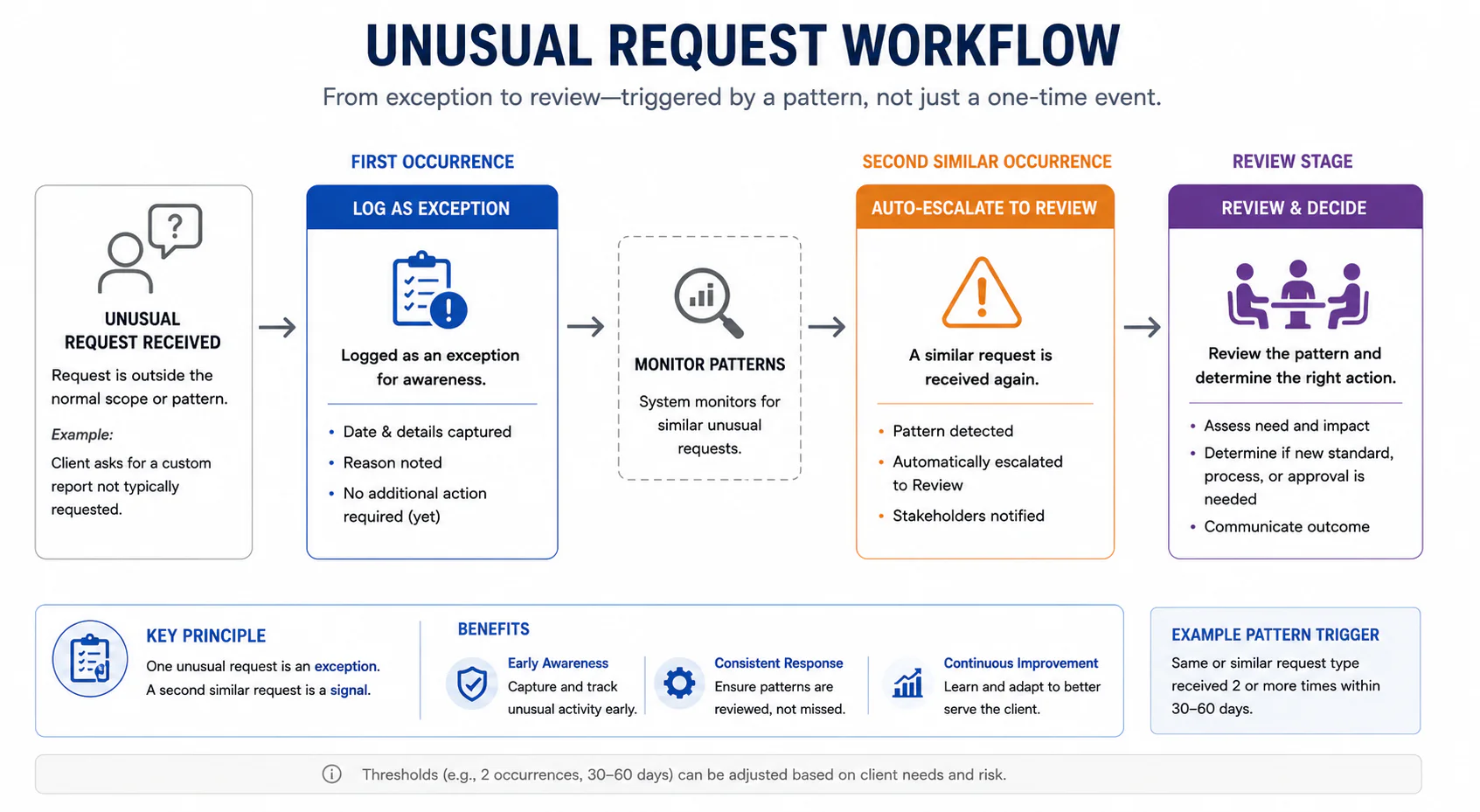
One request: Log it.
Second similar request: Review it.
Repeated requests: Decide whether it should become a standard service.
This avoids both extremes:
Ignoring repeated work
and
Building a policy around a one-off event.
Give Employees a Safe Way to Say “Let Me Check”
Employees sometimes accept extra requests because they do not want to disappoint a client.
Give them a neutral response.
For example:
“Let me confirm the best way for us to handle that and I’ll get back to you.”
This creates space for internal review.
The employee does not need to say:
“That’s out of scope.”
before they know whether it actually is.
Create a “Boundary Language” Library
Your team can keep a few professional phrases available.
One-Time
“We can handle this as a one-time addition for the current project.”
Temporary
“We can support this through the current launch period and review it afterward.”
Additional Work
“This is outside the current service, so we’ll confirm the additional work before proceeding.”
Needs Approval
“I’ll confirm internally before committing to that.”
Becoming Recurring
“Since this is becoming a regular requirement, let’s agree on the best ongoing arrangement.”
These phrases are not scripts employees must use word-for-word.
They simply make boundary-setting easier.
Review Exceptions at the End of the Month
Once a month, spend 15 minutes reviewing unusual client requests.
Ask:
- Which exceptions repeated?
- Which ones consumed significant time?
- Which temporary arrangements expired?
- Which requests became expected?
- Which exceptions should stop?
- Which should become standard?
- Which need a commercial decision?
This is enough to reveal patterns.
You do not need a full management meeting.
Create Four Possible Outcomes
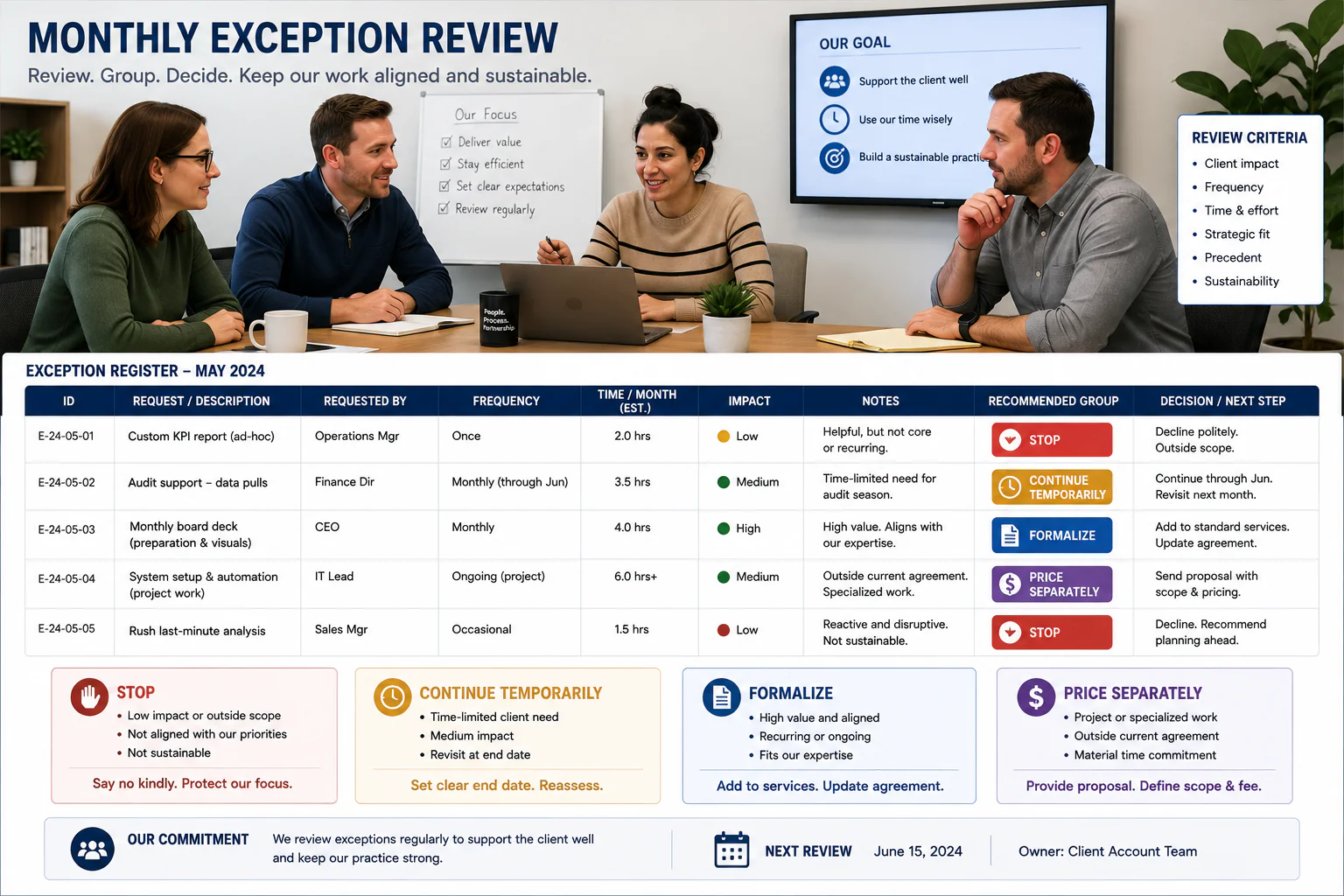
Every reviewed exception should end with a clear decision.
Stop
The business will not continue the request.
Continue Temporarily
The work continues until a specific date.
Formalize
The request becomes part of the normal service.
Requote
The business will provide the work under a new commercial arrangement.
These four choices prevent a fifth outcome:
“We just kept doing it.”
That is the outcome you want to eliminate.
What If the Client Says, “But You Did It Before”?
This is where the original boundary note becomes valuable.
You do not need to argue.
You can explain:
“Yes, we handled that as a one-time exception for the previous project. This new request is outside that temporary arrangement, so we’d like to confirm how you want to handle it going forward.”
The business is not denying history.
It is explaining that history had a boundary.
That is much easier to defend when the original decision was documented.
Do Not Let Temporary Work Become Invisible Training
There is another hidden cost.
When employees repeatedly perform unusual tasks, new employees may eventually assume those tasks are normal.
The exception becomes institutional knowledge.
A new staff member joins.
They are shown:
“This is how we handle this client.”
Nobody explains that the process was originally temporary.
Now the business has converted an old exception into a standard operating habit.
This is why recurring exceptions should eventually be either formalized or removed.
Use a “First Appearance” Date
For repeated requests, record when the pattern first appeared.
For example:
First observed: June 4
Repeated: June 18, July 2, July 16
Review date: July 20
This helps the team see how long an exception has been quietly operating.
It also makes the review less dependent on memory.
Track the Original Reason
A temporary decision may have made perfect sense when it was created.
Three months later, the reason may no longer exist.
For example:
Original reason: Client launch deadline
Current situation: Launch completed
If the extra work is still happening, ask why.
The original justification may have expired.
That is one of the easiest ways temporary work becomes permanent.
Build an “End Condition,” Not Just an End Date
Dates are useful.
But some exceptions end when an event occurs.
For example:
“Support this reporting format until the client’s internal system migration is complete.”
The end condition is:
Client system migration completed.
Other examples:
- Until launch
- Until the replacement employee starts
- Until the backlog is cleared
- Until the campaign ends
- Until the temporary supplier arrangement finishes
An end condition can be more meaningful than an arbitrary date.
A Fictional Example: The Extra Report
Consider a fictional marketing studio called Brightlane Creative.
A client asks for a weekly performance report that is not part of the studio’s normal service.
The account manager agrees to prepare it for four weeks because the client is preparing for an important internal review.
The request is recorded:
Status: Temporary
Reason: Client’s internal review
End condition: Four weekly reports
Owner: Account Manager
At week three, the client asks:
“Can we keep receiving this report every Monday?”
Instead of automatically continuing, the account manager reviews the request.
The studio has three choices:
- Stop after the fourth report
- Continue under the existing service
- Offer the report as a separate recurring service
The request has changed from temporary support to a potential ongoing responsibility.
The team can now make that decision deliberately.
This example is fictional and is included only to demonstrate the framework.
The Client Is Not Always Asking for “More”
Sometimes a repeated request reveals something else.
It may show that:
- The original service is missing a useful feature
- The client’s needs changed
- The team discovered a better workflow
- The business is underpricing a valuable service
- A manual task should be redesigned
- A recurring request should become a productized service
This is why exception tracking can be useful for growth as well as protection.
A pattern can reveal an opportunity.
But the business should choose to capture that opportunity.
It should not happen accidentally.
Turn Repeated Exceptions Into Product Ideas
Suppose five clients independently ask for the same additional service.
Instead of treating those requests as annoying extras, ask:
“Is there a service here that clients actually value?”
Perhaps the business could create:
- A reporting package
- A maintenance add-on
- A monthly review
- A support tier
- A content update service
- A technical monitoring package
- A consultation session
The important sequence is:
Exception → Pattern → Decision → Service
not:
Exception → Permanent free work
Protect the Team From Quiet Scope Expansion
Scope creep is often discussed as a pricing problem.
It is also a workload problem.
When extra requests become normal without being acknowledged, employees may experience:
- More interruptions
- More context switching
- Less predictable schedules
- More deadline pressure
- Confusion about priorities
- Frustration about inconsistent expectations
A boundary system gives employees something concrete to point to.
Instead of asking:
“Should I do this?”
they can ask:
“Which category does this request belong to?”
That is a much easier operational question.
Don’t Make Boundary Tracking a Weapon
There is a danger in the opposite direction.
A manager could use the exception register to criticize employees:
“Why did you agree to this?”
That destroys the system.
Employees need to feel safe recording exceptions.
The register should answer:
“What did we learn?”
not:
“Who should we blame?”
If staff hide unusual requests because they fear criticism, the business loses visibility.
Review the Client Relationship, Not Just the Task
Repeated requests sometimes indicate a broader issue.
For example:
A client keeps requesting extra meetings.
Maybe they are confused.
A client repeatedly asks for revisions.
Maybe the brief is unclear.
A client constantly asks for status updates.
Maybe the normal reporting process is insufficient.
The exception is a signal.
Do not only ask:
“How do we stop doing this?”
Also ask:
“Why does this keep happening?”
The answer may improve the whole client relationship.
Build a Small “Exception Dashboard”
You do not need sophisticated software.
A spreadsheet can contain:
| Client | Exception Type | First Seen | Last Seen | Frequency | Current Boundary | Decision |
|---|---|---|---|---|---|---|
| Client A | Extra reporting | June 4 | Aug 28 | Weekly | Sept 15 | Review |
| Client B | Extra revisions | July 10 | Aug 12 | Occasional | Current project | Continue |
| Client C | Extra meetings | Aug 2 | Aug 30 | Weekly | Sept 5 | Formalize |
The dashboard is not meant to measure employees.
It is meant to show where the service is changing.
Create a Quarterly Scope Reality Check
Once every few months, compare:
What we originally agreed to
with
What we actually do
This can reveal services that quietly entered the business.
Ask:
- Which activities were not part of the original service?
- Which ones now happen regularly?
- Which ones are valuable?
- Which ones are inefficient?
- Which ones should stop?
- Which ones should be formally included?
- Which ones should be separately priced?
The goal is not to eliminate flexibility.
It is to make the actual service visible.
A Simple One-Page Temporary Work Boundary Template
You can use this structure internally.
TEMPORARY WORK BOUNDARY
Client: ______________________________
Date: ________________________________
Requested By: ________________________
REQUEST
What additional or unusual work was requested?
CLASSIFICATION
☐ One-Time
☐ Temporary
☐ Recurring — review required
DECISION
☐ Approve
☐ Decline
☐ Approve temporarily
☐ Quote separately
☐ Escalate
REASON
Why are we making this decision?
BOUNDARY
Time limit: __________________________
Quantity limit: _______________________
Outcome limit: ________________________
End condition: ________________________
OWNER
Request owner: _______________________
Work owner: _________________________
Approval owner: ______________________
REVIEW
Review date: _________________________
Repeated before? Yes / No
What should happen if requested again?
SOURCE
Relevant brief, agreement, project record, or client communication:
The template is intentionally short.
If employees need a complicated form every time someone asks for an extra task, they will stop using it.
Common Mistakes When Managing One-Off Client Requests
Saying Yes Without Defining the Boundary
The client may reasonably assume the work will happen again.
Treating Every Extra Request as a Pricing Dispute
Some requests are better solved through classification and clarification first.
Recording Exceptions Only in Email
Important boundaries can disappear inside long conversations.
Letting the Person Doing the Work Decide Everything
The worker may not have authority to change the service.
Forgetting Why the Exception Was Created
The original reason may disappear while the work continues.
Ignoring the Second Request
A repeated request is often the first useful signal that the situation has changed.
Making Exceptions Permanent by Silence
If nobody decides to stop, the work may continue indefinitely.
Tracking Tasks Instead of Patterns
Different wording can still represent the same recurring work.
Punishing Employees for Recording Exceptions
People will hide exceptions if documentation feels like blame.
Creating Too Much Administration
The system should take seconds or a minute, not become another project.
Never Reviewing the Register
A list that nobody examines cannot reveal emerging patterns.
Assuming the Client Is the Problem
Repeated requests can reveal weaknesses in the business’s own service design.
Frequently Asked Questions
What is scope creep in a small business?
Scope creep occurs when work gradually expands beyond the originally understood service, project, or responsibility without a clear decision about the change.
Does every extra client request count as scope creep?
No. A request may be included, intentionally accepted as goodwill, approved as a one-time exception, or formally added to the service. The important issue is whether the business makes the decision deliberately.
How can a small business prevent scope creep?
Start by recording unusual requests, defining their boundaries, watching for repetition, and reviewing repeated exceptions before they become permanent work.
What should I do when a client asks for a small favor?
First determine whether the request is already included. If it is not, decide whether it should be handled once, temporarily, separately, or not at all.
Why should the second request trigger a review?
A second similar request provides evidence that the need may not be isolated. It is a useful point to decide whether the work is becoming part of the expected service.
Should I charge for every extra request?
Not necessarily. Some businesses intentionally use small exceptions as goodwill. The important part is knowing when goodwill ends and when a recurring service needs a different arrangement.
What if the client says, “You did this before”?
Explain the original boundary. If the previous work was a one-time or temporary exception, the new request can be evaluated separately without pretending the previous work never happened.
How long should a temporary exception last?
There is no universal duration. Use a specific date, quantity, milestone, or end condition that makes sense for the situation.
Should employees be allowed to approve extra work?
Only within clearly defined authority. Employees should know what they can approve independently and when a manager or account owner must decide.
Can tracking exceptions improve the business?
Yes. Repeated requests can reveal customer needs, inefficient processes, potential new services, unclear agreements, or areas where the existing offering should be redesigned.
Is an exception register necessary for every small business?
No. A simple note in the existing project or client record may be enough for a very small team. The important thing is that unusual decisions remain visible.
How often should exceptions be reviewed?
Monthly is a practical starting point for businesses that receive frequent unusual requests. Smaller businesses with fewer exceptions may review them quarterly or whenever a pattern becomes noticeable.
Can freelancers use this system?
Yes. A freelancer can use a simple four-field note—request, decision, reason, boundary—to prevent occasional client favors from quietly becoming permanent unpaid responsibilities.
Final Thoughts
A small client request rarely announces itself as a business problem.
It arrives as:
“Could you just do this one thing?”
Sometimes the right answer is yes.
The mistake is not saying yes.
The mistake is allowing one yes to silently become twenty more.
A business needs a way to distinguish:
a favor from a service,
a temporary arrangement from a permanent expectation,
and
a useful experiment from an accidental obligation.
The Temporary Work Boundary provides that structure.
Record the request.
Classify it.
Decide what you are willing to do.
Define the boundary.
Name the owner.
Set an end point.
Then watch what happens next.
If the request never returns, there is nothing else to do.
If it returns once, review the pattern.
If it keeps returning, make a deliberate decision.
Stop it.
Continue it temporarily.
Formalize it.
Or create a separate commercial arrangement.
The goal is not to become rigid with clients.
It is to become clear with yourself.
A flexible business can still have boundaries.
In fact, clear boundaries often make flexibility easier because employees know which requests they can handle without creating a new obligation.
The strongest question is not:
“How do we stop clients from asking for extra work?”
It is:
“How do we make sure every repeated request becomes a conscious business decision?”
That shift changes the entire conversation.
You stop treating every small request as a confrontation.
You start treating unusual work as information.
And when a pattern appears, you decide what the business actually wants that pattern to become.
Do the favor when you choose to. Just make sure the favor does not quietly write the next version of your service agreement.