
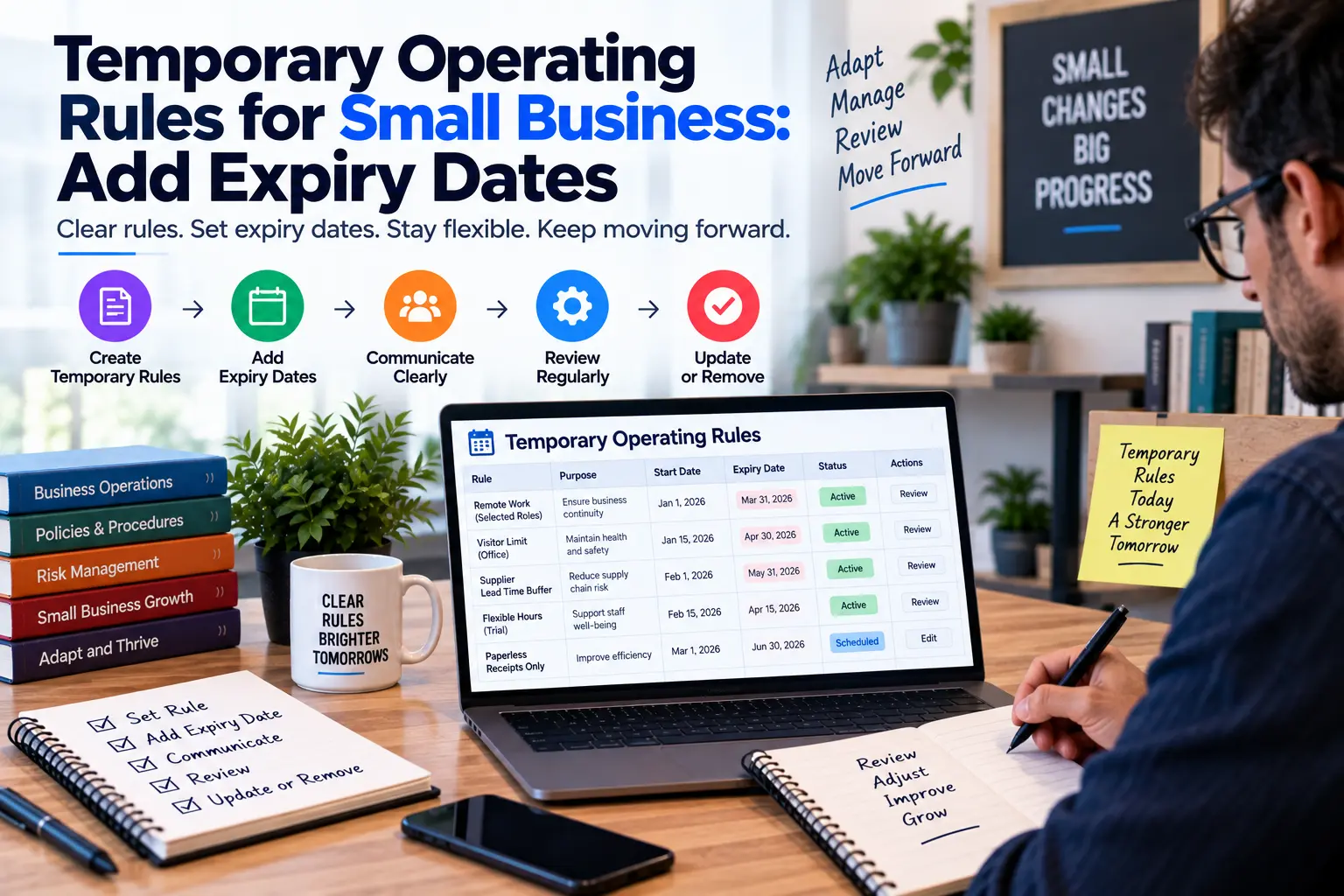
Temporary Operating Rules for Small Business: Add Expiry Dates
- by Muhammad Raza
- 0 Comments
- 21 minutes read
- 60 Views
Temporary operating rules for small business help teams handle short-term changes without letting workarounds, exceptions, or temporary responsibilities quietly become permanent processes.
A team member is away, so someone else handles their work.
A supplier is late, so the company uses a different ordering method.
A busy week means approvals are temporarily handled by someone else.
A client needs an unusual arrangement, so the business creates a short-term exception.
A software problem forces employees to use a spreadsheet until the normal system works again.
None of these decisions is necessarily bad.
In fact, temporary decisions are often exactly what keeps a small business moving.
The problem begins when the temporary arrangement survives longer than the reason that created it.
A workaround becomes the normal process.
A backup person becomes the permanent approver.
A special customer exception becomes an unofficial policy.
A temporary spreadsheet becomes the system everyone depends on.
Nobody deliberately approved the change.
It simply stayed.
This creates a subtle operational problem:
The business can end up following old decisions without remembering why they were introduced.
A practical solution is to give important temporary rules a Review or Expiry Point.
That does not mean every business decision needs a deadline.
It means temporary operating arrangements should have a visible answer to one question:
“When will we decide whether this still needs to exist?”
That small question can prevent temporary fixes from becoming invisible permanent systems.
What Is a Temporary Operating Rule?
A temporary operating rule is a short-term instruction, exception, responsibility, process, or arrangement created to deal with a specific condition.
Examples include:
- “Until the new employee starts, Sara approves these requests.”
- “For this campaign only, orders are checked twice a day.”
- “Until the supplier issue is resolved, purchase requests go through the alternate vendor.”
- “For the next two weeks, the owner reviews every refund.”
- “Until the software issue is fixed, the team records these transactions in a backup sheet.”
- “During this launch period, customer messages are answered by the operations team.”
These rules can be useful.
They become dangerous when nobody knows whether they are:
- still temporary,
- intentionally permanent,
- no longer necessary,
- or simply forgotten.
That is why a temporary rule should have three basic properties:
Reason → Owner → Review Point
If the reason disappears, the rule should be reconsidered.
If the owner changes, the rule should be reassessed.
If the review point arrives, someone should make an explicit decision.
The Difference Between a Temporary Rule and a Permanent Rule
The distinction is not complicated.
A permanent rule is intended to remain part of normal operations until the business deliberately changes it.
A temporary rule exists because something unusual is happening.
For example:
Permanent
Customer refunds below the approved threshold are handled by the support lead.
Temporary
For the next two weeks, the operations manager approves all refunds because the support lead is away.
The second instruction may be completely reasonable.
The problem appears when two weeks pass and nobody revisits it.
Now the team may be following a temporary arrangement without knowing whether it was ever meant to continue.
That is rule drift.
Why Temporary Rules Survive
Temporary rules rarely become permanent because someone announces:
“Let’s make this permanent.”
They usually survive through silence.
A temporary arrangement works well enough.
Nobody complains.
The original problem remains partly unresolved.
The person who introduced the rule forgets about it.
A new employee joins and assumes it is standard.
The team documents the workaround as a normal step.
Eventually, nobody remembers the original condition.
This is especially common in small businesses because the same people often perform several roles.
A founder might introduce a temporary approval process.
A manager might remember why it was created.
A new employee sees only the process.
The reason disappears before the rule does.
Build a Rule Shelf-Life System
Instead of maintaining a large policy library, create a simple Rule Shelf-Life System.
Every temporary operating rule receives:
- A reason
- A start date
- An owner
- A review date
- An expected end condition
- A decision when the review arrives
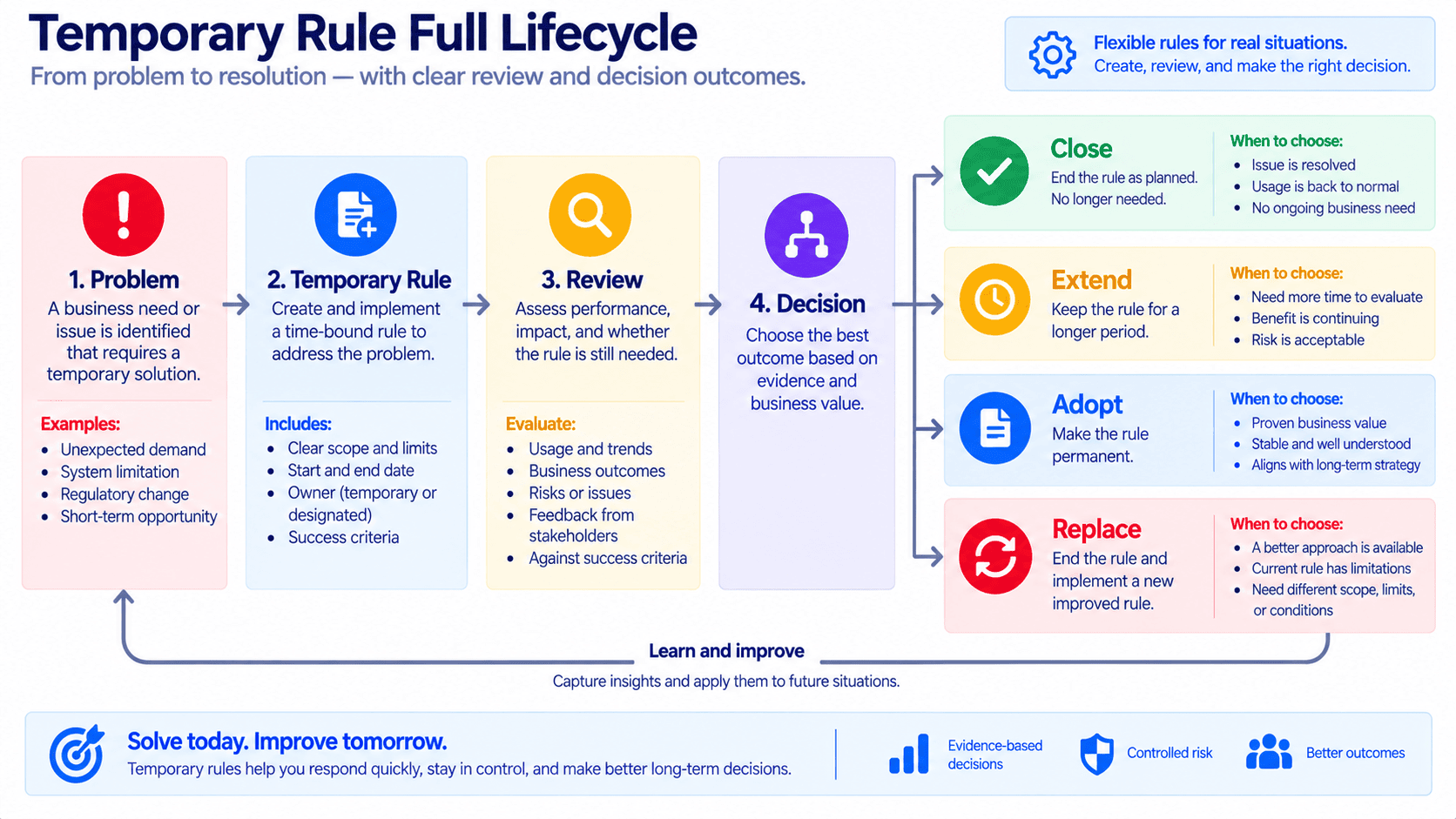
This creates a lifecycle:
Need → Temporary Rule → Review → Decision → Close or Adopt
The important part is the final decision.
A temporary rule should not disappear simply because nobody remembers it.
At review time, the business should deliberately choose what happens next.
Use the Temporary Rule Card
A simple Temporary Rule Card can contain:
| Field | What to Record |
|---|---|
| Rule | What temporarily changes |
| Reason | Why the change was introduced |
| Start date | When it began |
| Owner | Who maintains the rule |
| Affected work | Which process or team is involved |
| Expected duration | How long it was expected to last |
| Review date | When it must be reconsidered |
| End condition | What needs to happen before it can stop |
| Risk if retained | What could go wrong if it stays |
| Decision | Close, Extend, Adopt, Replace |
| Last reviewed | Most recent review date |
This does not need to become a formal policy document.
A spreadsheet row can be enough.
The goal is visibility, not paperwork.
The Four Decisions at Expiry
When the review date arrives, use four possible outcomes.
1. Close
The temporary rule is no longer required.
Example:
A backup approval arrangement was created because an employee was away.
The employee has returned.
Decision: Close.
2. Extend
The original reason still exists, but the business needs more time.
Example:
A supplier disruption was expected to last two weeks but is now expected to continue for another month.
Decision: Extend.
The new review date should also be recorded.
3. Adopt
The temporary method turned out to be useful and should become the normal process.
Example:
A business temporarily introduced a second quality check during a busy period and discovered that it caught expensive mistakes.
Decision: Adopt.
But adoption should mean the rule is deliberately converted into a permanent process.
4. Replace
The temporary arrangement solved the immediate problem but exposed a better long-term solution.
Example:
A team created a spreadsheet because its software workflow could not handle a particular request.
The spreadsheet works, but it creates duplicate data entry.
Decision: Replace.
The temporary solution is closed and a better process is introduced.
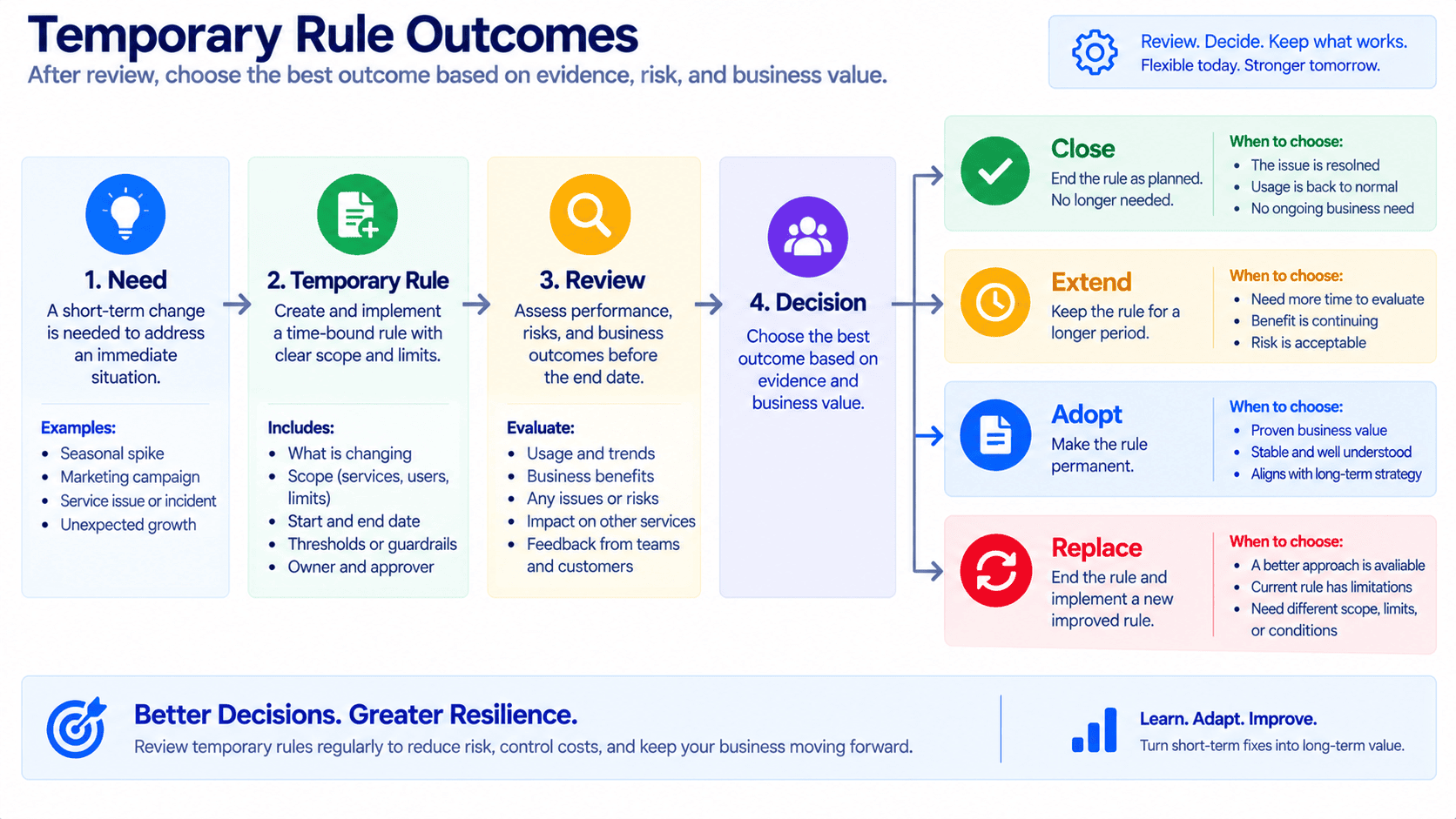
This is more useful than a simple “expiry date” because expiry should trigger a decision, not automatically delete something that may still be necessary.
Add an End Condition, Not Just a Date
Dates are useful, but they are not always enough.
Suppose a business creates this rule:
“Use the backup supplier until March 31.”
What happens if the supplier problem is fixed on March 10?
Should the business continue using the backup supplier until March 31?
Probably not.
Instead, write an End Condition:
“Return to the primary supplier when normal delivery reliability is restored.”
Now the temporary rule has two possible stopping points:
- the expected review date,
- or the condition being resolved.
This makes the rule more intelligent.
Use the “Why Does This Still Exist?” Test
At every review, ask one question:
Why does this rule still exist today?
There are only a few good answers.
The original problem still exists.
Keep it temporarily.
The problem changed.
Reconsider the rule.
The original problem disappeared.
Close it.
The rule works better than the old method.
Consider adopting it.
Nobody knows why it exists.
Treat that as a warning.
A rule with no known reason should not automatically be kept simply because “that’s how we do it.”
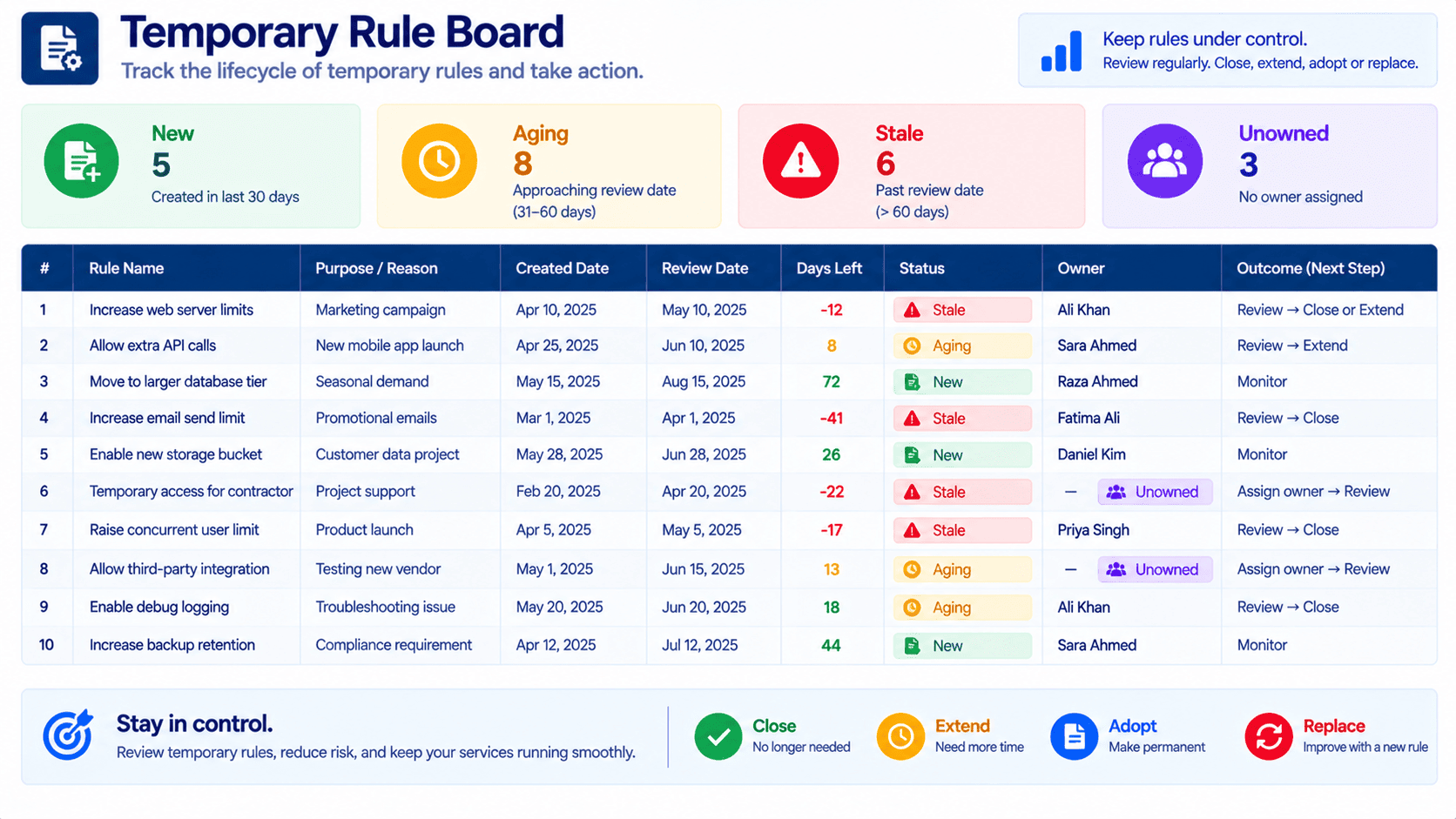
Create a Rule Age Indicator
Age does not automatically mean a rule is bad.
But age can tell you when to ask questions.
Use a simple indicator:
New
Recently introduced.
No concern.
Aging
The rule has existed longer than originally expected.
Review the reason.
Stale
The original review point has passed without a clear decision.
Require action.
Unowned
Nobody can identify who is responsible for reviewing it.
Escalate.
The most important category may be Stale.
A stale temporary rule is not necessarily harmful.
It is simply a rule whose continued existence has not been consciously confirmed.
Avoid the “Temporary Forever” Trap
Consider this fictional example.
LumaCraft Studio temporarily changes its customer approval process because its account manager is unavailable.
The owner says:
“For the next three weeks, all client approvals should come directly to me.”
The arrangement works.
Three weeks later, the account manager returns.
But the owner continues receiving approvals.
The owner assumes the manager will eventually take them back.
The manager assumes the owner prefers the new arrangement.
Six weeks later, everyone is still following it.
Nothing has officially changed.
But the business has quietly created a new process.
This is the Temporary Forever Trap.
The fix is not complicated.
At the beginning, record:
Rule: Owner handles client approvals.
Reason: Account manager unavailable.
Start: June 1.
Expected review: June 22.
End condition: Account manager resumes normal approval responsibility.
When June 22 arrives, someone asks:
“Should this still exist?”
That question prevents accidental permanence.
Separate the Rule From the Person
Temporary arrangements often become attached to individuals.
For example:
“Ahmed handles these orders until Maria returns.”
That is useful for a short period.
But the business should also record what happens when Maria returns.
Otherwise, the rule may survive because Ahmed has become accustomed to doing the work.
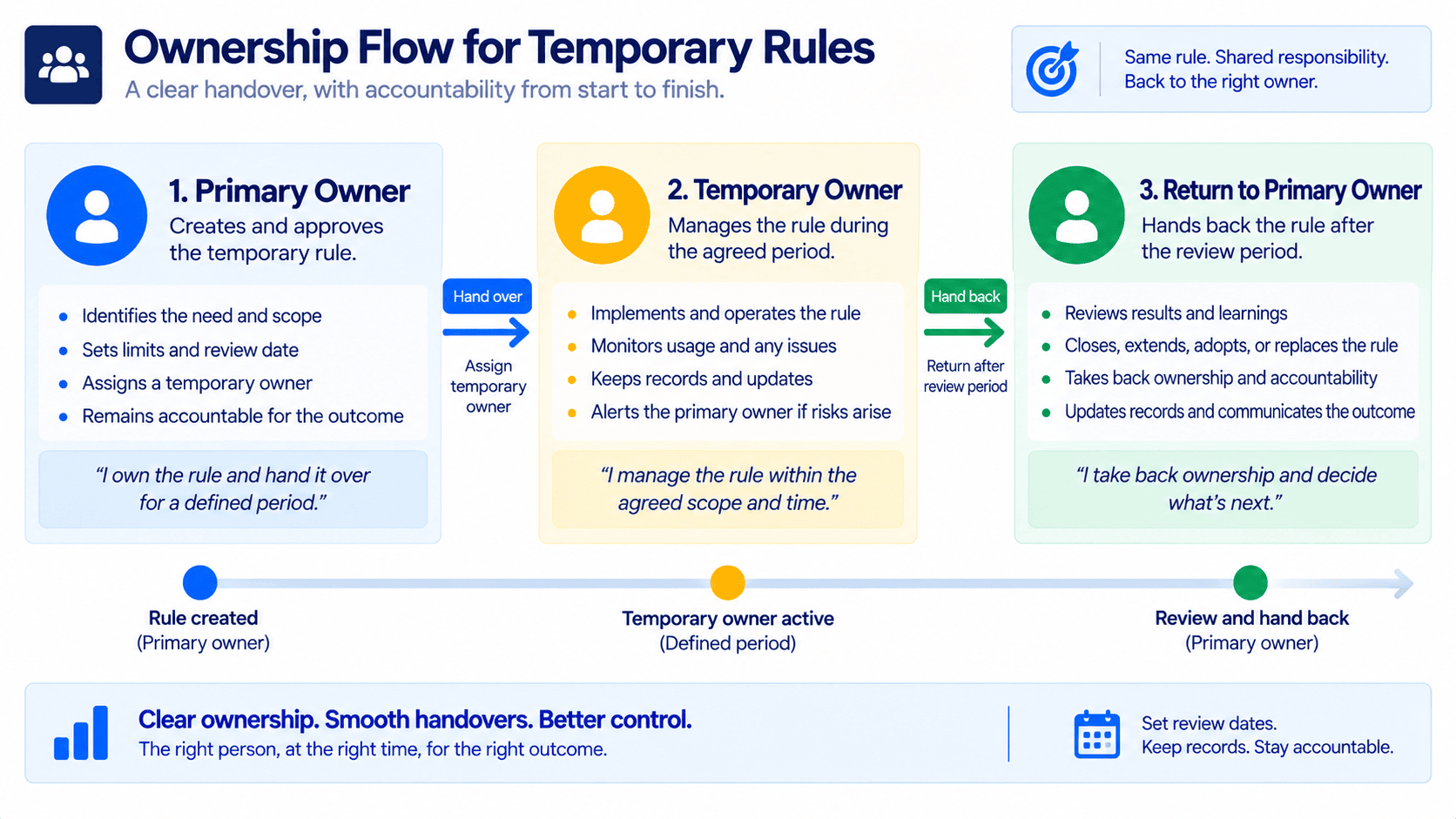
Use:
Temporary Owner → Original Owner → Review
This keeps the temporary arrangement connected to the business process rather than personal memory.
Watch Temporary Ownership Changes
Temporary ownership deserves special attention because responsibilities can move quietly.
Examples:
- temporary invoice approval,
- temporary customer support,
- temporary purchasing authority,
- temporary scheduling responsibility,
- temporary project review,
- temporary account management,
- temporary access to a business process.
For each one, record:
Who owns it now?
Why did ownership change?
When should ownership return?
What condition ends the temporary assignment?
Temporary Rules Should Not Create Hidden Authority
A temporary process can accidentally give someone more authority than they were originally meant to have.
For example:
“For this month, the operations assistant can approve supplier purchases.”
That may be reasonable.
But what exactly does “approve” mean?
Does it include:
- selecting the supplier?
- changing prices?
- approving new vendors?
- committing to contracts?
- authorizing payment?
- approving exceptions?
A temporary rule should define its boundary.
Use the Authority Boundary Test:
What can the temporary owner do?
What can they not do?
What still requires escalation?
When does the authority end?
This prevents a short-term responsibility change from becoming an informal permanent expansion of authority.
Use a “No Silent Extension” Rule
One of the strongest rules you can introduce is simple:
A temporary rule cannot continue past its review point without an explicit extension.
Silence is not approval.
If nobody reviews the rule, it becomes Stale, not automatically renewed.
This does not mean the business has to hold a meeting every time.
The owner can simply update the record:
Extended until: September 30.
Reason: Supplier recovery delayed.
That is enough.
The important part is that continuation becomes a conscious decision.
Do Not Make Every Temporary Change Formal
Not every temporary choice deserves documentation.
If someone moves a meeting once because of a personal appointment, there is no need for a Rule Card.
Use the system for changes that affect how work operates.
Good candidates include:
- responsibilities,
- approval rights,
- customer handling,
- financial controls,
- supplier arrangements,
- operational workflows,
- service commitments,
- access to important business systems,
- recurring work methods,
- temporary exceptions that may repeat.
The rule should be:
Document operational change, not ordinary daily flexibility.
Use the Second-Week Question
A useful practical trigger is the Second-Week Question.
When a temporary arrangement survives beyond its first expected period, ask:
“Are we still calling this temporary because it actually is temporary, or because nobody has decided what to do with it?”
This catches many forms of operational drift.
For a rule expected to last two days, ask after the first week.
For a rule expected to last two weeks, ask during the third week.
For a seasonal arrangement, review it before the next equivalent season.
The exact timing depends on the business.
The principle remains the same:
Temporary arrangements should become more visible as they age.
Build a Temporary Rule Register
A small business can maintain one register.
| Rule | Reason | Owner | Start | Review | Age | Status | Decision |
|---|---|---|---|---|---|---|---|
| Alternate supplier | Delivery disruption | Operations | Aug 3 | Aug 17 | Aging | Active | Extend |
| Owner approval | Staff absence | Founder | Aug 10 | Aug 24 | New | Active | — |
| Manual order sheet | Software issue | Admin | Jul 28 | Aug 11 | Stale | Active | Replace |
| Extra QA check | Campaign volume | Production | Aug 1 | Aug 15 | Aging | Active | Adopt |
This register does not replace normal SOPs.
It serves a different purpose.
An SOP tells people:
“This is how we normally work.”
The Temporary Rule Register tells the business:
“These are the things we are doing differently right now.”
That distinction is valuable.
Connect Temporary Rules to the Normal Process
Temporary rules should point back to the normal process they modify.
For example:
Normal process: Customer refund approval.
Temporary rule: Operations manager approves refunds while support lead is away.
Return condition: Support lead returns.
This creates a clear relationship:
Normal Process → Temporary Modification → Return to Normal
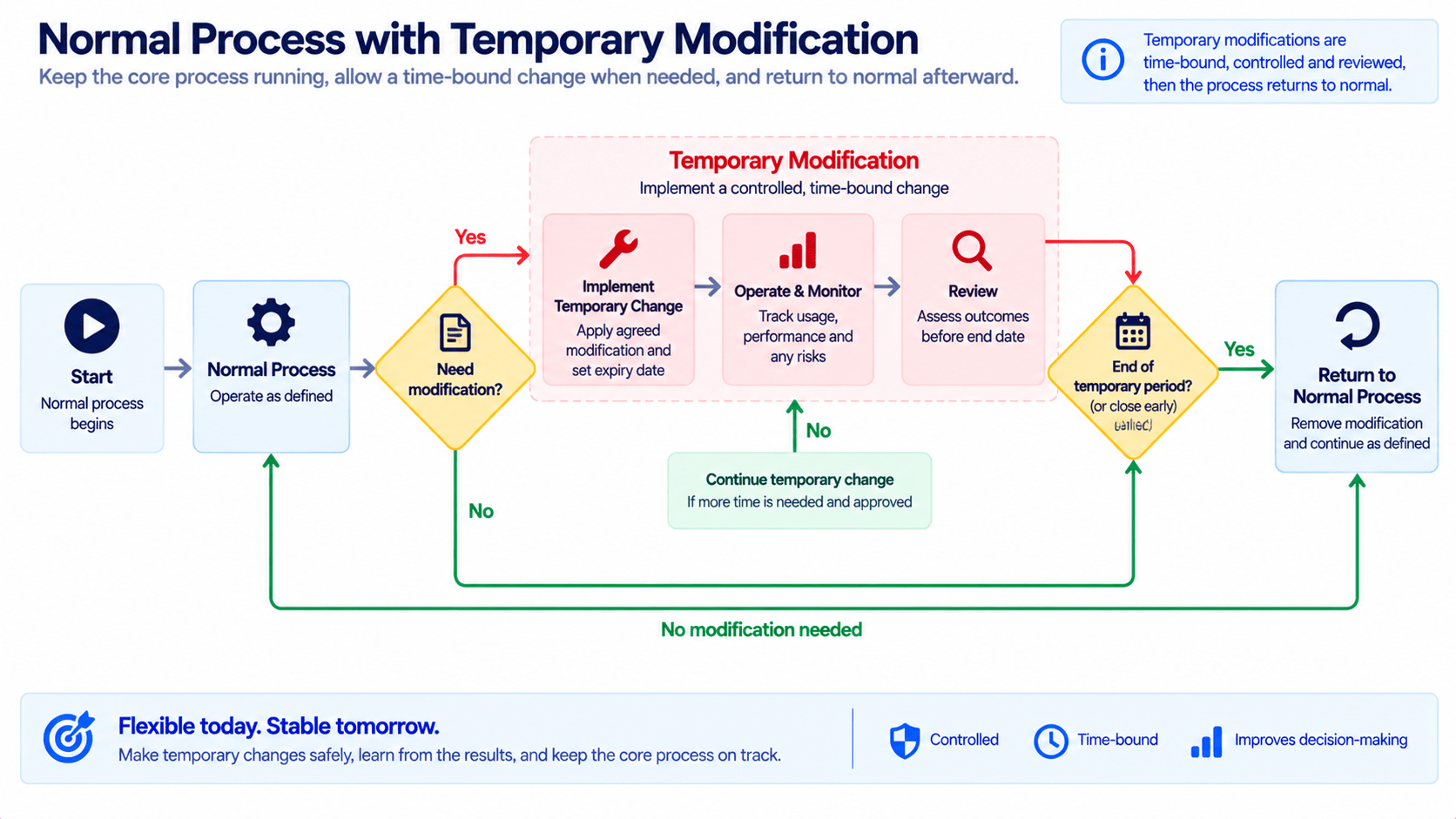
Without that connection, temporary instructions can become isolated notes that nobody remembers to remove.
The Temporary Rule Review
A five-minute review is often enough.
For each active temporary rule, ask:
1. Is the original reason still true?
If no, close it.
2. Is the current owner still correct?
If no, update it.
3. Is the temporary method creating new problems?
If yes, redesign it.
4. Is the end condition still realistic?
If no, change it.
5. Should the rule become permanent?
If yes, formally adopt it.
6. Is another process now dependent on it?
If yes, review the dependency before closing it.
This keeps the system lightweight.
Look for Temporary Rules That Became Infrastructure
One of the most interesting signals is when other work starts depending on the temporary arrangement.
For example:
A business temporarily creates a spreadsheet to track urgent orders.
Then:
- customer service starts using it,
- finance references it,
- warehouse staff update it,
- management reports are built from it.
The spreadsheet is no longer merely a temporary workaround.
It has become operational infrastructure.
That does not automatically mean it should stay.
It means the business should make a deliberate decision.
Ask:
“If we remove this temporary rule tomorrow, what else breaks?”
If the answer is “several things,” the rule has accumulated dependencies.
That deserves a more careful transition.
Create a Dependency Check Before Closing
Before closing an old temporary rule, ask:
- Does another process depend on it?
- Does another employee use it?
- Does a customer expect it?
- Does a report rely on it?
- Does a supplier relationship depend on it?
- Does a SaaS workflow reference it?
- Is there another document that assumes it exists?
If the answer is yes, do not simply delete the rule.
Plan the transition.
This is especially important for temporary processes that survive for months.
Temporary Rules and Customer Expectations
Some temporary arrangements eventually become visible to customers.
For example:
“During the holiday period, customer support replies within one business day.”
If customers experience that service repeatedly, they may begin expecting it.
The business therefore needs to distinguish:
Temporary internal rule
from
Temporary customer-facing promise
Customer-facing rules deserve more careful review.
Ask:
- Did we communicate this externally?
- Could customers reasonably expect it to continue?
- Does our website mention it?
- Did employees start promising it?
- Does it affect pricing or service levels?
A temporary internal change can become a customer expectation if it is repeated or communicated without an end point.
Temporary Pricing and Service Exceptions
Small businesses frequently create temporary commercial arrangements.
Examples:
- temporary discount,
- special payment timing,
- additional support,
- temporary service inclusion,
- unusual delivery arrangement,
- custom reporting,
- temporary priority handling.
These should have an explicit boundary.
For example:
Temporary service: Weekly reporting.
Reason: Client launch period.
Start: September 1.
End: September 30.
Review: September 25.
After review: Return to standard reporting unless separately agreed.
This prevents a temporary customer accommodation from quietly becoming unpaid permanent work.
That is particularly useful when the business is trying to prevent recurring exceptions from becoming normal operations.
Use a Temporary Rule Risk Score
Not every temporary rule deserves the same review intensity.
Score each rule from 1 to 4.
1 — Low
Minor internal convenience.
2 — Moderate
Changes normal work for one person or one small process.
3 — High
Affects customers, money, authority, or an important workflow.
4 — Critical
Could create major financial, customer, legal, operational, or security consequences if left unchanged.
For example:
Temporary meeting time: 1
Temporary task assignment: 2
Temporary purchasing authority: 3
Temporary payment approval process: 4
The score determines how carefully the rule should be reviewed.
A low-risk temporary arrangement may need only a simple review date.
A high-risk arrangement may need a named backup and explicit end condition.
Use the Rule Expiry Board
A simple board can show:
| Rule | Owner | Risk | Review | Status | Next Action |
|---|---|---|---|---|---|
| Alternate supplier | Operations | 3 | Sep 12 | Aging | Check supplier recovery |
| Manual tracking | Admin | 2 | Sep 8 | Stale | Replace |
| Extra approval | Founder | 4 | Sep 10 | Active | Review authority |
| Campaign QA | Production | 2 | Sep 20 | Active | Decide after campaign |
This gives management a quick answer to:
“What temporary arrangements are still running?”
Example: A Temporary Rule That Should Become Permanent
Consider a fictional company called Northfield Prints.
During a busy seasonal period, the team introduces a second order review before production.
The original purpose is simple:
Catch mistakes during the unusually high-volume period.
The extra check works well.
After the season ends, the owner reviews the rule.
The team discovers:
- the extra check catches common order errors,
- it takes only a few minutes,
- employees understand it,
- the process reduces rework,
- and the business wants to continue it.
The correct decision is not:
“The temporary period is over, so remove it.”
The correct decision is:
Adopt.
The team updates the normal production process and removes the temporary label.
This is an important part of the system.
Expiry does not mean every temporary rule must disappear.
It means the business must decide whether the rule still deserves to exist.
Example: A Temporary Rule That Should Close
Now consider Harborline Media, a fictional small agency.
One employee takes unexpected leave.
The agency temporarily assigns their client reporting to another team member.
The arrangement is documented for three weeks.
When the employee returns:
- normal ownership resumes,
- the temporary owner no longer needs the reporting task,
- no customer dependency remains,
- and the temporary rule has served its purpose.
The correct decision is:
Close.
Without a review point, the temporary owner might continue receiving reports indefinitely.
That creates unnecessary work and unclear accountability.
Example: A Temporary Rule That Should Be Replaced
Imagine Cedar Row Services temporarily tracks customer requests in a spreadsheet because its normal ticketing workflow is unavailable.
The spreadsheet works.
But after six weeks, the team discovers:
- duplicate entries,
- missing updates,
- manual status checks,
- inconsistent ownership,
- and extra reporting work.
The temporary method solved the immediate problem.
It is not a good permanent system.
The correct decision is:
Replace.
This is why temporary rules should not be judged only by whether they “work.”
They should also be judged by what they cost when they remain in place.
What Freelancers Can Learn From Temporary Rules
Freelancers often use temporary arrangements without naming them.
Examples:
- manually tracking a client project in a spreadsheet,
- giving one client extra support during a launch,
- taking over a client task temporarily,
- accepting an unusual communication schedule,
- using a backup invoicing process,
- changing the normal revision process for a specific project.
The useful question is:
“Is this part of my normal service, or is it temporary?”
If temporary, record:
Why → Until when → What returns to normal
This is especially valuable when a one-off client request could become a repeated expectation.
You can also connect the review to your existing scope-control process rather than allowing temporary client accommodations to quietly become standard service.
What Small Teams Should Do
A small team does not need a policy department.
Start with one shared table.
Use six essential fields:
Temporary Rule
Reason
Owner
Start Date
Review Date
Decision
That is enough for most teams.
If a rule affects money, authority, customer commitments, or critical operations, add:
End Condition
Risk Level
Backup Owner
The system should become more detailed only when the consequences justify it.
A Simple Weekly Temporary Rule Review
Add five minutes to an existing operations review.
Ask:
Which temporary rules are active?
List them.
Which ones are past their review date?
Mark them stale.
Which original reasons have disappeared?
Close those rules.
Which temporary rules are becoming normal?
Decide whether to adopt them.
Which rules are causing new dependencies?
Plan a controlled transition.
This is enough to keep temporary arrangements from disappearing into operational memory.
Common Mistakes to Avoid
1. Giving a temporary rule no review date
If nobody knows when to reconsider it, it can survive indefinitely.
2. Treating the expiry date as automatic deletion
A review date should trigger a decision, not blindly terminate a useful arrangement.
3. Recording only the rule
Without the reason, future employees cannot judge whether it is still relevant.
4. Forgetting the end condition
Some temporary rules should end when a condition changes, not merely when a calendar date arrives.
5. Allowing silent extensions
If a temporary rule continues, record why.
6. Making every small decision formal
Only document changes that meaningfully affect operations.
7. Ignoring temporary authority
Short-term responsibility changes can quietly become permanent decision rights.
8. Forgetting customer-facing effects
Temporary service arrangements can create expectations if customers experience them repeatedly.
9. Closing a rule without checking dependencies
Another process may already rely on it.
10. Keeping a workaround because it is familiar
Familiar does not mean effective.
One-Page Temporary Operating Rule Template
Temporary Operating Rule
Rule:
What temporarily changes?
Reason:
Why is this needed?
Affected Process:
What normal workflow does this change?
Primary Owner:
Backup Owner:
Start Date:
Expected Review Date:
End Condition:
What must happen before this rule can stop?
Risk Level:
1 / 2 / 3 / 4
Authority Boundary:
What can the temporary owner do?
What They Cannot Do:
Customer Impact:
None / Internal / Customer-Facing
Dependencies:
What other work may rely on this arrangement?
Review Decision:
Close / Extend / Adopt / Replace
Decision Date:
Reviewed By:
Notes:
When to Review a Temporary Rule Early
Do not wait for the planned review date when something important changes.
Review immediately if:
- the original problem is solved,
- the temporary owner leaves,
- customer expectations change,
- the business enters a new operating period,
- the temporary process creates errors,
- the rule affects money or authority differently than expected,
- another workflow becomes dependent on it,
- the underlying software or vendor problem changes,
- or the temporary arrangement becomes significantly more expensive.
A review date is a minimum checkpoint.
It should never prevent an earlier review when circumstances change.
The Real Purpose of an Expiry Date
An expiry date is not about forcing businesses to stop useful processes.
It is about preventing unconscious continuation.
That distinction matters.
A business should be able to say:
“We reviewed this temporary rule and intentionally extended it.”
It should also be able to say:
“We reviewed it and decided to make it permanent.”
Or:
“We reviewed it and removed it.”
All three are healthy outcomes.
The unhealthy outcome is:
“We are still doing it because nobody changed it.”
A Better Operating Habit: Make Temporary Status Visible
A temporary rule should look temporary.
Use labels such as:
- TEMPORARY
- REVIEW REQUIRED
- ENDS WHEN…
- EXTENDED UNTIL…
- PENDING ADOPTION
- REPLACEMENT NEEDED
This is especially useful when the rule appears inside a document, spreadsheet, workflow, or team instruction.
A new employee should be able to recognize:
“This is not necessarily the normal process.”
That single signal can prevent temporary instructions from becoming institutional assumptions.
The Temporary-to-Permanent Decision Path
A useful operating model is:
Problem
↓
Temporary Rule
↓
Reason Recorded
↓
Owner Assigned
↓
Review Point
↓
Evaluate Current Condition
↓
Close / Extend / Adopt / Replace
This creates a controlled lifecycle without creating heavy bureaucracy.
Final Takeaway
Temporary operating rules are not a sign that a business is badly managed.
They are often evidence that a small team is adapting quickly.
The problem is what happens afterward.
A temporary arrangement can quietly become:
- a permanent responsibility,
- an unofficial policy,
- an unexpected customer promise,
- an authority change,
- a manual process,
- or an operational dependency.
The business does not need to eliminate temporary decisions.
It needs to give important temporary decisions a shelf life.
The simplest model is:
Reason → Owner → Start → Review → End Condition → Decision
Then, when the review arrives:
Close → Extend → Adopt → Replace
This gives small businesses something valuable: the ability to change quickly without accidentally turning every emergency solution into a permanent way of working.
A temporary rule should not become permanent merely because everyone forgot to remove it.
If it matters enough to change the way work happens, it matters enough to decide when that change should be reviewed.
Frequently Asked Questions
What is a temporary operating rule?
A temporary operating rule is a short-term instruction, responsibility, exception, or process created to handle a specific business condition. It should have a reason, owner, and review point.
Why should temporary business rules have expiry dates?
An expiry or review date prevents temporary arrangements from continuing indefinitely without an explicit decision. It creates a point where the business can close, extend, adopt, or replace the rule.
Does every temporary decision need documentation?
No. Focus on temporary changes that affect responsibilities, customers, money, authority, important workflows, or recurring operations.
What should happen when a temporary rule expires?
Do not automatically delete it. Review the original reason and choose whether to close, extend, adopt, or replace the rule.
What is a stale temporary rule?
A stale temporary rule is an arrangement whose review point has passed without a clear decision about whether it should continue.
Can a temporary rule become permanent?
Yes. If the temporary process proves valuable, the business can deliberately adopt it as part of its normal operating process.
What is the difference between an expiry date and an end condition?
An expiry or review date is a calendar checkpoint. An end condition describes the event that allows the temporary arrangement to stop. Good temporary rules can use both.
Can freelancers use temporary operating rules?
Yes. Freelancers can use them for temporary client arrangements, unusual service commitments, backup workflows, temporary responsibilities, or project-specific processes.
How often should a small business review temporary rules?
Review them at the agreed dates, with higher-risk rules checked more frequently. A short weekly or biweekly review can be enough for a small team with several active temporary arrangements.
What is the biggest mistake with temporary business processes?
The biggest mistake is allowing a temporary arrangement to continue without anyone consciously deciding that it should remain.