
Winning Upwork Proposals: Personalized Tips That Get Client Replies
- by Muhammad Raza
- 0 Comments
- 23 minutes read
- 52 Views
Personalized Upwork proposals are not simply about finding projects and clicking the Apply button.
The real challenge begins after you find a project that matches your skills.
You need to convince the client that you understand the problem, have the right experience, can communicate clearly, and can deliver the requested work.
That is where a strong proposal becomes important.
Learning how to write winning Upwork proposals can help freelancers present their experience more effectively and avoid one of the most common mistakes on freelance marketplaces: sending the same generic cover letter to every client.
Upwork’s current guidance explains that freelancers submit proposals by setting their terms, writing a cover letter, answering screening questions, and adding relevant work samples or profile highlights.
Upwork also recommends tailoring proposals to the job, leading with relevant experience or samples, and keeping the cover letter concise.
That does not mean there is a magic proposal template that guarantees clients.
There is no guaranteed formula.
A proposal is simply your opportunity to make a strong first impression and start a professional conversation.
The best approach is to treat each proposal as a mini sales document written specifically for one client’s situation.
In this complete guide, you will learn how to research an Upwork job, decide whether it is worth applying for, write an effective opening, demonstrate your expertise, choose portfolio samples, discuss pricing, answer screening questions, avoid common mistakes, and create a repeatable proposal-writing system.
What Is an Upwork Proposal?
An Upwork proposal is your response to a client’s job posting.
It gives you an opportunity to explain:
- Why you are suitable for the project
- How you understand the client’s needs
- What relevant experience you have
- How you would approach the work
- Which examples prove your ability
- What questions you need answered
- What the client should do next
Upwork’s official proposal process allows freelancers to set rates or fixed-price terms, estimate the project timeline, write a cover letter, answer screening questions, and include relevant work samples.
Think of the proposal as the bridge between the job description and your profile.
Your profile says:
“Here is what I can do.”
Your proposal should say:
“Here is how what I can do relates to your specific problem.”
That difference is extremely important.
Why Generic Upwork Proposals Often Fail
Imagine a client posts:
“We need an SEO writer for a technology blog. The writer should understand SaaS, search intent, and technical topics.”
Now imagine receiving this proposal:
Hi Sir/Madam,
I am an experienced freelancer. I can do your project professionally and provide high-quality work. I have many years of experience and can start immediately. Please contact me for further discussion.
The freelancer may actually be talented.
But the proposal does not demonstrate it.
The client still does not know:
- Whether the freelancer read the job
- Whether they understand SaaS
- Whether they can write technical content
- Whether they have relevant samples
- Whether they understand search intent
- How they would approach the project
A generic proposal forces the client to do the work of figuring you out.
A strong proposal does the opposite.
It makes the client’s evaluation easier.
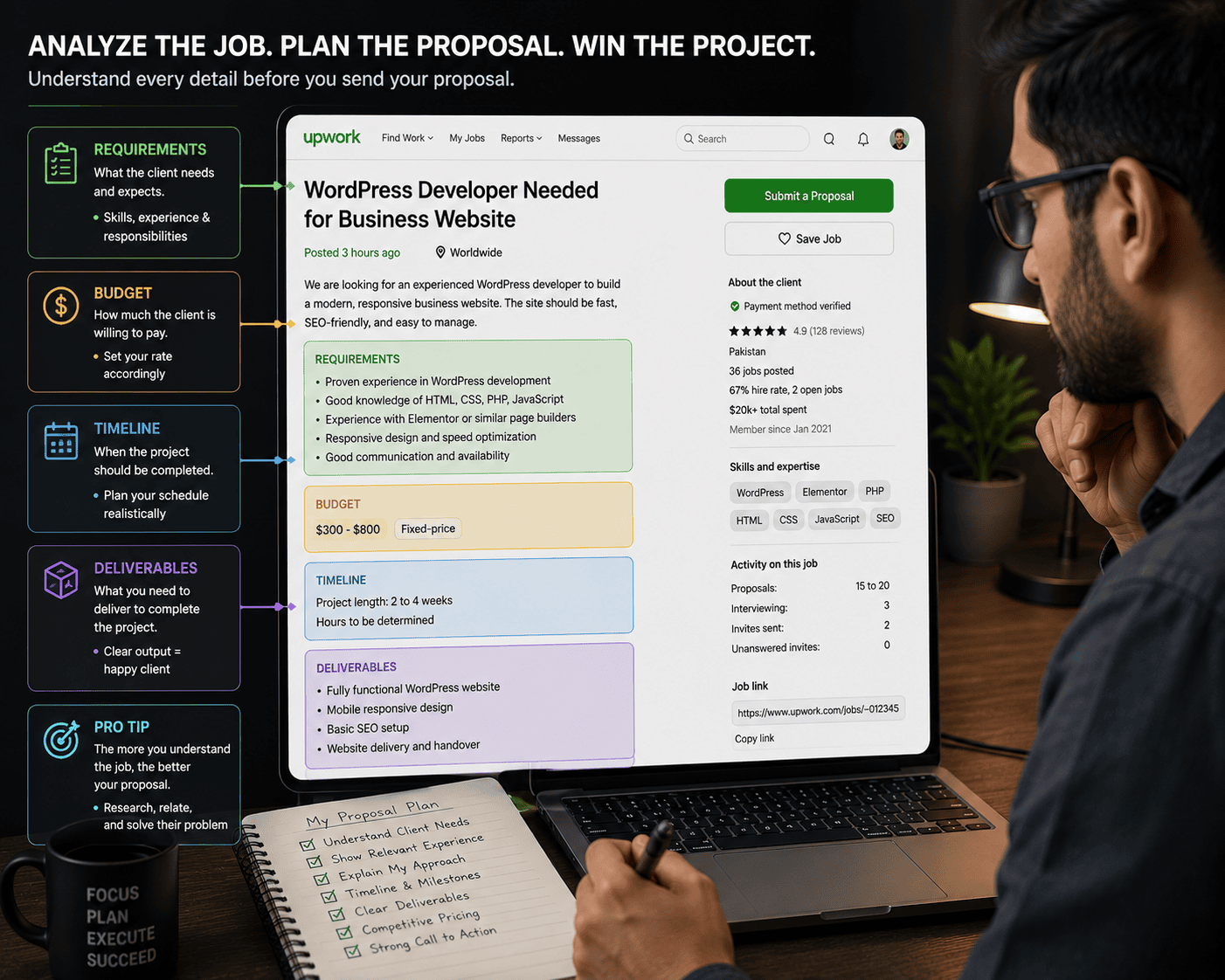
Start by Reading the Entire Job Description
Before writing anything, read the project carefully.
Do not skim the first two sentences and immediately start typing.
Look for:
- Main objective
- Deliverables
- Required skills
- Experience requirements
- Preferred tools
- Target audience
- Timeline
- Budget
- Client concerns
- Screening questions
- Existing problems
- Expected outcomes
Then identify the most important requirement.
For example, a client might say:
“We already have traffic but our landing page isn’t converting.”
The real problem may not be website design.
It may be conversion optimization.
If you respond with:
“I can build you a beautiful website.”
you have missed the client’s actual need.
Identify the Client’s Core Problem
Every good proposal should answer one question:
What problem is the client actually trying to solve?
Clients rarely care about your skill in isolation.
They care about what your skill can do for their business.
A client does not necessarily want:
“A WordPress developer.”
They may want:
“A website that is easier to manage and generates more inquiries.”
A client may not simply want:
“A content writer.”
They may want:
“Consistent blog content that targets valuable search queries.”
A client may not want:
“A video editor.”
They may want:
“Short-form videos that keep viewers engaged.”
Your proposal should connect your skill to the desired outcome.
Research the Client Before Applying
Whenever appropriate, investigate the information available on the client’s Upwork profile and job posting.
Look for clues such as:
- Previous jobs
- Hiring history
- Business type
- Project descriptions
- Feedback patterns
- Typical project sizes
- Long-term hiring behavior
The goal is not to stalk the client.
The goal is to understand their context.
For example, if a client has previously hired freelancers for a long-term content project, they may value consistency and communication more than someone looking for a one-time task.
That can influence how you position yourself.
Decide Whether You Should Apply
Not every job is worth applying to.
One of the biggest freelance mistakes is sending proposals to every project that contains your keyword.
Instead, qualify the opportunity.
Ask yourself:
Is the project related to my strongest skill?
If not, skip it.
Does the client explain what they need?
If the job is extremely vague, consider whether you can realistically clarify it.
Is the budget compatible with the work?
Do not accept every project simply because you are afraid of missing an opportunity.
Can I show relevant work?
If yes, your proposal can be stronger.
Does the project fit my availability?
Winning a project you cannot deliver properly creates bigger problems later.
Relevance Is More Important Than Length
A long proposal is not automatically a good proposal.
In fact, excessive text can make it harder for a busy client to identify the important information.
Upwork’s current guidance recommends keeping cover letters brief, with its 2026 proposal guidance describing two or three short paragraphs as a useful target.
The objective is not to tell your entire life story.
The objective is to communicate:
- I understand your problem.
- I have relevant experience.
- Here is proof.
- Here is how I would approach it.
- Here is an easy next step.
That can often be accomplished without writing an essay.
Write a Strong First Sentence
The opening sentence matters because it determines whether the client has a reason to continue reading.
Avoid:
Dear Sir/Madam, I hope you are doing well.
It is polite, but it uses valuable space without showing relevance.
Instead, start with the project.
For example:
Your main challenge appears to be improving the landing page’s conversion flow without rebuilding the entire website.
That immediately demonstrates that you read the job.
Another example:
I noticed you’re looking for a writer who can explain technical SaaS topics without making them difficult for non-technical readers.
Now the client has a reason to keep reading.
Show That You Understand the Job
One of the easiest ways to personalize a proposal is to mention a specific requirement from the posting.
Suppose the client says:
“We need a WordPress website optimized for mobile devices.”
You might write:
I noticed mobile responsiveness is one of your main requirements. My approach would be to structure the layouts for smaller screens from the beginning rather than treating mobile optimization as a final adjustment.
This demonstrates understanding.
Do not copy the job description word-for-word.
Interpret it.
Explain Your Relevant Experience
Once you show that you understand the project, explain why you are qualified.
Do not list every skill you have.
Focus on relevant experience.
For example:
I have worked on WordPress websites where the main focus was improving navigation, mobile usability, and service-page structure.
This is better than:
I know WordPress, HTML, CSS, JavaScript, PHP, Photoshop, SEO, marketing, social media, and many other skills.
More skills do not automatically mean more relevance.
Use Proof Instead of Empty Claims
Anyone can write:
“I am an expert.”
That statement has little value without evidence.
Instead:
“Here is a relevant landing page project I completed.”
Or:
“I’ve written technical SaaS articles covering product-led growth, automation, and software workflows.”
Or:
“Here is a before-and-after example showing how I reorganized the page structure.”
Proof is stronger than adjectives.
Choose the Right Portfolio Samples
Do not attach your entire portfolio if the client only needs one relevant example.
Choose samples based on similarity.
If the client wants:
SaaS blog writing
show SaaS or technology articles.
If the client wants:
E-commerce design
show e-commerce websites.
If the client wants:
Short-form video editing
show short-form videos.
Upwork’s proposal system allows freelancers to add work samples and profile highlights to demonstrate what they can do.
The key is relevance.
What If You Have No Client Experience?
This is a common problem for beginners.
You may think:
“I cannot apply because I have no Upwork reviews.”
But reviews are not the only form of proof.
You can create:
- Sample projects
- Personal projects
- Practice websites
- Mock landing pages
- Sample articles
- Open-source contributions
- Relevant previous employment work
- Certifications
- Case-study style demonstrations
Be honest about the origin of the work.
Do not claim a sample project was created for a paying client when it was not.
Your goal is to demonstrate capability, not manufacture credibility.
Create Niche-Specific Portfolio Samples
If you want to specialize, create samples for your target market.
For example, a beginner web designer could create:
- Restaurant website concept
- Real estate landing page
- SaaS homepage
- Local service business website
A content writer could create:
- SaaS blog article
- Cryptocurrency explainer
- Marketing guide
- Technology tutorial
These samples make your proposal more convincing because the client can see relevant work.
Explain Your Process Briefly
Clients often want to know what happens after they hire you.
A simple process can reduce uncertainty.
For example:
Step 1: Review existing materials
Step 2: Confirm requirements
Step 3: Create the first version
Step 4: Collect feedback
Step 5: Make revisions
Step 6: Deliver final files
You do not need to write ten paragraphs.
A short process is enough.
Ask One or Two Smart Questions
Questions demonstrate that you are thinking about the project.
For example:
Do you already have the final copy and brand assets, or would you like those included in the scope?
Or:
Are you targeting a specific keyword group, or should the initial content strategy include keyword research?
Good questions can move the conversation forward.
Avoid asking questions whose answers are already clearly provided in the job post.
That suggests you did not read it carefully.
Do Not Ask Too Many Questions
There is a balance.
A proposal containing ten questions can feel like homework.
The client wants a freelancer who can solve problems, not create additional work.
Ask only the questions necessary to clarify important project details.
You can discuss deeper requirements after the client responds.
Create a Clear Call to Action
Do not end your proposal with:
Thank you.
and nothing else.
Give the client an easy next step.
For example:
If the approach sounds aligned, I can review the existing page and suggest the first three changes I would prioritize.
Or:
If you’d like, we can discuss the project requirements through Upwork Messages and confirm the scope before starting.
Upwork’s official proposal guidance also suggests proposing a clear next step such as a conversation or video call through Upwork Messages.
Keep Communication on Upwork
When using Upwork, follow the platform’s current rules and communication requirements.
Do not automatically move a new client to another platform simply because you want to exchange contact details faster.
Upwork specifically provides messaging and proposal functionality for client-freelancer communication.
Always check the platform’s current Terms of Service before changing how you communicate or handle payments.
Following marketplace rules is part of building a sustainable freelance business.
How to Discuss Your Rate
Pricing can be one of the hardest parts of a proposal.
Do not choose a number randomly.
Consider:
- Project complexity
- Estimated hours
- Required expertise
- Deliverables
- Revision requirements
- Urgency
- Your experience
- Business expenses
- Platform fees
- Long-term value
Upwork recommends considering market rates, project complexity, expenses, and circumstances when deciding your rate or bid.
Your lowest possible price should not automatically become your standard price.
Avoid Winning Projects That Lose You Money
Suppose a client offers $50 for a project.
You estimate:
- 6 hours research
- 5 hours production
- 2 hours revisions
- 1 hour communication
That is 14 hours.
If you accept without considering your effective rate, you may end up regretting the project.
Freelancing is a business.
Revenue matters, but profitability and sustainability matter too.
Don’t Compete Only on Price
There will always be freelancers willing to charge less.
If your entire proposal says:
“I can do it cheaper.”
you are entering a race that is difficult to win sustainably.
Instead, differentiate through:
- Specialization
- Quality
- Communication
- Reliability
- Process
- Relevant experience
- Faster understanding
- Strong portfolio
- Clear deliverables
A client who values quality may not choose the cheapest proposal.
Offer a Specific Approach
Suppose a client wants SEO content.
Instead of:
“I will write high-quality SEO articles.”
try:
“I would start by identifying the search intent behind the target topic, reviewing competing pages, structuring the article around the user’s questions, and then optimizing the title, headings, internal links, and supporting terms.”
Now the client can see how you think.
You are selling your process, not only your output.
Use the Client’s Language Naturally
If the client repeatedly uses terms such as:
- Shopify
- WordPress
- SaaS
- Landing page
- Technical SEO
- Short-form video
you can naturally use the relevant terms in your proposal.
This reinforces relevance.
But do not stuff keywords into every sentence.
The proposal should sound like a conversation, not a search-engine page.
Avoid Overpromising
Never write:
“I guarantee your website will double sales.”
unless you have an exceptionally specific contractual basis and evidence—which freelancers generally cannot guarantee.
Marketing results depend on many factors.
Instead:
“I would focus on improving the page structure, messaging, and user journey to give the site a stronger conversion foundation.”
That is professional and realistic.
Do Not Invent Results
This is extremely important.
Never write:
“I increased my previous client’s revenue by 300%.”
unless it is true and you can legitimately represent the result.
Fake numbers may sound impressive, but they can destroy trust.
Use genuine evidence.
If you do not have measurable results, describe what you actually delivered.
Customize the Proposal, Not Your Entire Life Story
Personalization does not mean rewriting everything.
You can create a base structure.
For example:
Opening: Customized to the job.
Relevant experience: Selected from your existing profile.
Portfolio: Customized.
Process: Slightly adjusted.
Questions: Customized.
Closing: Adapted to the project.
This creates efficiency without turning your proposals into copy-paste spam.
Build a Proposal Template
A good template might contain:
Opening
Show that you understand the problem.
Relevant Experience
Explain why your experience matches.
Approach
Describe how you would solve the problem.
Proof
Provide one or two relevant examples.
Question
Ask something useful.
Call to Action
Suggest the next step.
The template is a framework.
It should never become a replacement for personalization.
Example Upwork Proposal for a Web Designer
Here is an example:
Your project caught my attention because the goal isn’t simply to redesign the website—it is to make the service information easier for visitors to understand and navigate.
I specialize in responsive website design and have worked on layouts where clarity, mobile usability, and conversion-focused structure were key priorities. I would first review the existing pages, identify the biggest usability issues, and then reorganize the layout before moving into the visual design.
I can share a relevant website sample from my portfolio. One question before estimating the final scope: do you already have the website copy and brand assets prepared?
If the approach fits what you’re looking for, we can discuss the current website and define the first set of improvements through Upwork Messages.
Notice what this proposal does not do.
It does not say:
“I am the best freelancer.”
It demonstrates relevance instead.
Example Proposal for a Content Writer
I noticed you’re looking for someone who can write SaaS content that is useful for readers rather than simply inserting keywords into an article.
My approach is to start with search intent, review the current search landscape, identify the questions the reader needs answered, and structure the article around those needs. I can also provide SEO titles, meta descriptions, internal-link suggestions, and clear heading structures when required.
I have relevant technology and SaaS writing samples available. Before starting, I’d like to know whether your team already provides the target keywords or expects the writer to handle the initial keyword research as well.
If the workflow matches your expectations, I can discuss the first article and proposed structure through Upwork Messages.
Again, the proposal focuses on the project.
Example Proposal for a Video Editor
Your requirement for short-form videos stood out because the editing needs to preserve attention rather than simply cut the long video into smaller pieces.
I would focus on strong opening moments, clean pacing, captions, visual changes, and removing unnecessary pauses while keeping the editing consistent with your brand.
I can provide short-form samples similar to the style you’re looking for. One question: do you already have a preferred caption style and brand template?
If yes, I can work within that system and discuss the first batch through Upwork Messages.
The proposal is short but specific.
Use Relevant Keywords in Your Profile Too
Your proposal is only one part of your Upwork presence.
Your profile should clearly communicate your specialization.
Upwork recommends using a descriptive title, focusing on primary talents, and clearly explaining the services you offer.
For example:
Weak:
Freelancer
Better:
WordPress Developer | Responsive Business Websites
Weak:
Writer
Better:
SEO Content Writer | SaaS & Technology
The goal is clarity.
Complete Your Profile
A proposal cannot completely compensate for a weak profile.
Upwork describes the freelancer profile as one of the most important tools for getting hired and recommends completing relevant sections such as skills, portfolio, and work history.
Make sure your profile contains:
- Professional photo
- Clear title
- Strong overview
- Relevant skills
- Work history
- Portfolio
- Education where useful
- Certifications where relevant
Keep information accurate.
Do not exaggerate your experience.
Make the First Part of Your Profile Strong
Upwork notes that only the first portion of the overview may appear in search results, so your opening lines should communicate your core value quickly.
Do not start with:
“Hello, my name is…”
Instead:
“I help SaaS companies create SEO content that explains complex products clearly and targets high-intent search topics.”
The reader immediately knows:
- What you do
- Who you help
- What type of outcome you focus on
Use Your Portfolio as Evidence
Your profile and proposal should support each other.
If your proposal says:
“I specialize in landing pages.”
but your portfolio contains only logo designs, the client may become confused.
Create a coherent professional identity.
Your strongest samples should match the projects you want to win.
Follow Up Carefully
If the client has not responded, do not repeatedly send messages.
Upwork’s official guidance states that repeatedly contacting a non-responsive client before a contract begins can violate its rules against spam.
If a client responds, continue the conversation professionally.
If they do not, move on.
Your time is valuable.
Learn From Rejected Proposals
A rejection is not always evidence that your proposal was bad.
The client may have:
- Chosen another freelancer
- Changed the project
- Canceled the project
- Had a different budget
- Preferred a different timezone
- Needed a specific experience level
But patterns matter.
If you send 50 proposals and receive almost no responses, examine your system.
Look at:
- Job selection
- Profile
- Proposal opening
- Portfolio relevance
- Pricing
- Specialization
Do not simply send 100 more identical proposals.
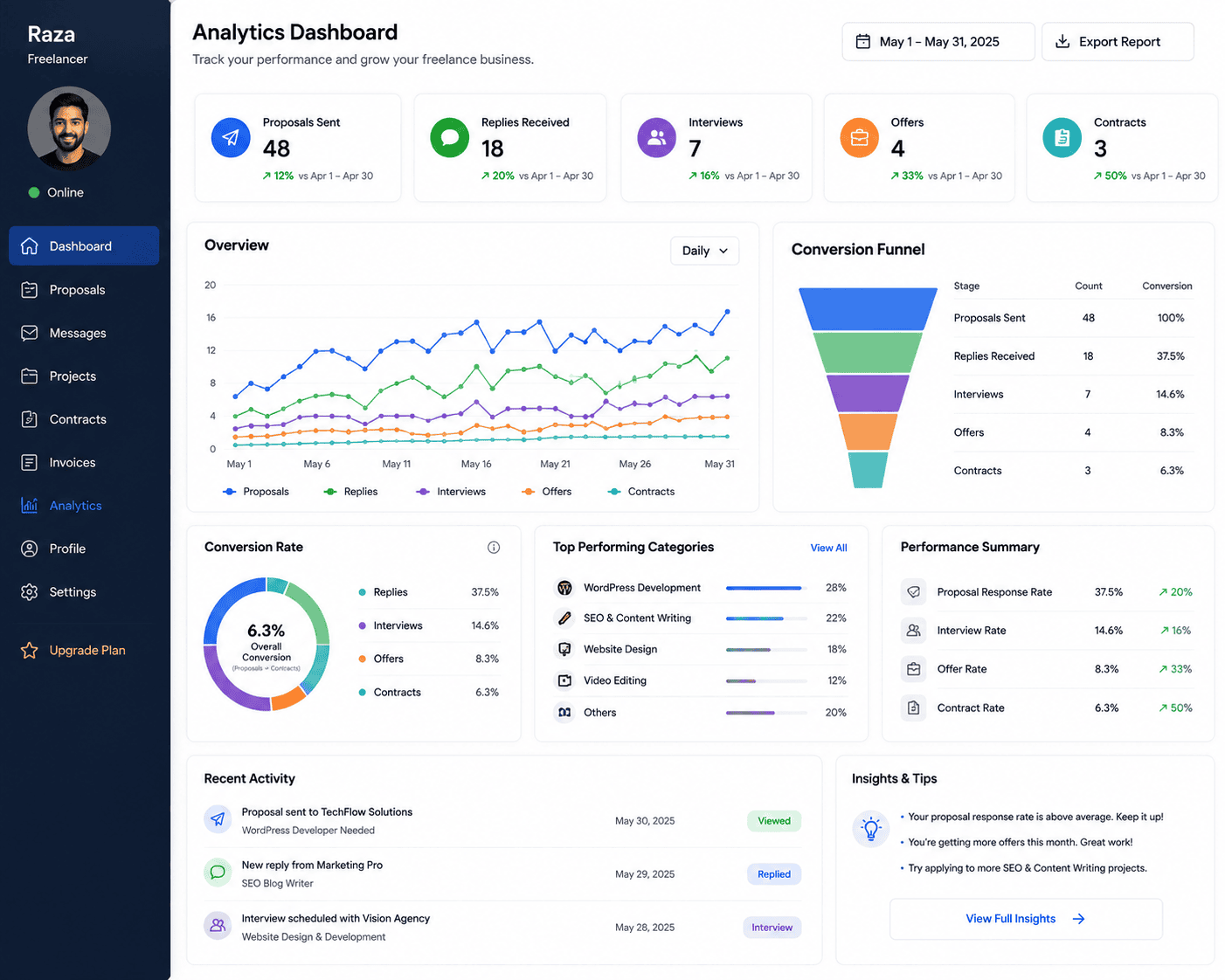
Track Your Proposal Metrics
Create a simple spreadsheet.
Track:
| Metric | What It Tells You |
|---|---|
| Proposals sent | Your activity |
| Relevant jobs | Quality of opportunities |
| Views | Whether clients are opening proposals |
| Replies | Quality of messaging |
| Interviews | Strength of qualification |
| Offers | Sales effectiveness |
| Contracts | Final conversion |
| Revenue | Business result |
The exact metrics available on Upwork may vary by account and feature.
But keeping your own record can help identify patterns.
Analyze Your Best Proposals
Suppose you eventually win five projects.
Review those proposals.
What did they have in common?
Maybe they:
- Started with a client problem
- Included one strong portfolio sample
- Asked a useful question
- Offered a clear process
- Had concise writing
Then use those patterns to improve future proposals.
Do not blindly copy the exact wording.
Copy the principles.
Do Not Apply to Everything
High-volume applications can feel productive.
But if you spend several hours every day applying to irrelevant projects, you may be creating activity without progress.
Instead, prioritize jobs where:
- Your skill matches closely
- You understand the problem
- You have relevant samples
- The scope is reasonable
- The client appears serious
- The budget makes sense
Quality applications are usually more valuable than meaningless volume.
Watch for Red Flags
Freelancers should also evaluate clients.
Potential warning signs can include:
- Unrealistic deadlines
- Extremely low budgets for complex work
- Requests for unpaid extensive work
- Vague project requirements
- Pressure to violate platform rules
- Requests for sensitive personal information
- Requests to pay fees to get the job
- Suspicious external links
- Unclear ownership of deliverables
If something feels wrong, slow down.
Winning a project is not worth compromising your safety or professional standards.
Don’t Do Large Unpaid Test Projects
Some clients may ask for a small sample.
A short, reasonable test can sometimes be useful depending on the industry.
But be careful when someone requests:
“Write five complete articles for free.”
or:
“Design the entire homepage before we decide.”
or:
“Edit ten videos as a test.”
That may be unpaid work disguised as evaluation.
A professional portfolio can often demonstrate your ability without requiring a large free project.
Make Your Proposal Easy to Scan
Use short paragraphs.
Avoid huge blocks of text.
You can use simple formatting where the platform allows it, but do not overdesign the proposal.
A busy client should be able to identify the main points quickly.
A strong structure might look like:
Problem
Short paragraph.
Experience
Short paragraph.
Approach
Short paragraph.
Question
One sentence.
Next step
One sentence.
That is enough for many projects.
Avoid Excessive Self-Promotion
Compare:
I am an amazing expert with 10 years of experience and excellent communication skills.
with:
I recently completed a similar project involving responsive layouts, mobile navigation, and service-page restructuring.
The second sentence provides evidence.
Whenever possible, replace adjectives with examples.
Instead of saying:
“I am reliable.”
say:
“I use a milestone-based workflow and provide progress updates before each review stage.”
Your process communicates reliability.
Don’t Use Fake Urgency
Avoid:
“You must hire me today.”
or:
“I’m the only person who can solve this.”
Professional clients do not need artificial pressure.
Show value.
Let the client decide.
Improve Your Writing
Your proposal is also a communication test.
Check:
- Grammar
- Spelling
- Sentence length
- Clarity
- Tone
- Relevance
A freelancer can have excellent technical skills but lose credibility because the proposal is difficult to understand.
Proofread before submitting.
Upwork itself recommends reviewing and proofreading proposals before sending them.
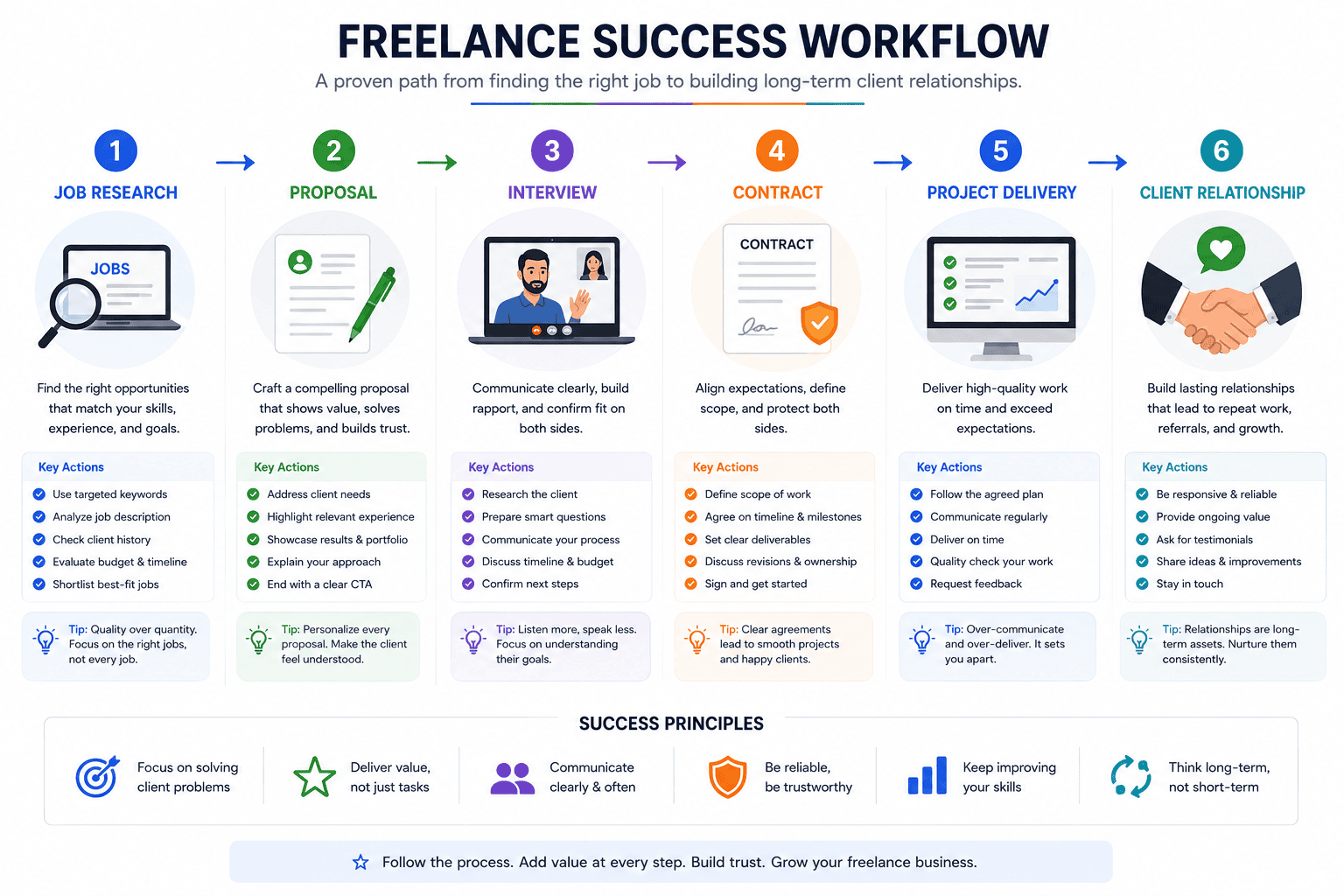
Build a Repeatable Proposal Workflow
Here is a practical system you can use for every relevant project.
Step 1: Read
Read the entire job description.
Step 2: Qualify
Decide whether the project fits your skills and business.
Step 3: Research
Look for useful client and project context.
Step 4: Identify
Find the client’s main problem.
Step 5: Select
Choose one or two relevant portfolio samples.
Step 6: Write
Create a personalized opening.
Step 7: Explain
Show your relevant experience and approach.
Step 8: Ask
Add one useful question.
Step 9: Close
Suggest an easy next step.
Step 10: Proofread
Check the proposal before submitting.
This system makes proposal writing faster without turning it into spam.
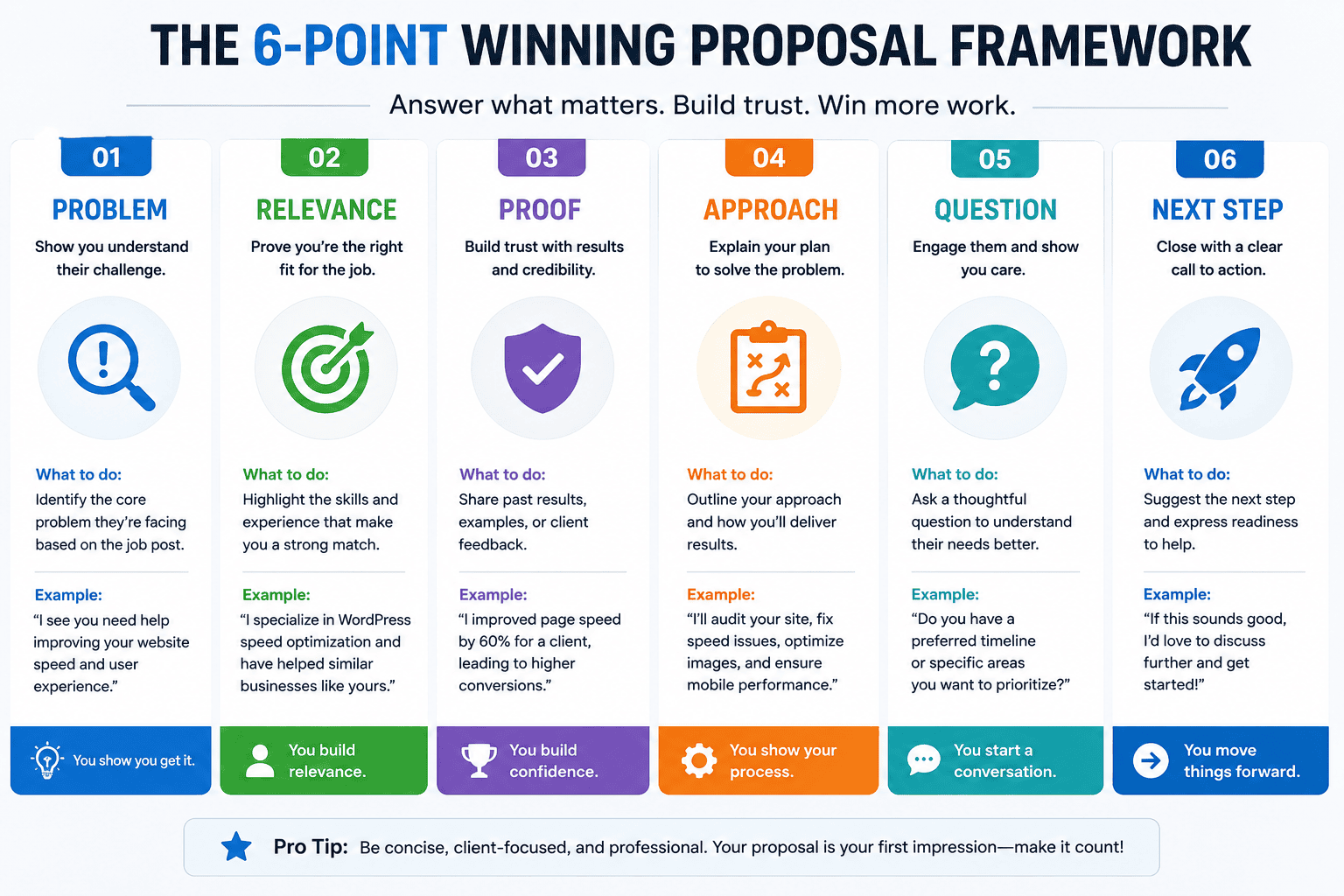
A Simple Winning Proposal Formula
You can remember the following formula:
Problem + Relevance + Proof + Approach + Question + Next Step
For example:
Problem: I noticed the main challenge is improving the landing page’s conversion flow.
Relevance: I work on conversion-focused landing pages for service businesses.
Proof: Here is a similar project from my portfolio.
Approach: I would first review the current hierarchy, messaging, and CTA placement.
Question: Do you already have the final copy?
Next Step: If so, we can review the current page and define the first revision.
This is simple enough to remember and flexible enough to adapt.
7-Day Upwork Proposal Improvement Plan
If your proposals are not producing enough conversations, use this seven-day process.
Day 1: Review Your Profile
Rewrite your title and opening overview.
Day 2: Improve Your Portfolio
Remove weak samples and add relevant work.
Day 3: Build Your Proposal Framework
Create a reusable structure.
Day 4: Study Successful Jobs
Analyze what clients repeatedly request in your niche.
Day 5: Apply Selectively
Send proposals only to strong matches.
Day 6: Review Responses
Identify which openings and samples generated replies.
Day 7: Improve
Change one or two weak areas and continue testing.
Do not change everything at once.
How Beginners Can Compete Without Reviews
A lack of reviews is a disadvantage, but it does not mean you have nothing to offer.
Focus on controllable factors:
Strong Profile
Clearly explain your service.
Relevant Portfolio
Show what you can actually produce.
Specific Proposals
Demonstrate that you understand the job.
Professional Communication
Respond clearly and respectfully.
Realistic Pricing
Do not price yourself at an unsustainable level simply to get reviews.
Small, Well-Defined Projects
A manageable first project can help you demonstrate reliability.
Over time, genuine completed work can strengthen your profile.
What Makes a Proposal Feel Human?
A human proposal usually sounds like someone who actually read the project.
It might mention:
- A specific challenge
- A unique requirement
- A relevant portfolio example
- A thoughtful question
- A practical idea
A robotic proposal often sounds like:
“I have read your project description carefully and I am confident I can provide high-quality services.”
There is nothing wrong with professionalism.
The problem is when every freelancer says exactly the same thing.
Specificity creates personality.
Final Thoughts
Learning how to write winning Upwork proposals is really about learning how to communicate value.
A strong proposal does not need complicated language.
It does not need exaggerated claims.
It does not need to be extremely long.
It needs to be relevant.
Start by understanding the client’s problem.
Then show why your experience fits.
Provide evidence.
Explain your approach.
Ask a useful question.
Suggest a clear next step.
At the same time, remember that proposals are only one part of your Upwork strategy.
Your profile needs to support your claims.
Your portfolio needs to demonstrate your ability.
Your pricing needs to make business sense.
Your communication needs to be professional.
And your project selection needs to be disciplined.
Upwork’s current guidance emphasizes complete profiles, relevant experience, portfolios, customized proposals, and clear communication.
The goal should not be to send the highest number of proposals.
The goal should be to send better proposals to better opportunities.
When you stop treating proposals as generic applications and start treating them as personalized business conversations, your freelance process becomes much more intentional.
You are no longer saying:
“Please hire me.”
You are saying:
“I understand the problem you’re trying to solve, I have relevant evidence that I can help, and here is a practical way we can move forward.”
That is the foundation of a professional Upwork proposal.
Related Freelancing Guides
- How to Write Better Fiverr and Upwork Proposals
- How to Get Freelance Clients on LinkedIn
- How to Get Your First Client on Fiverr and Upwork
- How to Build a Freelance Retainer Business
Frequently Asked Questions
How long should an Upwork proposal be?
There is no universal word count, but concise proposals are generally easier for clients to review. Upwork’s current proposal guidance recommends keeping the cover letter brief, with two or three short paragraphs as a useful target.
Should I use the same proposal for every Upwork job?
No. You can use a basic framework, but customize the opening, relevant experience, portfolio examples, questions, and approach for each project.
What should I write in the first sentence of an Upwork proposal?
Start with something relevant to the client’s project. Mention the problem, requirement, or goal you identified rather than beginning with a generic introduction.
Should I mention my experience in every proposal?
Mention experience that is directly relevant to the project. You do not need to list every skill or job you have ever had.
How many portfolio samples should I include?
Use enough to demonstrate relevance without overwhelming the client. One or two highly relevant samples can often be more useful than a long list of unrelated projects.
Can beginners win jobs without Upwork reviews?
Yes, although building initial credibility can be challenging. Beginners can use relevant sample projects, previous professional experience, strong profiles, and personalized proposals to demonstrate capability honestly.
Should I offer the lowest price to win my first Upwork job?
Not necessarily. Upwork recommends considering project complexity, market rates, expenses, circumstances, and your own financial requirements when setting rates.
Should I ask questions in my proposal?
Yes, when the questions are genuinely useful. One or two thoughtful questions can show that you understand the project and are thinking about the client’s requirements.
Should I follow up if a client doesn’t respond?
Be careful. Upwork states that repeatedly contacting a client who is not responding before a contract begins can violate its rules against spam.
What is the biggest Upwork proposal mistake?
One of the biggest mistakes is submitting a generic proposal that could have been written for any job. The client should be able to see from the opening lines that you understand their specific project.