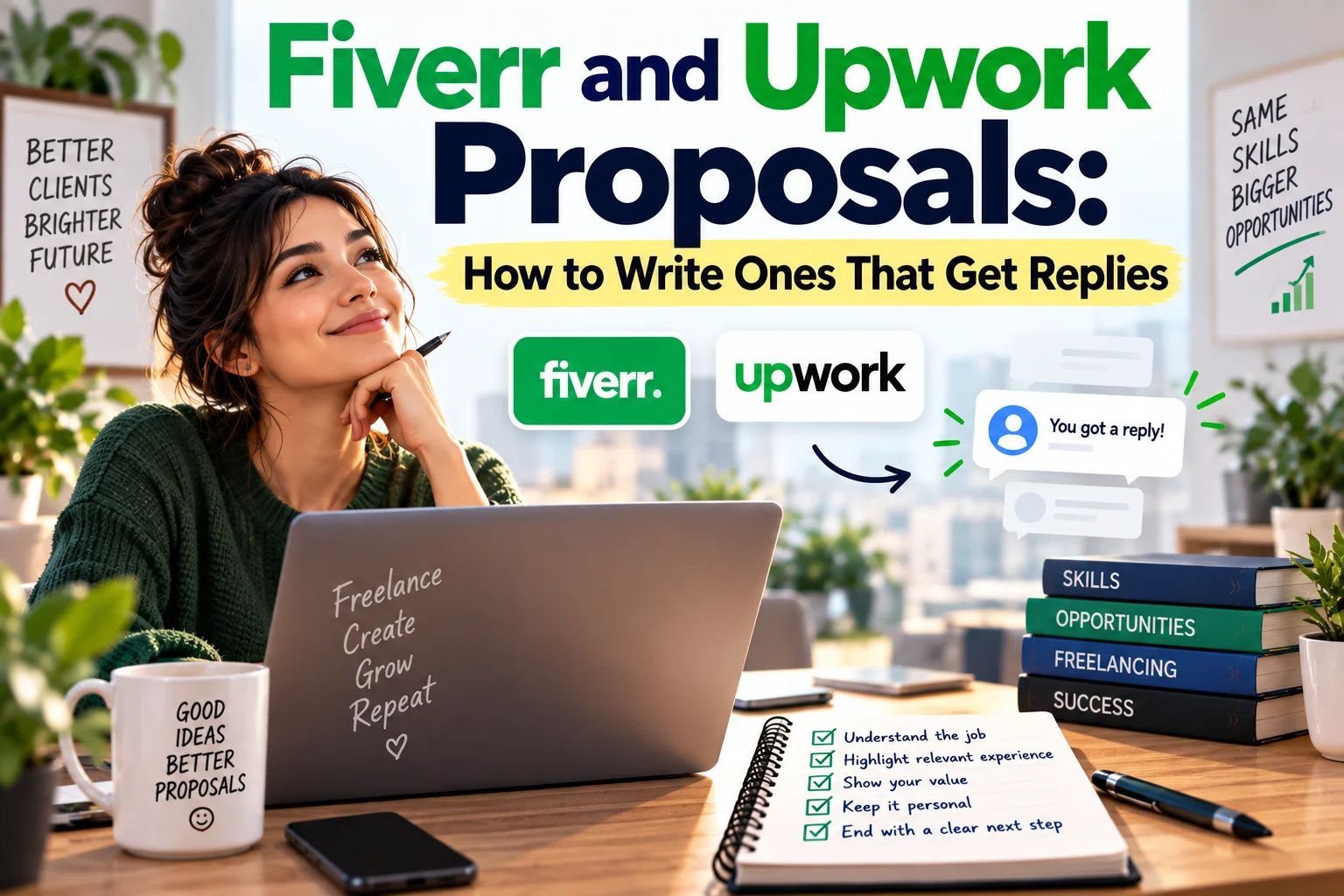
Fiverr and Upwork Proposals: How to Write Ones That Get Replies
- by Muhammad Raza
- 0 Comments
- 11 minutes read
- 47 Views
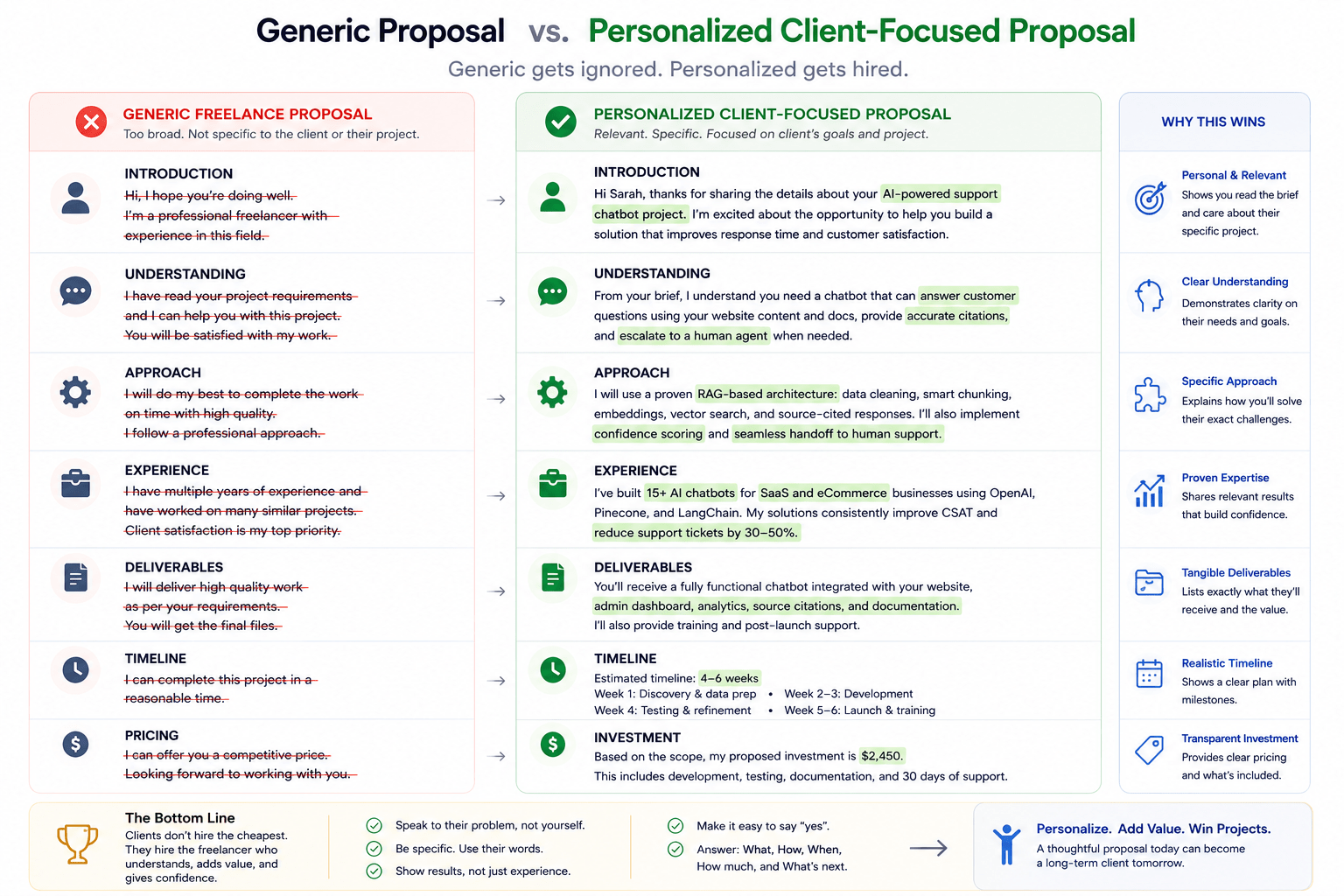
Writing better Fiverr and Upwork proposals starts with showing the client that you understand the project, not simply listing your skills.
A strong proposal connects the client’s problem to relevant experience, explains your approach briefly, and gives the client an easy reason to reply.
This guide shows how to personalize proposals, choose useful portfolio proof, ask better questions, avoid common mistakes, and build a repeatable proposal process without sounding generic.
They need relevant evidence.
Instead of:
“I started freelancing in 2018 and have worked with many different clients across multiple industries…”
Try:
“I’ve worked on similar e-commerce interfaces where the existing theme needed improvements without changing the underlying checkout process.”
The second version uses fewer words while providing more relevant information.
Step 5: Mention One Relevant Portfolio Example
Your portfolio should support your proposal.
Do not dump ten unrelated links into the message.
Choose the example that most closely resembles the client’s project.
For example:
Client needs: SaaS dashboard design
Show:
Relevant example: SaaS dashboard redesign
Not:
- Restaurant logo
- Wedding invitation
- Social media banner
- Business card
unless those are relevant to the project.
The goal is not to show everything you have ever created.
The goal is to show:
“I’ve solved something similar.”
Step 6: Explain Why the Example Is Relevant
Simply saying:
“Here is my portfolio.”
is weaker than explaining the connection.
Try:
“This project is relevant because I redesigned a similar dashboard while keeping the existing data structure intact.”
Now the portfolio item has context.
The client does not have to figure out why you included it.
Step 7: Ask One Intelligent Question
A good proposal often ends with a useful question.
For example:
“Is the current website built with a custom theme or a page builder?”
Or:
“Do you already have the final brand guidelines, or should the visual direction be developed as part of the project?”
A relevant question does two things.
First, it shows that you thought about the project.
Second, it gives the client an easy way to respond.
Avoid asking questions whose answers are already clearly provided in the brief.
That makes it look like you did not read the listing.
Step 8: Give a Simple Next Step
Do not end with:
“Hope to hear from you.”
You can be more useful.
For example:
“If you share the current site URL, I can quickly review the existing setup and tell you what I would tackle first.”
This gives the client a reason to respond.
However, do not offer extensive free work just to get a reply.
A short initial assessment is different from completing the project for free.
Step 9: Don’t Promise What You Cannot Guarantee
Freelancers sometimes use aggressive claims to stand out.
Examples:
“I guarantee your sales will double.”
“I’ll finish everything perfectly.”
“You will rank #1 on Google.”
“I guarantee approval.”
These promises create risk.
A better proposal focuses on what you can actually control.
For example:
“I can review the current structure, identify the main technical issues, and implement the agreed improvements.”
Specific and realistic beats exaggerated.
Step 10: Match the Client’s Communication Style
If the client writes a short, direct project brief, a huge formal proposal may feel unnatural.
If the project is technical and detailed, a structured response may work better.
Match:
- Level of detail
- Tone
- Technical depth
- Formality
- Communication style
This does not mean copying the client’s writing.
It means making the conversation comfortable.
A Simple Proposal Structure That Works
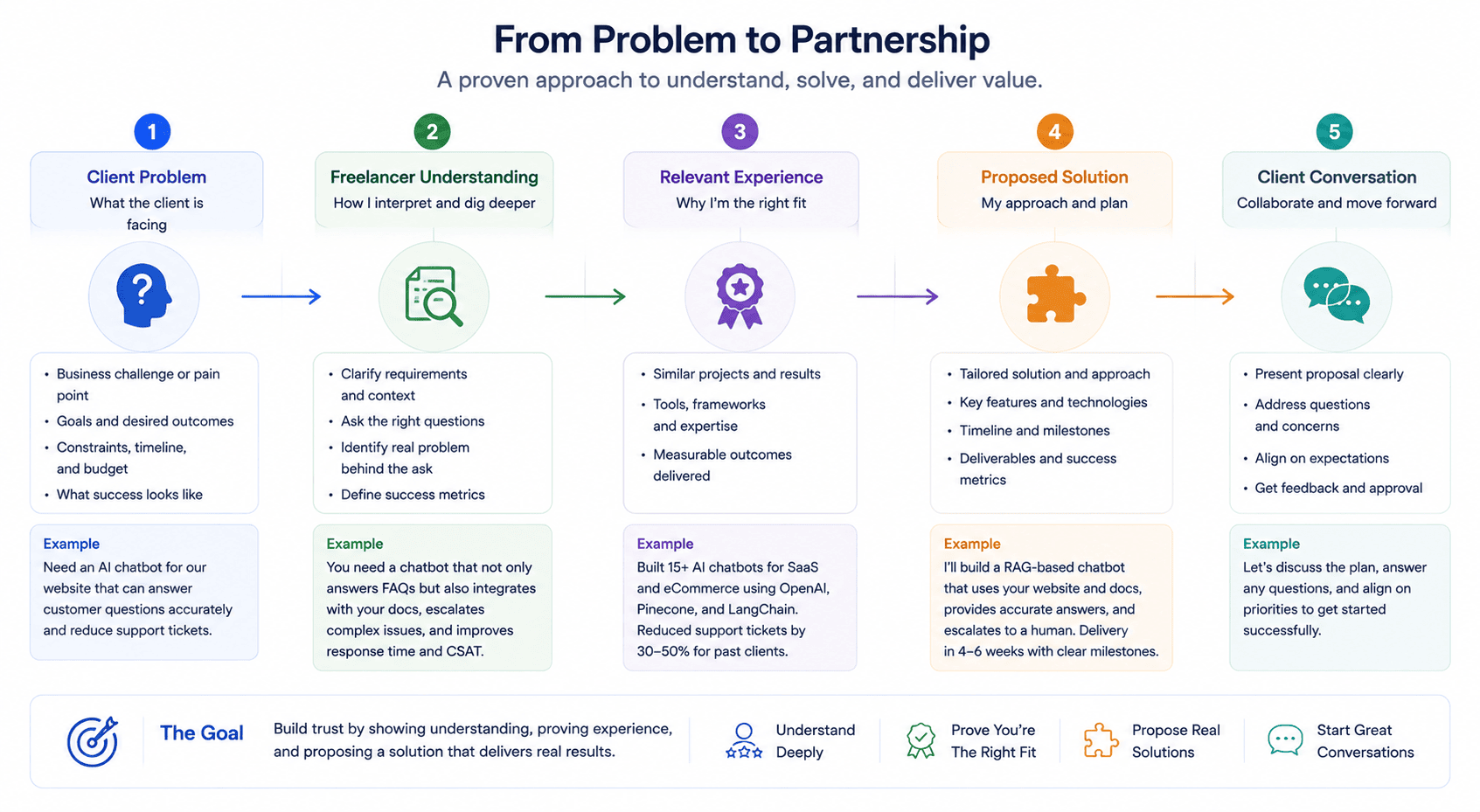
A practical proposal can follow this structure:
1. Relevant Opening
Mention something specific about the project.
2. Understanding
Explain what you believe the client needs.
3. Relevant Experience
Mention one or two directly related examples.
4. Approach
Briefly explain how you would handle the work.
5. Question
Ask one useful question.
6. Next Step
Make it easy for the client to continue the conversation.
This structure keeps the proposal focused.
Example: Web Development Proposal
Imagine a client needs a WordPress website fixed after a theme update.
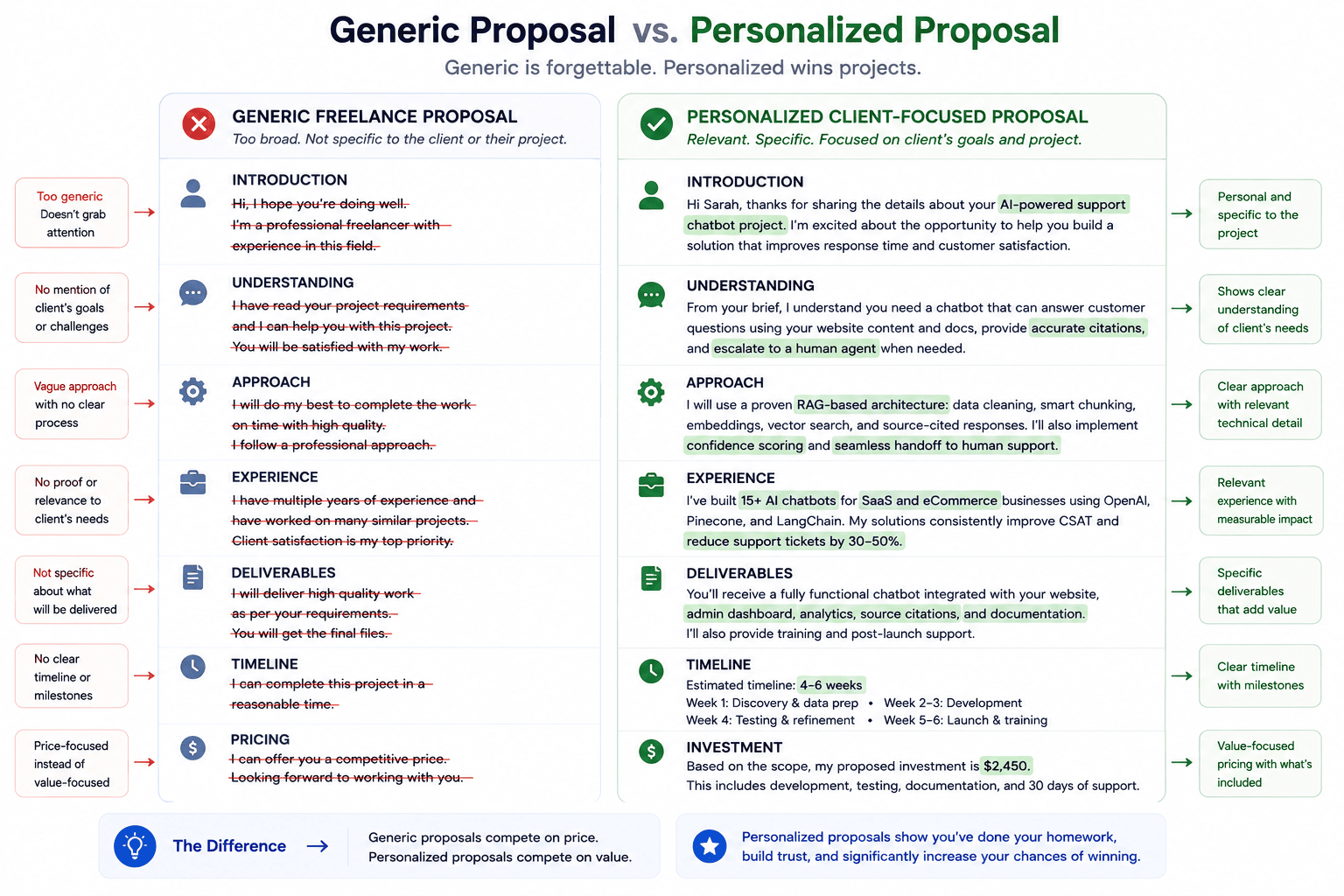
A weak proposal might say:
“Hello, I am an experienced WordPress developer. I have five years of experience and can fix your website quickly. I am available immediately. Please check my profile.”
A stronger version:
“I noticed the issue started after the recent theme update, so I would first compare the affected templates and plugin interactions rather than immediately replacing the theme. I’ve handled similar WordPress issues where an update caused layout and functionality conflicts. If you share the site URL and the affected pages, I can identify the likely starting point.”
The second proposal feels more specific.
Example: Logo Design Proposal
Suppose a client needs a logo for a technology startup.
Instead of:
“I am a professional graphic designer with many years of experience.”
Try:
“Your brief mentions a technology brand that should feel modern without looking overly futuristic. I would explore a simple mark that remains recognizable at small sizes, especially for the website header and app icon.”
Then show one relevant branding example.
The proposal demonstrates understanding before talking about experience.
Example: Automation Project Proposal
Suppose a client wants to automate lead processing.
A weak proposal:
“I am an AI automation expert. I can automate anything you need.”
A stronger proposal:
“The key part of your workflow appears to be moving new leads from the form into the CRM while avoiding duplicate entries. I would map the current workflow first, then automate the transfer and add a duplicate check before the CRM record is created.”
Again, the difference is specificity.
Fiverr Proposals vs Upwork Proposals
Fiverr and Upwork operate differently, so your communication strategy should reflect the platform.
On Upwork, freelancers commonly respond directly to posted projects.
That makes proposal relevance especially important.
On Fiverr, your service listing, positioning, package structure, portfolio, and buyer communication can play a larger role in attracting and converting inquiries.
The underlying principle remains the same:
Show the buyer that your service matches their specific need.
Do not use exactly the same message everywhere.
Adapt your communication to the context in which the client encounters you.
Why Copy-Paste Proposals Usually Fail
Templates are not automatically bad.
The problem is using the same template without meaningful customization.
A template can save time.
For example, keep a reusable structure:
Opening
Understanding
Relevant experience
Approach
Question
Next step
Then customize the important sections for each project.
A useful rule is:
Template the structure, not the personality.
Your proposal should still sound written for that particular client.
Build a Proposal Library
Instead of saving one giant proposal template, create smaller reusable components.
For example:
Opening Templates
For website projects.
For design projects.
For automation projects.
For writing projects.
Experience Statements
Different statements for different services.
Process Statements
Different approaches for different project types.
Questions
A collection of useful discovery questions.
This lets you assemble proposals faster without making them identical.
Create a “Proof Bank”
Keep a private list of your strongest project examples.
For each project, record:
- Project type
- Client problem
- Your role
- Tools used
- Main deliverable
- Interesting challenge
- Final result, where verifiable
- Portfolio link
Then when you receive a new project, you can quickly find the closest example.
This is much more efficient than searching through your entire portfolio every time.
Don’t Invent Results
If you have a verified result, mention it.
For example:
“The redesigned landing page increased the client’s measured conversion rate from X to Y.”
If you do not have verified numbers, do not create them.
Instead:
“The project focused on simplifying the landing-page structure and improving the mobile experience.”
Credibility is more valuable than impressive-looking numbers.
Pricing in Your Proposal
You do not always need to spend most of the proposal defending your price.
If the platform already shows your bid or package price, focus the proposal on value and project fit.
If clarification is needed, explain what the price covers.
For example:
“The quoted amount covers the existing-page redesign, responsive implementation, and two revision rounds.”
That is clearer than:
“My price is low because I really want this opportunity.”
Avoid apologizing for your price.
Don’t Compete Only on Being Cheap
Low pricing may attract attention, but it does not automatically create good freelance relationships.
Instead of positioning yourself as:
“The cheapest developer.”
position yourself around:
- Relevant expertise
- Clear communication
- Reliable process
- Understanding of the problem
- Quality of execution
Clients who value those things are more likely to evaluate your proposal on more than price.
The First Message Is Not the Entire Sales Process
Getting a reply is only the first step.
After the client responds, the conversation should move toward clarification.
Ask about:
- Current situation
- Desired outcome
- Existing assets
- Technical environment
- Deadline
- Constraints
- Approval process
Do not immediately send a huge list of questions.
Start with the most important unknown.
Follow Up Without Becoming Annoying
Sometimes a client reads your proposal but does not respond.
A short follow-up can be appropriate when the platform and project context make it reasonable.
Avoid messages like:
“Hello???”
or:
“Why haven’t you replied?”
Instead, add useful context.
For example:
“Just following up on this. One thing I’d want to confirm before starting is whether the existing checkout needs to remain unchanged. That will affect how I approach the implementation.”
The follow-up should add value, not pressure.
Analyze Your Proposal Performance
Do not judge your proposals only by whether you won a project.
Track the stages.
For example:
| Stage | Metric |
|---|---|
| Applications | Number sent |
| Views | Proposals viewed |
| Replies | Client responses |
| Interviews | Conversations started |
| Offers | Projects offered |
| Wins | Projects accepted |
This helps identify the problem.
If proposals are rarely viewed, your opening or profile positioning may need attention. If you are still building your profile, see our guide to optimizing your LinkedIn profile for another practical way to improve your professional positioning.
If they are viewed but rarely receive replies, your proposal may not be relevant enough.
If you get replies but few projects, the problem may occur during the conversation, pricing, scope, or qualification stage.
Improve One Variable at a Time
Do not completely rewrite your entire process after every unsuccessful proposal.
Test individual changes.
For example:
Test 1
Shorter opening.
Test 2
More project-specific opening.
Test 3
One relevant portfolio example.
Test 4
A stronger discovery question.
Test 5
Clearer next step.
Track what changes.
This gives you more useful feedback than randomly changing everything.
A 10-Minute Proposal Workflow
You do not need to spend an hour writing every proposal.
Try this process.
Minutes 1–3: Read
Read the project carefully.
Identify the main problem.
Minutes 4–5: Match
Choose your most relevant experience.
Minutes 6–7: Write
Create a personalized opening and explain your approach.
Minute 8: Question
Add one useful question.
Minute 9: Proofread
Remove generic claims and unnecessary sentences.
Minute 10: Final Check
Confirm that:
- You addressed the actual project.
- You did not ignore requirements.
- Your portfolio example is relevant.
- Your next step is clear.
Then send it.
Proposal Checklist
Before submitting a proposal, ask:
Relevance
Did I mention something specific from the project?
Understanding
Did I explain the problem in my own words?
Evidence
Did I provide relevant proof?
Approach
Did I explain what I would do?
Clarity
Can the client understand my offer quickly?
Question
Did I ask something useful?
Next Step
Is it easy for the client to reply?
Honesty
Did I avoid unsupported claims?
If the answer is yes across the board, the proposal is probably ready.
Common Proposal Mistakes
Starting With a Biography
Clients care about their project first.
Sending Huge Portfolio Lists
More examples can create more noise.
Using Generic Openings
Generic openings look mass-produced.
Repeating the Job Description
Show understanding instead of copying the brief.
Asking Obvious Questions
Read the project before asking.
Promising Guaranteed Results
Do not promise outcomes you cannot control.
Competing Only on Price
Cheap does not automatically mean valuable.
Writing Too Much
Long proposals can bury the important information.
Writing Too Little
A one-line message may fail to demonstrate understanding.
Ignoring the Next Step
Give the client an easy reason to respond.
What Makes a Proposal Memorable?
A proposal does not need to be clever.
It needs to be relevant.
The client should finish reading it and think:
“This person understands what I am trying to accomplish.”
That is more valuable than using complicated sales language.
A memorable proposal usually contains three things:
Specificity
It refers to the actual project.
Evidence
It demonstrates relevant experience.
Clarity
It explains what happens next.
Build Your Own Proposal System
If you regularly freelance on Fiverr or Upwork, turn proposal writing into a system rather than a daily improvisation.
Create:
Service categories
Separate your proposals by service.
Portfolio bank
Store your strongest examples.
Opening library
Save adaptable opening structures.
Discovery questions
Keep useful questions organized.
Case-study notes
Record problems and solutions from previous projects.
Performance tracker
Monitor replies and wins.
This reduces writing time while preserving personalization.
Frequently Asked Questions
How long should a Fiverr or Upwork proposal be?
There is no universal ideal length. It should be long enough to demonstrate understanding and relevance without burying the main point.
Should I use a proposal template?
Yes, a reusable structure can save time. However, customize the content for each client rather than sending the same message repeatedly.
Should I mention my years of experience?
You can, but only when it strengthens your case. Relevant project experience is often more useful than a generic experience statement.
How many portfolio examples should I include?
Start with the most relevant example. Add another only when it provides useful additional proof.
Should I offer free work to win a project?
Avoid completing substantial unpaid work. A brief assessment or explanation can demonstrate expertise without giving away the project.
Should I mention my price in the proposal?
If the platform already displays your bid, you may not need to repeat it. If scope needs clarification, explain what your quoted price includes.
What if the client does not respond?
Do not assume your work was poor. Clients may receive many applications or change their plans. Analyze your overall proposal performance rather than one individual result.
Should I use AI to write proposals?
AI can help organize ideas, summarize requirements, or improve wording. However, the final proposal should accurately reflect your real experience and contain project-specific details.
Should every proposal be completely different?
No. Your structure can remain consistent. The important parts—opening, understanding, evidence, approach, and question—should be adapted to the project.
Final Thoughts
Winning more freelance projects is not simply about sending more proposals.
It is about making each proposal more relevant.
Before you write, understand the client’s problem.
Then connect that problem to something you can genuinely solve.
Show one relevant example.
Explain your approach briefly.
Ask a useful question.
Give the client an easy next step.
Most importantly, stop thinking about a proposal as a document whose purpose is to describe you.
Think of it as the beginning of a conversation about the client’s project.
Your skills get you into consideration.
Your portfolio provides evidence.
But your proposal creates the first impression that you understand what the client actually needs.
On Fiverr and Upwork, that difference can turn a generic application into a conversation.
And a conversation is where the real opportunity begins.