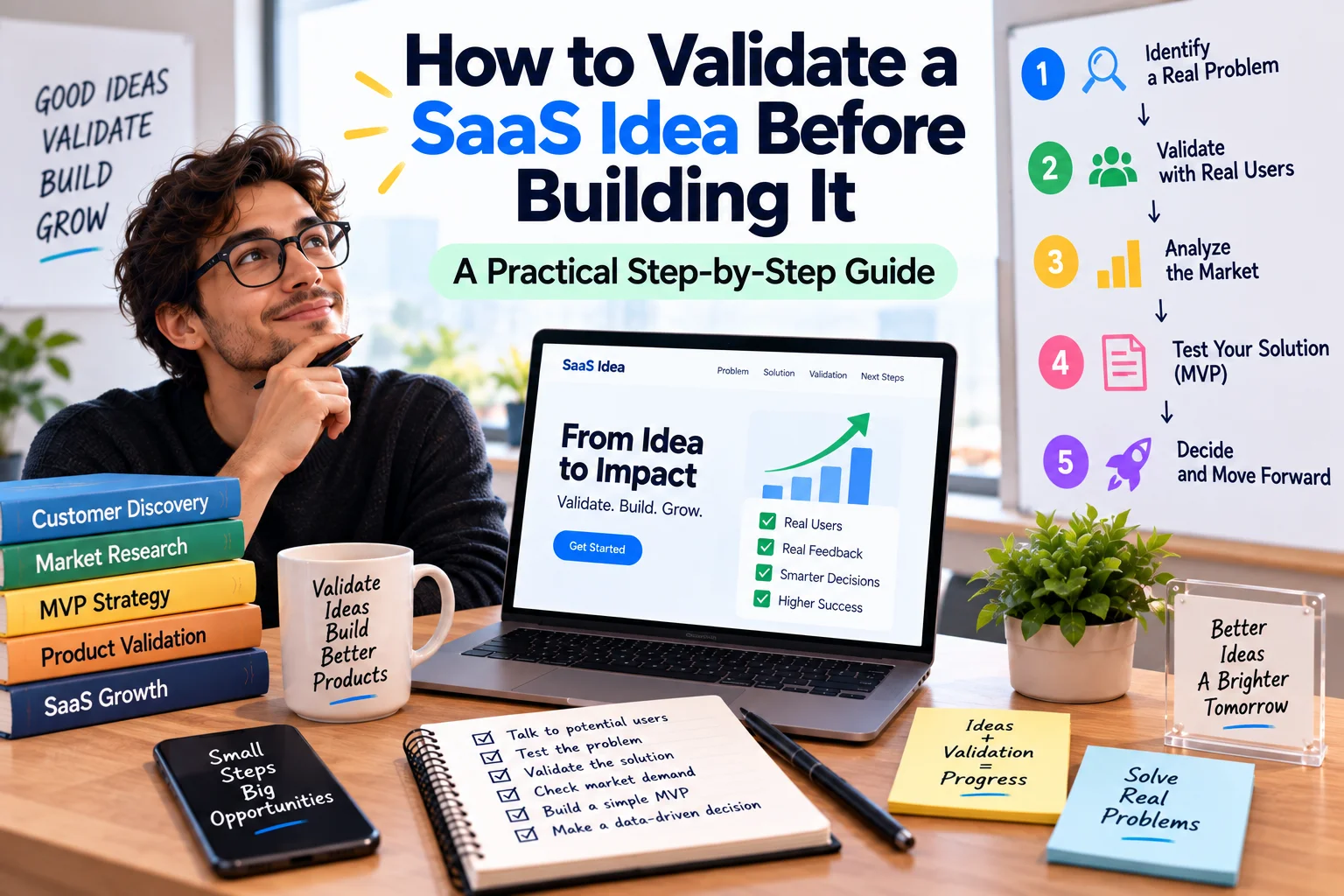
How to Validate a SaaS Idea Before Building It: A Practical Step-by-Step Guide
- by Muhammad Raza
- 0 Comments
- 16 minutes read
- 49 Views
Building a software-as-a-service product can be exciting. You may have identified an annoying business problem, imagined a better solution, and already started thinking about features, pricing, branding, and technology.
But there is one important question to answer before investing heavily in development:
Do people actually want this product badly enough to use or pay for it?
This is where SaaS idea validation becomes important.
Learning how to validate a SaaS idea before building the complete product can help founders replace assumptions with evidence. Instead of spending months creating a sophisticated application and discovering afterward that the market is too small, the problem is not urgent, or customers already have a satisfactory alternative, you can test the riskiest assumptions much earlier.
Validation does not guarantee that a SaaS business will succeed. It also cannot predict every future challenge. What it can do is help you make better decisions with less unnecessary development.
A useful validation process can include customer conversations, competitor research, landing-page experiments, prototype testing, manual pilots, pricing experiments, and eventually real commitments from potential customers.
The goal is not to prove that your original idea is perfect.
The goal is to discover whether the problem, customer, solution, and business model are strong enough to justify the next step.
What Does It Mean to Validate a SaaS Idea?
To validate a SaaS idea means gathering evidence about whether a specific group of potential customers has a meaningful problem and whether your proposed solution could realistically address it.
This is different from simply asking friends whether they think your idea is good.
People are naturally encouraging. Someone may say:
“That sounds useful.”
But that statement does not necessarily mean the person has the problem, needs your solution, or would pay for it.
Real validation focuses on behavior and evidence.
For example, stronger signals might include someone:
- Explaining a problem they regularly experience
- Showing you their current workaround
- Spending money on an alternative
- Asking when your product will be available
- Agreeing to test a prototype
- Providing data for a pilot
- Introducing you to another potential buyer
- Signing up for an early-access list
- Agreeing to a paid pilot
The stronger the commitment, the more useful the signal can become.
Recent SaaS validation guidance similarly emphasizes learning about real customer problems and testing demand before committing to a large build.
Why Founders Should Validate Before Building
One of the easiest mistakes for a technical founder is confusing the ability to build something with evidence that the market needs it.
Modern development tools can make software creation faster, but faster development does not automatically create demand.
You can build:
- A beautiful dashboard
- A mobile application
- A complex analytics system
- A powerful automation platform
- An advanced reporting tool
- A sophisticated subscription system
and still discover that customers do not care enough to switch from what they already use.
Validation helps you investigate the business opportunity before committing to a large technical project.
For example, suppose you want to create a SaaS platform for small agencies that automatically generates client reports.
Before building the entire platform, you could talk to agency owners and discover that many already use spreadsheets and existing reporting tools.
That does not necessarily mean the idea is useless.
You might discover something more valuable:
Agency owners are not primarily frustrated by creating reports. They are frustrated because clients constantly request customized reports and the existing tools make those changes difficult.
Now the opportunity has changed.
Instead of building a generic reporting platform, you might investigate a narrower product specifically designed for customizable client reporting.
That is the purpose of validation.
You are not trying to defend your original idea. You are trying to improve it.
Step 1: Define the Exact Customer
A SaaS idea becomes difficult to validate when the target market is too broad.
“Small businesses” is not a very specific customer segment.
Neither is:
- Entrepreneurs
- Professionals
- Companies
- Online businesses
- Content creators
These groups contain people with very different needs, budgets, workflows, and priorities.
Instead, try to identify a narrower first customer.
For example:
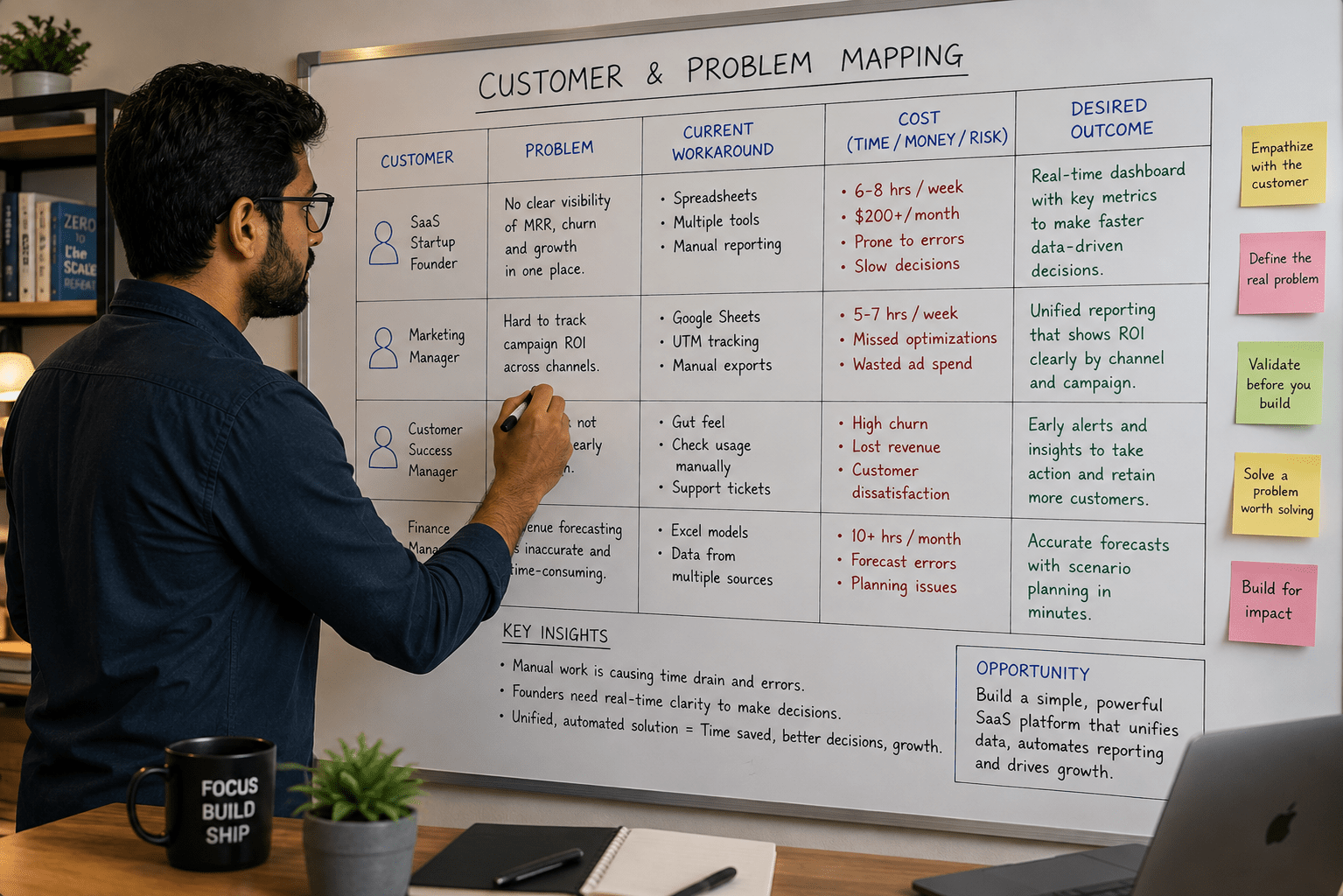
Independent marketing agencies with 5–20 employees that manage recurring social media clients.
That description is much more useful.
You can ask:
- Who experiences the problem?
- How frequently does it happen?
- What role experiences it?
- Who decides whether to buy software?
- What tools do they currently use?
- What does the problem cost them?
- How are they solving it today?
A narrow customer profile makes research much easier.
You can always expand the audience later.
Step 2: Define the Problem Before the Solution
Founders often start with a product description.
For example:
“I want to build an AI-powered SaaS platform that automates business reports.”
That is a solution.
Before validating it, describe the underlying problem.
For example:
“Small agencies spend several hours every month manually preparing customized client performance reports.”
Now you have something you can investigate.
Ask whether the problem actually exists.
Ask who experiences it.
Ask how often it happens.
Ask what people currently do about it.
Ask whether the current process is expensive, frustrating, slow, risky, or inconvenient enough to justify change.
This approach prevents you from becoming emotionally attached to a particular feature set too early.
Step 3: Talk to Potential Customers
Customer conversations are one of the most useful early validation methods.
However, the quality of the conversation matters.
Do not turn the interview into a sales presentation.
Instead of saying:
“Would you use an application that automatically solves this problem?”
ask about what the person currently does.
Useful questions include:
- How do you currently handle this task?
- When did you last experience this problem?
- How often does it happen?
- What makes the process difficult?
- What tools do you currently use?
- Have you paid for a solution before?
- What happens when the problem is not solved?
- Who else is involved in the process?
- What would make you change your current solution?
These questions encourage people to describe real experiences rather than hypothetical opinions.
Recent customer-discovery resources for SaaS validation also recommend focusing on existing behavior and workflows instead of simply asking whether someone likes a proposed product.
What Not to Ask During Customer Interviews
Some questions sound useful but produce weak evidence.
Avoid relying heavily on questions such as:
“Would you buy this?”
or:
“Do you think this is a good idea?”
A person may answer positively because they want to be polite.
Instead, investigate what they have already done.
For example:
Weak question:
Would you pay $50 per month for this?
Better question:
What are you currently paying to solve this problem?
The second question gives you information about existing spending.
Similarly:
Weak:
Would this save you time?
Better:
How much time did you spend doing this last week?
The difference is important.
You are collecting evidence rather than compliments.
Step 4: Identify Existing Alternatives
Every SaaS idea competes with something.
That “something” may not be another SaaS company.
Your customer may currently use:
- Excel
- Google Sheets
- Notion
- A paper process
- A virtual assistant
- An internal employee
- A combination of several tools
- An outdated software product
When an existing SaaS tool is no longer working well for the business, understanding the workflows built around it can help you evaluate a replacement more safely.
This is why competitor research should include current alternatives, not only companies that look like your future product.
Imagine you want to build a SaaS application for scheduling freelance projects.
A competitor analysis that only looks at scheduling software could miss the fact that your target freelancers already manage their schedules through Google Calendar and spreadsheets.
Your real challenge is therefore not just beating another SaaS product.
You need to provide enough additional value to convince customers to change their existing behavior.
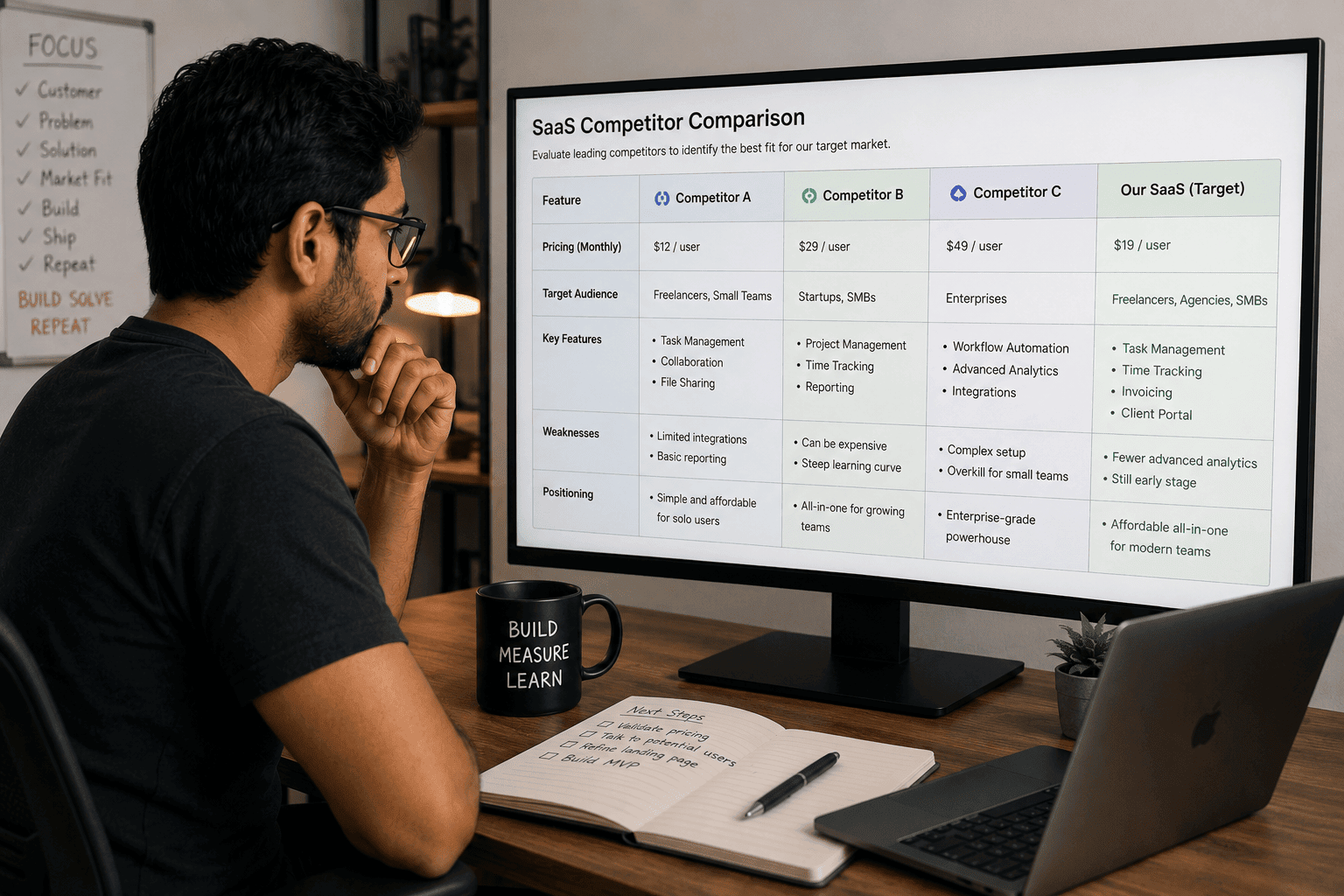
Step 5: Study Competitors Without Copying Them
Competitor research can reveal useful information about:
- Target customers
- Pricing
- Features
- Positioning
- Customer complaints
- Reviews
- Onboarding
- Business models
- Product limitations
Do not simply copy a competitor’s feature list.
Instead, look for gaps.
Suppose five competing products all provide:
- Dashboards
- Reports
- Integrations
- Notifications
But users repeatedly complain about complicated setup.
That could be an opportunity.
Your product might focus on a much simpler onboarding experience.
Similarly, if competitors target large companies with expensive plans, there may be an opportunity to serve a narrower small-business segment.
A competitor does not automatically prove that your idea is bad.
In some cases, competitors prove that customers already spend money in the category.
The question becomes:
Why would someone choose your product instead?
Step 6: Create a Simple Value Proposition
After talking to potential customers, simplify your idea.
A useful value proposition should explain:
Who is it for?
What problem does it solve?
What useful result does it provide?
For example:
“A reporting platform for small marketing agencies that reduces the manual work involved in creating recurring client reports.”
This is much easier to test than:
“An innovative next-generation business intelligence ecosystem.”
Avoid vague marketing language.
Customers should understand the practical benefit quickly.
Your value proposition may change during validation.
That is a good thing.
If customer conversations reveal that the original positioning does not match how buyers describe their problem, update the message.
Step 7: Build a Landing Page Before Building the Full Product
A landing page can be a relatively simple way to test whether your message attracts attention.
It does not need to pretend that a complete product already exists.
Your landing page could contain:
- Product name
- Problem statement
- Main benefit
- Short explanation
- Example workflow
- Early-access form
- Demo request
- Pricing indication
- Call to action
The goal is not to generate millions of visitors.
The goal is to put your value proposition in front of relevant people and observe what happens.
You can test different headlines and messages.
For example:
Version A:
Automated Client Reporting for Small Agencies
Version B:
Stop Spending Hours Building Monthly Client Reports
The second headline focuses more directly on the pain.
If relevant visitors repeatedly ignore both versions, that is useful information.
You may need to reconsider the audience, problem, offer, or messaging.
Step 8: Create a Prototype Instead of the Entire Application
You do not always need a functioning SaaS application to test a product concept.
A prototype can demonstrate:
- Main screens
- Navigation
- User workflow
- Core functionality
- Expected outcome
The prototype can help customers react to something concrete.
However, avoid spending months perfecting the prototype.
Its purpose is learning.
If a five-screen prototype can answer the main product question, there may be little reason to build fifty screens.
The best prototype is often the smallest representation that can test your most important assumption.
Step 9: Consider a Concierge MVP
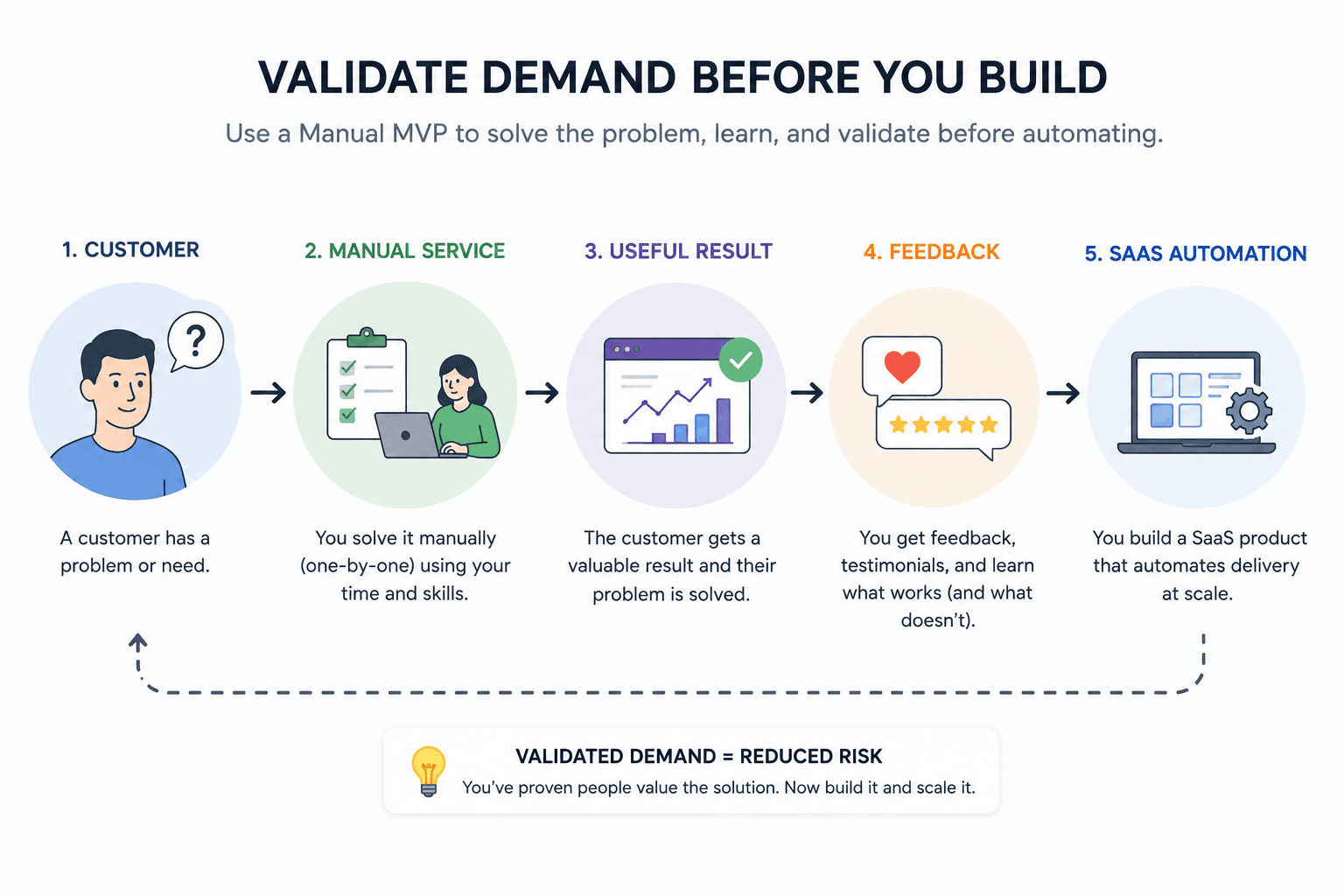
One of the most useful validation techniques is to manually deliver a service that you eventually plan to automate.
Suppose your proposed SaaS automatically analyzes business expenses.
Instead of building the complete analytics engine, you could initially ask a small number of potential customers to provide sample data.
You manually analyze it and return a useful report.
This is sometimes called a concierge-style MVP.
The customer receives the intended outcome even though much of the work behind the scenes is manual.
This can answer an important question:
Do customers value the outcome?
If they do not care about the manually delivered service, automating it may not solve the underlying problem.
If they find it genuinely valuable, you have stronger evidence that automation could eventually improve the delivery model.
Step 10: Test Pricing Earlier Than You Think
Pricing is one of the most important parts of SaaS validation.
A product can receive positive feedback and still fail commercially if customers do not value it enough to pay for it.
You do not need to determine the perfect price immediately.
Instead, test whether your target customers see enough value to discuss money seriously.
You can explore:
- Monthly pricing
- Annual pricing
- Per-user pricing
- Usage-based pricing
- Tiered plans
- Paid pilots
Avoid asking only:
“Is $30 per month too expensive?”
Instead, investigate what customers currently spend on solving the problem.
If they already pay $500 per month for several disconnected tools and manual processes, a new product may have room to create value.
If they spend almost nothing and experience little pain, your pricing challenge could be much harder.
Step 11: Look for Real Commitments
Not every positive response is equally valuable.
Think about signals as a progression.
Weak Signal
“Interesting idea.”
Better Signal
“I’d like to see the prototype.”
Stronger Signal
“Can I test it?”
Strong Signal
“Can we run a pilot?”
Very Strong Signal
“How much does it cost and when can we start?”
Strong Commercial Signal
Customer agrees to a paid pilot, subscription, deposit, or other meaningful commitment.
This does not mean every SaaS product must collect money before development.
But meaningful commitments can provide stronger evidence than casual interest.
Step 12: Define Your MVP Carefully
MVP stands for minimum viable product.
The key word is “minimum.”
Your first version should not attempt to compete with every mature software product in the market.
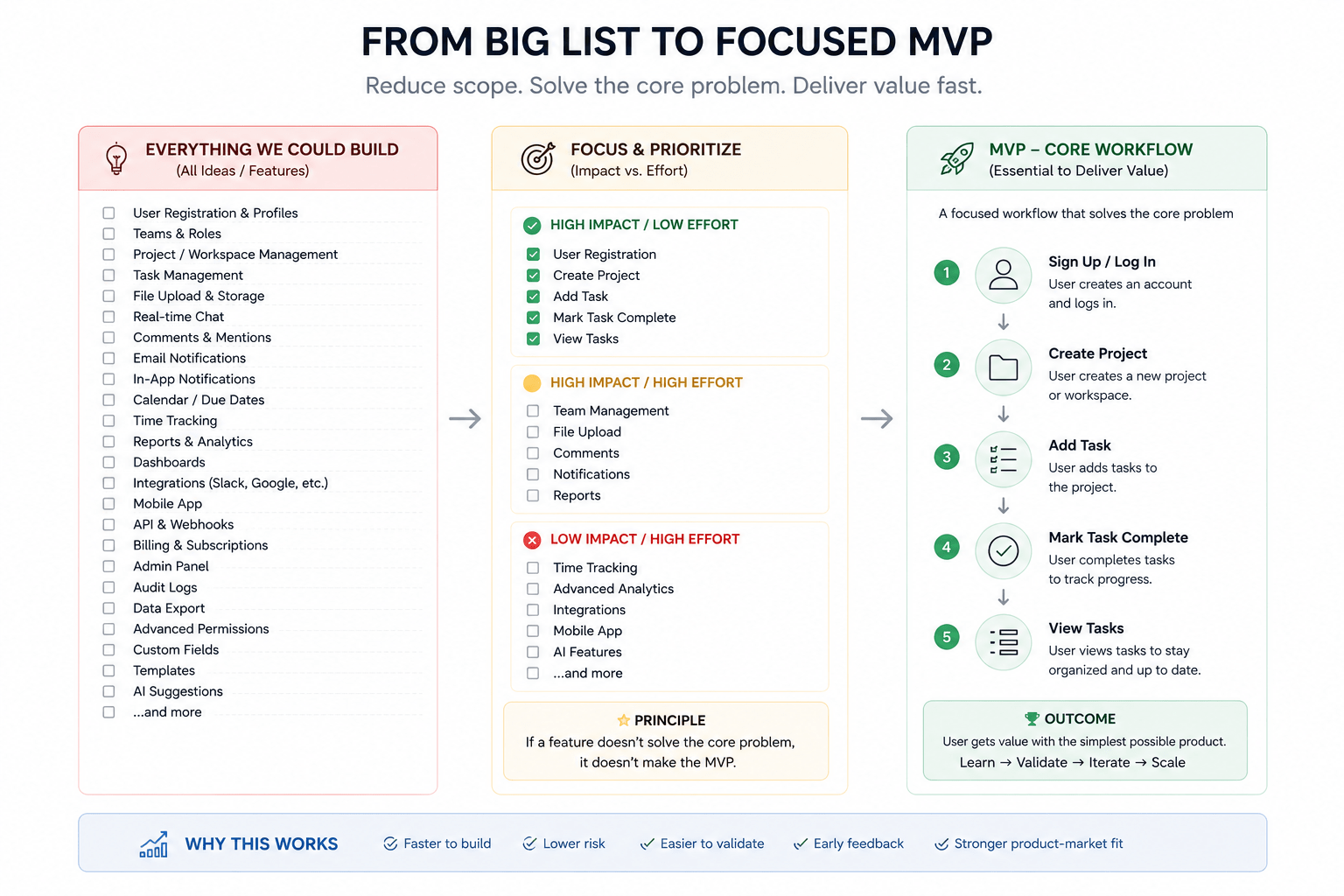
Instead, identify the smallest version capable of delivering the primary value.
Suppose the product idea is a project management SaaS.
You may eventually want:
- Time tracking
- Chat
- Invoicing
- Reporting
- Automation
- Calendar integrations
- Mobile apps
- AI features
- Team permissions
- Advanced dashboards
But the first version may only need:
- Create project
- Add task
- Assign task
- Mark task complete
If the core workflow does not provide value, adding twenty more features will not automatically fix it.
Step 13: Decide What Success Looks Like
Validation becomes much more useful when you define your decision criteria before running experiments.
For example:
Customer interviews
Goal: identify a repeated problem among a specific customer segment.
Landing page
Goal: determine whether the message attracts qualified interest.
Prototype
Goal: determine whether the proposed workflow makes sense to target users.
Pilot
Goal: determine whether customers can successfully use the solution.
Pricing test
Goal: determine whether customers consider the value worth paying for.
You should also define what would cause you to change direction.
For example:
If interviews repeatedly show that the problem is infrequent, we will narrow the audience or reconsider the problem.
This prevents confirmation bias.
Step 14: Track Evidence in a Validation Spreadsheet
You do not need complicated software to manage early validation.
A spreadsheet can contain columns such as:
| Customer | Problem | Current Solution | Frequency | Cost/Pain | Interest | Next Step |
|---|---|---|---|---|---|---|
| Agency A | Manual reporting | Spreadsheet | Monthly | High | High | Prototype |
| Agency B | Client reporting | Existing tool | Weekly | Medium | Medium | Follow-up |
| Agency C | Manual reporting | Staff member | Monthly | High | High | Pilot |
This gives you a record of what people actually told you.
Do not rely on memory.
As the number of conversations grows, your notes become increasingly valuable.
Step 15: Know When to Stop
Validation is not about collecting endless feedback.
At some point, you need to make a decision.
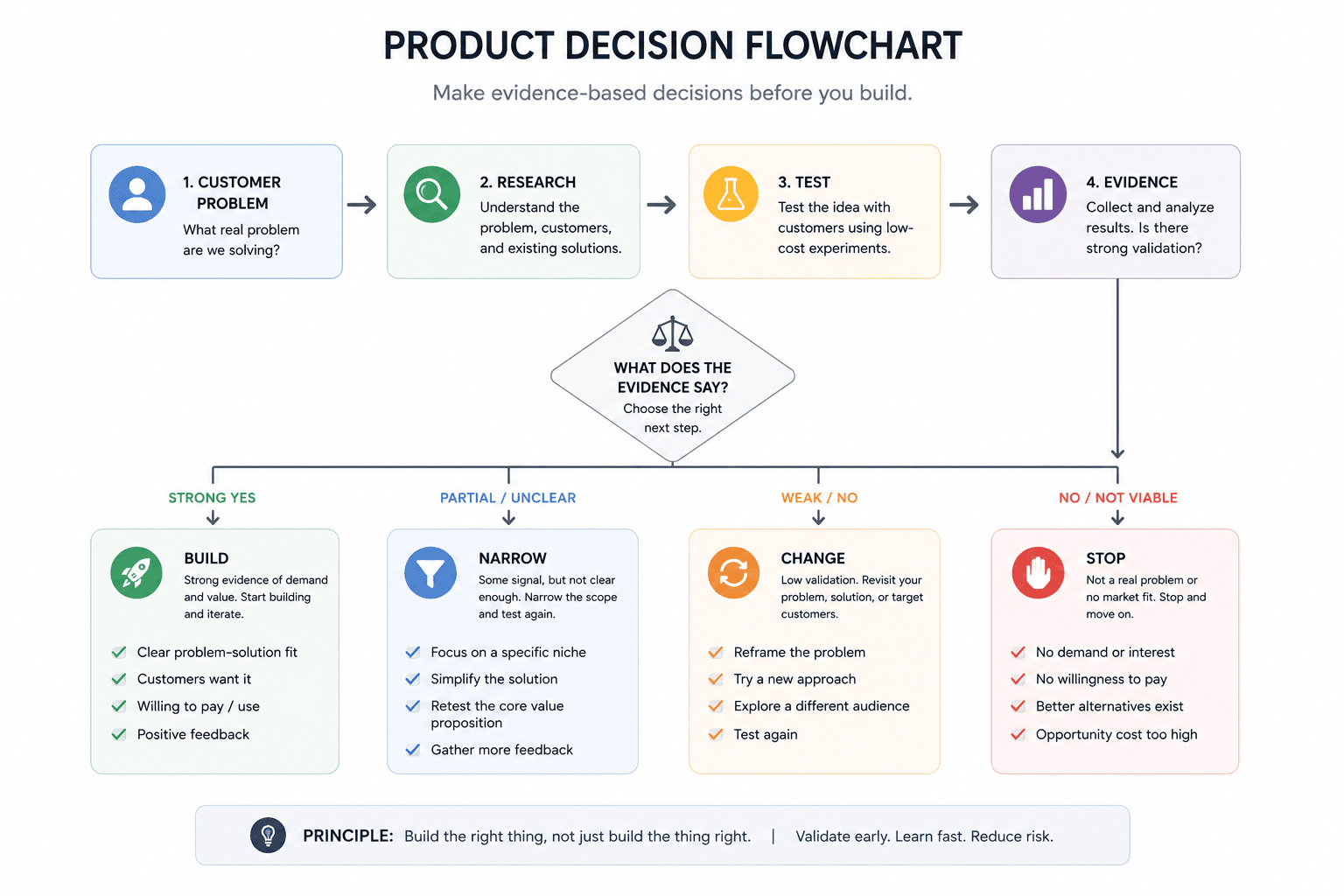
There are generally several possible outcomes.
Build
Evidence suggests there is a meaningful problem and a plausible customer.
Narrow
The problem exists, but your audience is too broad.
Change the Solution
Customers have the problem, but your proposed solution does not appear compelling.
Test Again
The evidence is inconsistent and you need more information.
Stop
The problem does not appear significant enough or the market does not justify continued investment.
Stopping an idea is not automatically failure.
If validation prevents you from spending months building something nobody needs, it has already created value.
Common SaaS Validation Mistakes
Building Too Early
Development can feel productive, but coding does not replace customer research.
Asking Friends
Friends may provide useful opinions, but they are rarely a substitute for conversations with actual target customers.
Asking Leading Questions
If you describe the solution enthusiastically, people may simply agree with you.
Ignoring Existing Alternatives
Customers already have a way of solving the problem, even if that method is inefficient.
Testing Too Many Features
A huge prototype can make it difficult to understand which feature actually creates value.
Obsessing Over Competitors
Competitor research should inform your positioning, not become an excuse to copy another product.
Chasing Vanity Metrics
A large number of social-media likes does not necessarily indicate SaaS demand.
Treating Signups as Customers
Someone entering an email address is useful, but actual usage, retention, and payment can provide stronger evidence.
A Simple 14-Day SaaS Validation Plan
If you want to test an idea without spending months on research, create a short validation sprint.
Days 1–2: Define the Customer
Choose one specific customer segment.
Days 3–4: Research the Problem
Study existing alternatives and customer complaints.
Days 5–7: Conduct Interviews
Speak with relevant potential customers.
Day 8: Rewrite Your Value Proposition
Use the language you heard during conversations.
Days 9–10: Build a Simple Landing Page
Explain the problem and proposed outcome.
Days 11–12: Create a Prototype
Show the most important workflow.
Day 13: Test the Prototype
Ask potential users to walk through it.
Day 14: Review the Evidence
Decide whether to:
- Build
- Narrow
- Change
- Test again
- Stop
This schedule is not a universal formula. Some products require significantly more research.
The important idea is to create a deliberate sequence of experiments instead of immediately starting full development.
Why Validation Should Continue After Launch
Validation does not end when your SaaS product goes live.
After launch, you can continue learning from:
- Activation
- Feature usage
- Churn
- Customer support requests
- Conversion rates
- Trial behavior
- Subscription upgrades
- Cancellation reasons
- Customer interviews
A SaaS business operates in a changing environment.
Customer expectations change.
Competitors launch new products.
Technology evolves.
Pricing expectations shift.
Therefore, successful product development should remain connected to customer evidence.
Your first validation answers:
“Is this worth building?”
Later validation asks:
“Is this worth improving?”
Those are different questions, but both are important.
Final Thoughts
A SaaS idea can look brilliant inside a founder’s notebook.
The real test begins when it meets customers.
Before spending months designing interfaces, writing backend systems, connecting APIs, creating dashboards, and setting up subscription infrastructure, take time to investigate whether the problem is real and valuable enough to solve.
Start with a narrow customer.
Understand the existing workflow.
Study the alternatives.
Talk to potential buyers.
Test your value proposition.
Create a simple landing page.
Use a prototype when necessary.
Consider manually delivering the outcome.
Discuss pricing.
Look for meaningful commitments.
Then use the evidence to decide what deserves to be built.
The most important mindset is to treat validation as learning rather than approval.
If customers tell you that your assumption is wrong, that information is valuable.
If they reveal a more painful problem, that is valuable.
If they show you an unexpected workaround, that is valuable.
If they refuse to pay, that is also valuable.
Every one of these outcomes can help you make a better product decision.
The goal is not to fall in love with an idea.
The goal is to discover whether the market gives you a reason to keep building.
A smaller, validated SaaS product can be a much better starting point than a massive application built entirely on assumptions.
Build less at first.
Learn more.
Then build what the evidence tells you matters.
Frequently Asked Questions
How do I validate a SaaS idea?
Start by defining a specific customer and problem, then interview potential users, research alternatives, test your value proposition, create a simple prototype or landing page, and look for meaningful evidence of demand before building the full product.
How many people should I interview?
There is no universal number. A small group within a very specific customer segment can reveal useful patterns, while broader or more complex markets may require more research. Focus on the quality and consistency of the evidence rather than chasing an arbitrary number.
Do I need to build an MVP immediately?
No. You can often validate important assumptions through interviews, landing pages, prototypes, manual services, and other lightweight experiments before building a complete MVP.
Should I ask customers if they would buy my SaaS?
You can discuss buying intent, but questions about hypothetical future behavior are usually weaker than questions about what customers currently do, what they already pay for, and what commitments they are willing to make.
How do I know if my SaaS idea is good?
A promising idea usually has a clearly identifiable customer, a meaningful problem, an existing or emerging willingness to seek solutions, and a realistic way to deliver valuable results. Validation provides evidence for these assumptions rather than guaranteeing success.
Can a SaaS idea have too many competitors?
Competition does not automatically make an idea bad. Competitors may demonstrate that a market already exists. The important question is whether your product has a clear reason for a particular customer to choose it.
What is the difference between an MVP and a prototype?
A prototype usually demonstrates an idea or workflow without necessarily functioning as a complete product. An MVP is a usable initial product designed to deliver enough value to real users while helping the team learn.
Should I validate pricing before building?
Yes, pricing can be explored before development. Understanding what customers currently pay, what alternatives cost, and what value the problem creates can help you avoid building a product around an unrealistic business model.